49 works in this view — arrow keys or swipe to move between them.
Dance in Art
Costume
Peter Hall
- Collection:
- Costume
- Source:
- Victoria and Albert Museum
- Rights:
- Rights vary by item — check the source record before reusing this image. Source record ↗
- Recorded as:
- V&A — check rights per item
Peter Hall was a major director and designer in British dance; his work at this period was influential in pushing contemporary dance toward more visually ambitious and conceptually ambitious costume design. For historians of 1980s theater and dance, this piece is documentary evidence of how a leading practitioner understood color, form, and the dressed body on stage.
What you are looking at
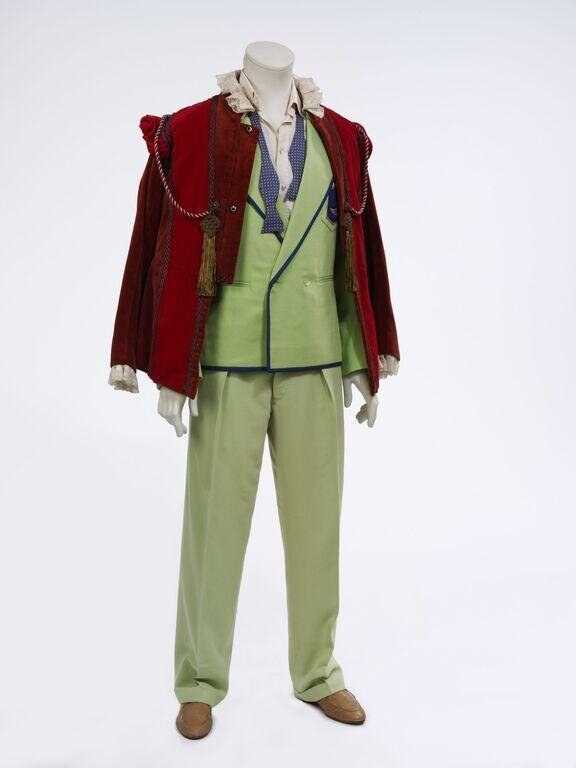
A mannequin displays a striking three-piece ensemble against a plain white background. The outfit centers on a lime-green suit with a double-breasted jacket and straight-leg trousers, paired with a navy-and-white patterned shirt with a broad collar. The jacket is cut with a modern sensibility — clean lines, subtle lapels, the kind of tailoring that reads as theatrical without being costume in the pantomime sense. Over this sits a dramatic wine-red velvet coat or cloak with deep, heavy folds, its shoulders dramatically bunched and gathered. The outerwear is fastened with ornamental gold-toned braiding or rope detailing that loops across the front, creating visual weight and formality. The figure wears a cream-colored silk scarf tied loosely at the neck in the manner of a cravat. Brown leather shoes with a low heel ground the outfit in practical reality. The whole ensemble reads as 1980s menswear theater — expensive, confident, slightly camp in its coordination, and unmistakably designed for a stage or performance context rather than everyday wear.
The dancing
The mannequin stands in a neutral pose, weight evenly distributed, arms at rest. This is a costume display, not a figure in motion, so body language is not available. However, the cut of the jacket and the length of the trousers suggest a performer of medium build, and the formality of the tailoring implies a character of authority or social standing.
The dance depicted
This is theatrical costume, almost certainly for a dance or theater production of the early 1980s. The outfit's structure — the bright contrasting colors, the dramatic outerwear, the careful attention to line and silhouette — is consistent with contemporary ballet or contemporary theatrical dance of the period, when designers were moving away from naturalism toward more sculptural, expressive use of the body's outline. Without more context it is impossible to identify the specific work, but the vocabulary suggests a character role in a mixed-media or experimental piece rather than classical ballet.
How it was made
This is a three-dimensional costume object on display, photographed in a museum or archive context. The photograph is contemporary with the archive itself, a straightforward documentation shot from a frontal angle and neutral height, designed to show the complete silhouette without distortion. The image carries no visible label, maker's mark, or inscription. The quality of the photographic printing and the mounting suggest institutional conservation — this is an artifact being preserved as a design record.
About this work
This is a costume designed by Peter Hall, a significant figure in British contemporary dance and theater of the 1980s. The piece exemplifies the period's approach to dance costume as visual sculpture: bold color, architectural construction, and a mixing of formal tailoring with experimental elements. The outfit sits at the intersection of dance, fashion, and theater design, where the body itself becomes a platform for artistic expression rather than merely an executing instrument. The ensemble is a record of how late-twentieth-century theatrical practice understood the relationship between costume and movement — the clothes as choreography in themselves.
How to look at it
Study the proportions first: the way the jacket sits relative to the trousers, the length of the torso line created by the suit against the drape of the coat. Notice how the green and the red do not harmonize in a traditional sense but instead create a kind of productive visual tension — they demand attention rather than soothing the eye. The gold braiding is not decorative frill but a structural and visual anchor point. A viewer familiar with 1980s theater design will recognize immediately that this is a work costume, not fashion — the choices are too deliberate, too sculptural, too committed to a particular visual idea.
The artist
Peter Hall (1930–2017) was a British theater and film director of major influence, known for his work with the Royal Shakespeare Company and later for directing opera and contemporary pieces. While primarily a director, Hall was also engaged with design and visual conception of performance. The dating of this costume to 1983 suggests it comes from one of his theatrical or dance projects of the early 1980s, a period of formal experiment.
The period
In the early 1980s, contemporary dance in Britain was moving beyond the legacies of Graham and Cunningham toward a new formalism that drew on postmodernism, fashion, and visual art. Costume design became a primary vehicle for expression: designers like Jasper Conran, Jennifer Tipton, and others were creating pieces that operated as independent artworks rather than mere practical garments. Color blocking and architectural tailoring became tools for rethinking the stage body. This outfit belongs to that moment of ambition and experiment.
Where it lives
The costume is held in a collection designated as 'Costume' in the catalogue record, with source noted as 'VA' (likely the Victoria & Albert Museum or another institutional archive). It is catalogued as an object without further contextual information about the production it served.
Dance in this work
Questions about this work
Who was Peter Hall and what did he design?
Peter Hall (1930–2017) was a British theater director of major international standing, best known for his work with the Royal Shakespeare Company and his staging of Shakespeare and opera. While primarily known as a director, he was deeply engaged with the visual conception of productions. This costume dates from 1983, likely a theatrical or dance work of that period.
What production was this costume made for?
The catalogue record does not identify the specific production. The piece is recorded only as a costume by Peter Hall from 1983. Further research in theater archives and Hall's production records would be needed to identify the work it served.
Is this a one-off or was it reproduced?
The record does not indicate whether this was a unique piece or one of multiple copies made for a cast. The quality of tailoring and materials suggests a professional production with adequate resources, but without more documentation the manufacturing history cannot be established.
Why are the colors chosen this way?
The lime green and wine red create visual tension rather than harmony — this is an intentional choice in 1980s theatrical design, where costume was meant to command attention and signal character or concept. Against a stage light, these colors would read as bold and present rather than subtle or naturalistic.
More dance artwork





