49 works in this view — arrow keys or swipe to move between them.
Dance in Art
An Evening party
Addey, Wilfrid R.
- Collection:
- Drawing
- Source:
- Victoria and Albert Museum
- Rights:
- Rights vary by item — check the source record before reusing this image. Source record ↗
- Recorded as:
- V&A — check rights per item
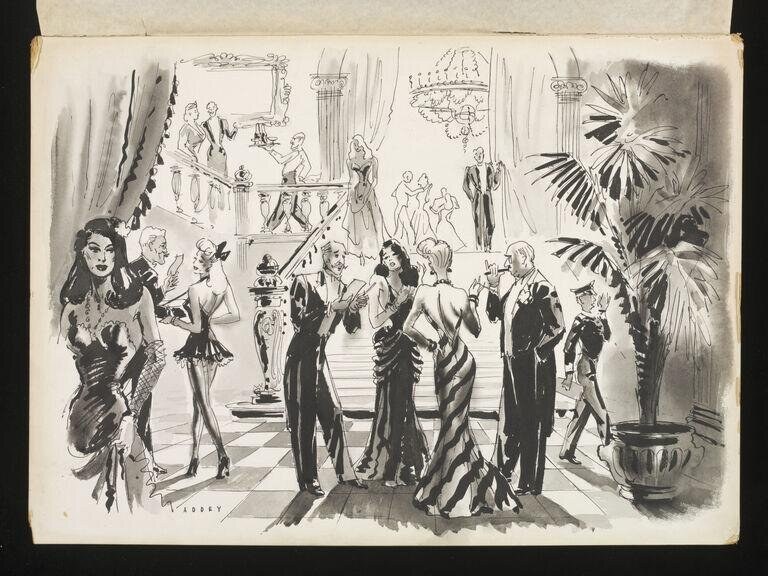
The drawing captures ballroom dancing not as an isolated technical or theatrical act but as embedded social practice—the dance floor as one zone in a much larger economy of class display, courtship, and leisure. For historians of dance and manners, it is a window into what social ballroom dancing actually looked like in situ, performed by non-professionals in a real social setting, rather than on a stage or in a dance studio.
What you are looking at
A crowded formal evening reception in an elegantly appointed interior, rendered in ink with gestural lines and areas of dramatic shadow. The setting features tall classical columns, elaborate drapery, potted palms, and a coffered or decorated ceiling, establishing an upper-class venue. Figures in evening dress—men in tuxedos, women in long gowns—occupy multiple planes of the composition: some stand in clusters engaged in conversation, others occupy a raised platform or mezzanine at the rear, and at least two couples occupy the foreground in dancing posture. The artist's technique emphasizes the social energy of the scene through overlapping figures, varied poses, and the selective deployment of deep black ink to create depth and focus. The mood is one of refined leisure and sophisticated social interaction, with dance as one element within a broader tableau of upper-class entertainment.
The dancing
Two couples are clearly identifiable in the foreground in dancing position. The nearest woman wears a figure-hugging dark gown and inclines toward her partner with an attentive frame; the man opposite her is in formal evening dress with an upright posture. A second couple visible in the middle distance follows similar proportions and hold. The arm positions and body alignment suggest ballroom dancing in a closed or semi-closed frame, with the characteristic upright carriage of 1930s–1940s social dance. The artist demonstrates understanding of ballroom posture and the relative positions of partners, though the sketch technique does not permit detailed analysis of footwork.
The dance depicted
The work depicts social ballroom dancing at a formal evening reception, most likely Waltz or Foxtrot given the era, the closed holds, and the upright frame visible in both couples. This is social dance rather than theatrical performance—the dancers are guests at a party, not professionals on a stage. The style and setting are consistent with upper-middle-class or wealthy British social life in the 1930s–1940s, when ballroom dancing was a standard accomplishment at such events. The artist's focus on the social context rather than technical virtuosity suggests a documentary or satirical interest in the manners and rituals of the period.
How it was made
Ink drawing on paper, executed with a combination of fine linear work and bold areas of wash or solid black for shadow and emphasis. The technique is characteristic of mid-twentieth-century illustration or caricature—economical, gestural, and designed for rapid reproduction. The artist uses the fluidity of ink to suggest movement and crowd, avoiding finicky detail in favor of compositional energy. This is a work made for publication or display in a commercial or journalistic context, not a fine-art original intended for intimate study.
About this work
This is a social document of upper-class leisure in the 1930s–1940s rendered as satirical or observational illustration. The artist captures the ballroom as a theater of manners and display, with dance as one ritual among many—an evening party where partners circulate, converse, and perform their social roles through both conversation and dance. The work belongs in a gallery of dance in art both as a record of how ballroom dancing functioned in its original social context and as evidence of how artists of the period used dance scenes to comment on class, courtship, and social performance. The illustrative, journalistic approach suggests that Addey was working in the tradition of satirical or documentary social commentary common to British illustration in the mid-twentieth century.
How to look at it
Attend to the placement of the dancers within the crowd: they are not isolated or spotlit, but rather one element in a busy social scene, which is the artist's real subject. Notice the varied postures and levels of engagement—some figures dance, others watch or talk—which suggests a interest in the social function of the dance rather than its technical content. The artist's use of shadow and ink wash to create depth allows multiple layers of action to coexist on the page, creating a sense of crowded sophistication and busy leisure. The viewer's eye is drawn to the nearest couple but invited to scan the entire room, suggesting that the evening party itself is the true protagonist.
The artist
Wilfrid R. Addey appears to have been a professional illustrator or cartoonist active in mid-twentieth-century Britain, working in ink and pen with a style suited to editorial and commercial reproduction. The fluent, gestural quality of the line and the satirical edge suggest training in either fine art or commercial illustration, and the subject matter—upper-class social life—indicates work for publications or clients interested in social observation and satire. No major biographical information is readily available, but the work is consistent with the output of skilled illustrators of the period who documented British social manners.
The period
In the 1930s and 1940s, ballroom dancing remained a central ritual of upper-middle-class social life in Britain, performed at private parties, hotels, and public dance halls, and mediated by professional instructors and fashion. Dance illustration was a staple of magazines, books, and satirical publications; the evening party was a stock subject in social satire and illustration. The period also saw a growing market for social commentary through illustration and caricature, as artists documented the rituals and pretensions of their own class. Addey's work sits within this tradition of observational social art.
Where it lives
The work is held in a British institutional collection (source code 'va' indicates the Victoria and Albert Museum or related archives). It is recorded as a drawing, consistent with its execution in ink on paper.
Dance in this work
Questions about this work
What kind of dance is happening here?
Two couples visible in the foreground are dancing in closed ballroom position, most likely Waltz or Foxtrot, the standard social dances of the 1930s–1940s at upper-class evening parties. The upright frame, closed holds, and formal dress are all consistent with social ballroom dancing of the period. This is not theatrical dance or competitive dancing, but social dancing—guests at a party dancing with partners as part of the evening's entertainment.
Who was Wilfrid R. Addey?
Addey was a mid-twentieth-century British illustrator or cartoonist working in ink, producing work for editorial and commercial publication. The style and subject matter suggest training in fine art or commercial illustration, and a career documenting social life. Little biographical detail is currently available, but the drawing demonstrates the technical fluency and social wit expected of professional illustrators of the period.
Why does the artist show the whole party instead of just the dancers?
The inclusion of the crowd, the mezzanine, the columns, and the décor suggests that Addey was interested in the social context of dance rather than dance in isolation. The evening party is the real subject: the work documents how ballroom dancing functioned as one ritual among many in upper-class leisure and courtship. This approach is typical of social satire and observational illustration of the period.
What does the drawing technique tell us?
The fluid ink work, economical line, and gestural approach are typical of mid-twentieth-century illustration designed for publication and reproduction. The technique was fast, effective, and suited to editorial and journalistic contexts. The artist was not aiming at fine-art finish but rather at capturing a moment of social observation with wit and clarity—a tool for comment and documentation rather than a precious object.
More dance artwork





