49 works in this view — arrow keys or swipe to move between them.
Dance in Art
Caricature
Cooke, George
- Collection:
- Caricature
- Source:
- Victoria and Albert Museum
- Rights:
- Rights vary by item — check the source record before reusing this image. Source record ↗
- Recorded as:
- V&A — check rights per item
The Cake Walk was one of the first African American vernacular dances to achieve massive international commercial success, and this image documents a performer and promotional moment in that history. The work is a primary source for understanding how the dance was marketed, performed, and consumed in early twentieth-century popular entertainment, revealing the gap between the dance's vernacular origins and its commodification as a stage spectacle.
What you are looking at
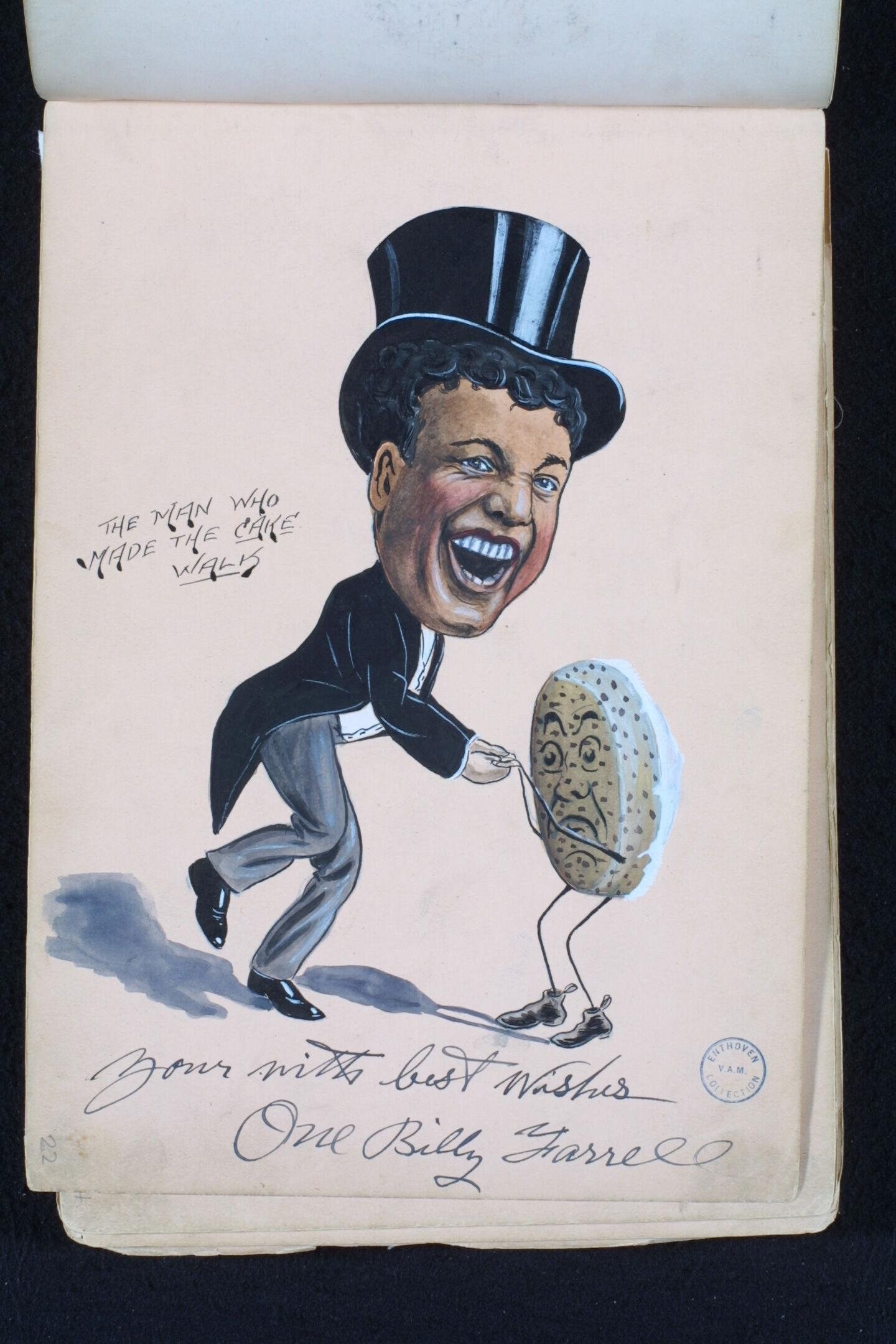
A caricatured male figure in formal evening dress dominates the composition. He wears a black top hat, tailcoat, and light trousers with black shoes, leaning forward with an exaggerated, gleeful expression and wide-open mouth suggesting laughter or song. His pose is dynamic—the upper body inclined forward, suggesting movement and showmanship. Beside him stands an anthropomorphized cake (or possibly a pudding or mold), rendered as a tall ovoid form decorated with blue spots and featuring a comical face with simple features and a mustache. The cake appears to stand upright on small feet. The handwritten inscription at bottom reads "The Man Who Made the Cake Walk" and is signed "Your With Best Wishes Odel Billy Farrer." The background is plain cream paper, focusing attention entirely on the figures. The style is colored caricature with watercolor or similar media applied to an initial ink drawing.
The dancing
The male figure's posture is theatrical and unstable—leaning sharply forward from the waist with knees slightly bent, weight forward on the balls of the feet, suggesting dynamic movement rather than a stationary pose. The upper body twists slightly, the face turned toward the viewer in a broad smile. This is not a dance frame in the technical sense, but rather a vaudeville performer's exaggerated stance. The relationship to the anthropomorphized cake is of showman to prop, with the figure's gesture implying ownership, pride, or introduction of the object beside him.
The dance depicted
The inscription explicitly names the "Cake Walk," a stage dance that emerged from African American entertainment in the 1890s and became a widespread popular phenomenon in both America and Europe in the early 1900s. The figure's posture—the forward lean, the swagger, the theatrical confidence—are consistent with the Cake Walk's characteristic high-stepping gait and exaggerated showmanship. However, no actual dancing footwork is visible; this is an advertisement or promotional image showing a performer associated with the dance rather than a representation of the movement itself. The anthropomorphized cake likely references either the prize structure of cake-walk competitions or the entertainment's carnival-like spectacle.
How it was made
This is a hand-colored caricature or illustration, drawn in ink and then tinted with watercolor or similar opaque pigment. The technique allows for sharp linear definition in the figures while the color application is bold and somewhat flat, typical of commercial entertainment illustrations and advertising ephemera of the early 1900s. The inscription is in handwritten script, and the work is signed by what appears to be the subject or a performer associated with the Cake Walk, suggesting this is a promotional piece meant for circulation among performers, fans, or promoters. The paper is aged cream cardstock, consistent with theatrical or music-hall promotional material of the period.
About this work
This is a promotional caricature of a stage performer advertising his association with the Cake Walk, a popular dance-theater entertainment of the early 1900s. The work sits at the intersection of performance, advertising, and social history—the Cake Walk was a commercial spectacle that drew audiences across racial lines in an era of rigid segregation, though its relationship to its African American vernacular roots remained contested. The exaggerated facial features and grotesque style of caricature reflect contemporary conventions of racial representation in entertainment advertising, a practice now understood as deeply problematic. The work documents both the dance's popularity and the era's visual language of minstrelsy and vaudeville promotion.
How to look at it
The caricature captures not a moment of the dance itself but the performer's characteristic theatrical persona—the swagger, the showmanship, the sense of comedic performance that audiences associated with the Cake Walk in commercial entertainment. Notice the forward lean and the exaggerated facial expression: these convey not athletic precision but entertainment spectacle. The grotesque caricature style was the standard visual language of vaudeville and music-hall promotion of the era, though contemporary viewers should recognize it as a product of historical racial representation practices that modern audiences would rightly reject.
The artist
George Cooke is not widely documented in standard art historical records. The signature and inscription suggest he was either the performer depicted, an artist working in commercial entertainment illustration, or both—a common practice in music-hall and vaudeville ephemera of the period. The work is consistent with the style of unsigned or semi-anonymous promotional illustration produced for theatrical producers and performers in the early 1900s. The signing convention ("Your With Best Wishes") suggests an inscription on a promotional print meant for distribution to friends or colleagues.
The period
The Cake Walk emerged in African American entertainment in the 1890s, likely developing from plantation-era performance traditions that satirized European court dance. By the early 1900s, it had become an international sensation, reaching London, Paris, and other major cities, often presented by African American performers but also adopted by white performers in minstrel and vaudeville contexts. The dance occupied a complex cultural position—celebrated for its novelty and spectacle, yet framed through the lens of racial caricature and minstrelsy conventions. This image dates to the period of the Cake Walk's commercial peak, when it was featured in Broadway shows, music halls, and popular entertainment across the Atlantic.
Where it lives
This work is held in a collection labeled "Caricature" in an archive identified as "VA" (likely Virginia archives). The work is a promotional or personal inscription piece rather than a fine-art work, consistent with theatrical and entertainment ephemera of the early 1900s. The aged cardstock and handwritten inscription suggest it may have been a gift or presentation print.
Dance in this work
Questions about this work
What is the Cake Walk and why was it popular?
The Cake Walk was a stage dance that emerged from African American entertainment in the 1890s and became an international sensation in the early 1900s. It featured high-stepping, rhythmic movement and exaggerated theatrical gestures. It was enormously popular in vaudeville, Broadway shows, and music halls because it was novel, visually striking, and fitted into the era's appetite for entertainment spectacle, though it was often presented through the distorting lens of minstrelsy conventions.
Who was Odel Billy Farrer?
Based on the inscription, Farrer appears to have been a performer associated with the Cake Walk in the early 1900s. The promotional nature of this image and the personalized inscription suggest he was either a notable performer or someone with a claim to fame in the dance. The vague historical record reflects both the ephemeral nature of music-hall performance and the tendency of archives to preserve the work of elite performers over popular entertainers.
Why is this caricature style offensive to modern viewers?
The exaggerated facial features and grotesque rendering reflect early twentieth-century minstrelsy conventions that depicted African Americans and African American performance through a lens of racial stereotype and ridicule. While this was the visual language of entertainment promotion in that era, modern audiences recognize it as a product of systemic racism. The image is historically important precisely because it documents how the Cake Walk—a brilliant and original African American dance—was mediated and distorted through racist visual conventions when presented to commercial audiences.
More dance artwork





