49 works in this view — arrow keys or swipe to move between them.
Dance in Art
Valentino.
Hyacinthe, A.
- Collection:
- Source:
- Victoria and Albert Museum
- Rights:
- Rights vary by item — check the source record before reusing this image. Source record ↗
- Recorded as:
- V&A — check rights per item
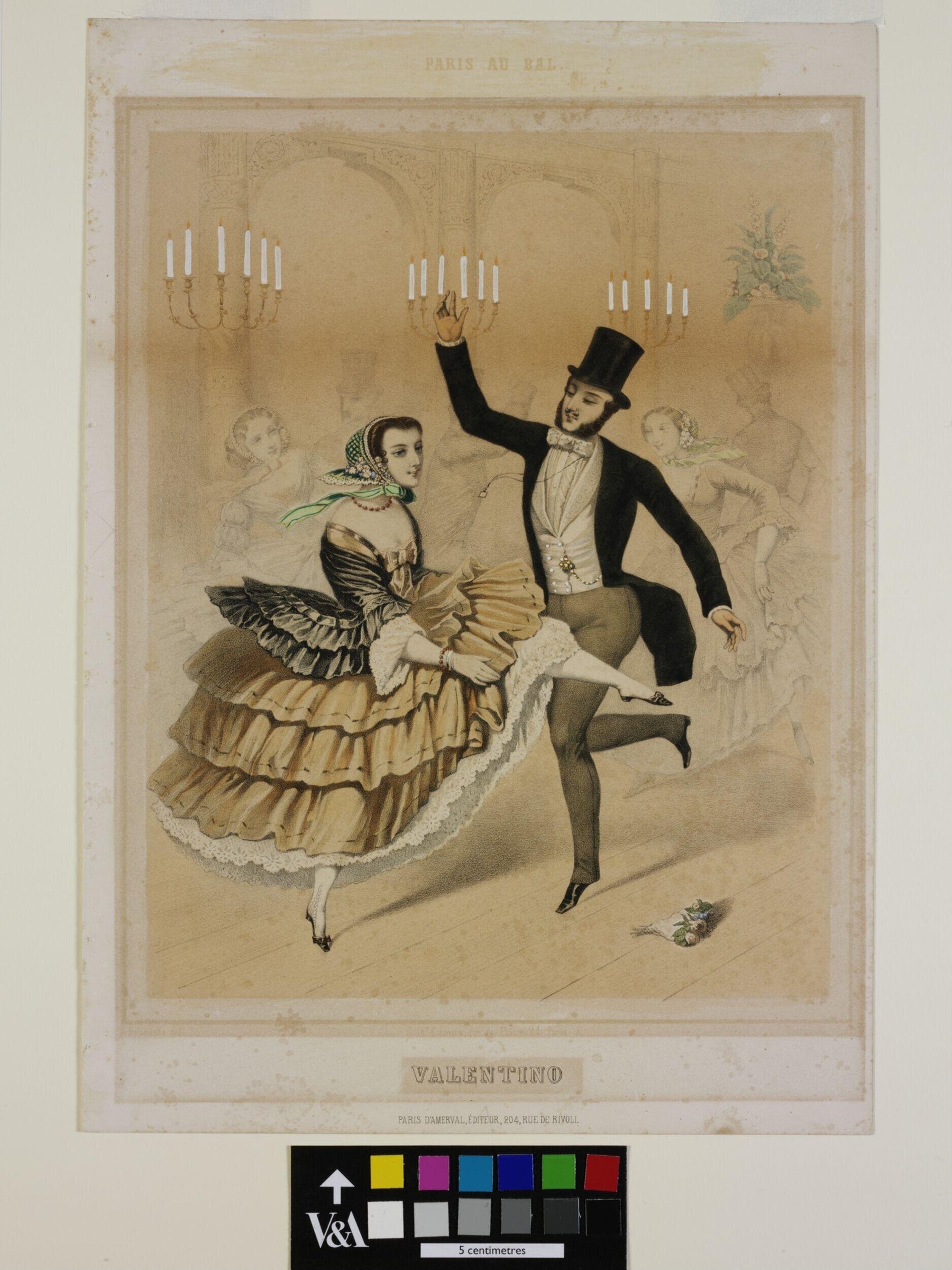
This work captures a specific moment in the commercialisation of dance: when theatrical dance scenes became subjects for mass-produced prints and when named dances (waltzes with individual titles, often tied to popular entertainments or dancers) became fashionable commodities. The composition—with its theatrical exaggeration, the symbolic candelabra, and the emphasis on costume and spectacle—shows how dance was being visualised and consumed outside the theatre, as part of popular visual culture.
What you are looking at
A man in formal evening dress—black tailcoat, white waistcoat, and top hat—dances with a woman in an elaborate ball gown of pale silk with deep black lace ruffles cascading down the skirt. The woman wears a jeweled headdress and glances back toward her partner as he raises one arm holding a candelabra aloft, its five lit candles bright against the muted palette. The setting is a grand ballroom with classical arched alcoves and ornate decoration visible in the background; two putti (cherubs) appear in the upper corners, and floral swags hang between the arches. The couple is captured mid-motion, the woman's skirt swept up by the momentum of the dance, her body leaning into the turn. The composition suggests a moment of playful abandon—the man's expression is animated and pleased, his posture jaunty despite the formal dress. A small nosegay lies on the floor nearby.
The dancing
The man holds the candelabra high in his right hand while his left gestures toward the woman, who inclines her body in a graceful curve. Their relative positions suggest she is being led in a turning movement, with her weight forward and her skirt rising with the centrifugal motion. The man's stance is upright but elastic, one leg extended. The physical relationship between them—not in closed ballroom hold, but in a looser spatial configuration—suggests a more theatrical or burlesque staging than a formal ballroom dance.
The dance depicted
This depicts a scene of social ballroom dancing, most likely a waltz given the fluid turning motion, the woman's raised skirt, and the composition suggesting rotation. The date is unknown, but the print's style and the couple's dress belong to the mid-to-late 19th century. The introduction of the candelabra—a playful, almost absurdist element—suggests this is not documentary but theatrical or satirical: it may illustrate a scene from a pantomime, operetta, or popular theatrical work. The title 'Valentino' does not appear to refer to a specific published dance or waltz but may be the name of a character or a work being advertised.
How it was made
This is a colour lithograph or hand-coloured engraving, executed with considerable technical refinement. The fineness of the line work in the background architecture, the delicate application of colour to the figures, and the even gradation of tones suggest a professional lithographic print, likely produced for commercial circulation—possibly as theatrical advertising, a souvenir, or a fashion print. The printing technique allowed rapid production and distribution, and the inclusion of the V&A accession mark suggests it was collected as a notable example of 19th-century popular graphic design.
About this work
This is a mid-to-late 19th-century colour lithograph depicting a waltz or turning dance in a grand ballroom setting. The artist captures a moment of theatrical elegance and playfulness: a formally dressed couple in motion, the woman's gown and the man's candelabra creating a sense of spirited gaiety. The print sits at the intersection of dance documentation and theatrical satire, recording not necessarily how people danced but how dance was imagined and celebrated in popular entertainment and visual culture. For a dance historian, it is valuable as evidence of what a 'Valentino' waltz looked or felt like to a 19th-century audience.
How to look at it
Notice the moment the artist chose: not a formal, static pose but a captured instant of motion, with the woman's skirt lifted and both figures leaning into the turn. The candelabra is not incidental—it is the focal point and the source of playfulness, suggesting this is not a faithful representation of ballroom practice but a theatrical fantasy or satirical comment on social dancing. The putti in the corners and the classical architecture anchor this in a refined, aristocratic world, yet the scene's energy and the man's delighted expression make it humorous. The composition balances elegance and comedy.
The artist
The artist is credited as 'Hyacinthe, A.', otherwise unidentified in the catalogue record. The printing was executed by the Paris firm Desgasne, Linter & Co., rue du Roule, suggesting a commercial print-publishing operation active in the mid-19th century. Without further documentation, the identity and practice of Hyacinthe cannot be established from the image alone.
The period
The mid-to-late 19th century saw an explosion of named waltzes and popular dances, each associated with celebrated dancers, composers, or theatrical productions. The waltz itself had become the dominant social ballroom dance across Europe and America, and theatre and commercial entertainment capitalised on this popularity. Colour lithography had become the dominant medium for theatrical advertising, fashion plates, and popular satire. This print belongs to that world of theatrical entrepreneurship, where a named dance could be packaged, advertised, and consumed as an image.
Where it lives
Held in the V&A collection, sourced from a London or British collection. It is catalogued as a print, likely acquired as an example of 19th-century theatrical advertising or popular graphic design.
Dance in this work
Questions about this work
Is this a real dance or a fictional one?
Both. 'Valentino' may have been a real waltz or a named dance popular in the mid-19th century, but this print is not documentary. The inclusion of the candelabra and the theatrical setting suggest this depicts a scene from a pantomime, operetta, or theatrical entertainment rather than social ballroom practice. It shows how dance was being reimagined and fantasised in theatrical and popular visual culture.
Who was Hyacinthe?
The artist is identified only as 'Hyacinthe, A.' in the catalogue record, and no further biographical information is available. Given the professional quality of the print and its commercial execution, Hyacinthe was likely a theatrical or commercial illustrator active in mid-19th-century Paris, but individual identification remains uncertain.
Why is he holding a candelabra while dancing?
The candelabra appears to be a theatrical prop or symbolic element, not a realistic feature of ballroom practice. It may indicate a scene from a specific theatrical production or operetta, or it may be a humorous or fantastical touch added for visual interest and comedy. Without access to the original theatrical work (if one exists), the precise meaning remains uncertain.
More dance artwork





