49 works in this view — arrow keys or swipe to move between them.
Dance in Art
Theatre costume
Wilhelm
- Collection:
- Theatre costume
- Source:
- Victoria and Albert Museum
- Rights:
- Rights vary by item — check the source record before reusing this image. Source record ↗
- Recorded as:
- V&A — check rights per item
Theatrical costumes are primary evidence for how dancers moved and how audiences saw them. This costume shows the weight, volume, and visual language that shaped early 20th-century stage dance—the ornament, the exoticism, the architectural headdress that would impose posture and presence on the dancer wearing it. Without surviving garments like this, we cannot fully understand the physicality and visual impact of the work.
What you are looking at
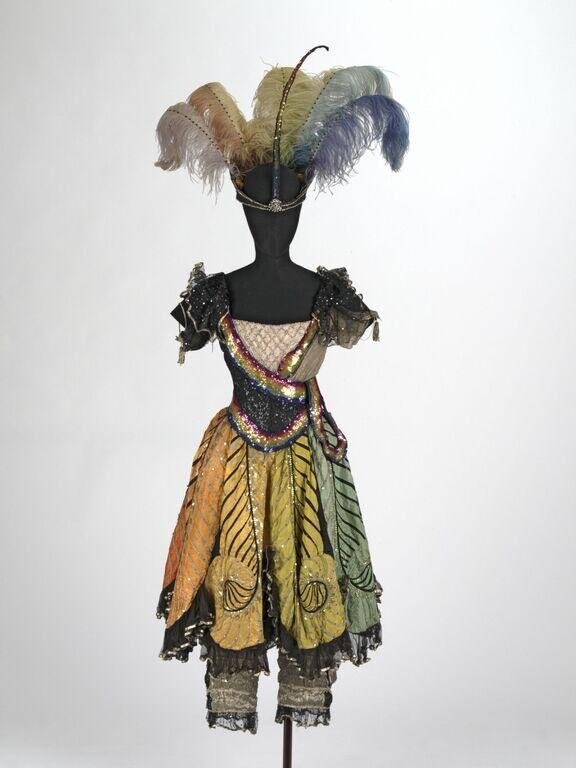
A theatrical costume displayed on a black dress form against a neutral background. The garment is a theatrical confection of the early 20th century: a short skirt in panels of gold, orange, and green silk, each panel decorated with black linear designs suggesting feathers or plant forms, edged with black lace. Over this sits a corseted bodice of black beaded or sequined fabric, cinched tight at the waist and decorated with a diagonal sash of jeweled trim in purple and gold. The shoulders are bare but for two black tasseled epaulettes or arm pieces. Most striking is the headdress: four long ostrich plumes in cream, pale gold, sage green, and dark blue arc upward from a central ornament, creating a dramatic silhouette that frames the invisible wearer's head. The plumes are wrapped partway down their length with gold cord or ribbon. The overall effect is opulent, exoticized, and unmistakably theatrical—a fantasy costume rather than costume for everyday wear.
The dancing
No dancer is present; this is a costume displayed on a mannequin. The form shows how the garment would sit on a body: the skirt hangs from a fitted waist, its panels arranged to suggest movement even at rest. The positioning of the epaulettes suggests the shoulders would be held back and open. The weight of the headdress would have imposed a certain posture—the head held high and steady to support the height and reach of the plumes.
The dance depicted
This is almost certainly a costume for theatrical ballet or a related form of early 20th-century theatrical dance—possibly a ballet pantomime, a music-hall number, or a vaudeville specialty dance. The exoticized vocabulary (the plumes, the jeweled sash, the color palette) suggests an orientalist or fantasy theme common to pre-1920s ballet. The construction of the skirt in separate panels rather than as a continuous tutu indicates this is not a classical ballet costume but something closer to a theatrical spectacle piece. The artist Wilhelm may have been a costume designer or atelier associated with theatre companies or opera houses in the early 20th century.
How it was made
This is a three-dimensional textile object—an actual costume garment, not a rendering of one. It comprises silk, lace, beads or sequins, ostrich plume, and ribbon or cord, hand-assembled. The fineness of the beadwork and the quality of the materials suggest professional theatrical manufacture, likely from an atelier or costume house. The survival of the costume as a museum piece indicates it held value either for the work of the designer Wilhelm or for the production it served.
About this work
A theatrical costume from 1916, comprising a jeweled black bodice, multicolored feathered silk skirt, and four ostrich plumes in an arched headdress. The garment exemplifies the visual excess and exoticist fantasy of pre-war theatrical dance—the kind of spectacle costume worn in ballet pantomimes, music-hall productions, and early 20th-century experimental theatre. The work is credited to an artist named Wilhelm, likely a costume designer working in a European theatrical tradition. The costume belongs in a dance collection because it represents both the material culture of early theatrical dance and the aesthetics that governed how dance bodies were dressed, framed, and presented to audiences during a period when ballet was expanding beyond the academy into popular entertainment.
How to look at it
Observe how the skirt is constructed: the separate panels in contrasting colors, each with its own linear pattern, would create a sense of motion and multiplicity even when stationary. Notice the position of the epaulettes and how they sit on the shoulders—these would constrain and frame the arm carriage, forcing a particular postural aesthetic. The headdress is the dominant feature; the four plumes at different heights and colors would move with every tilt of the head and create a visual profile impossible to achieve without costume. The jeweled sash across the bodice creates a diagonal line that would be emphasized in any rotational movement.
The artist
Wilhelm is credited as the designer or maker of this costume. Without further documentation, it is impossible to determine whether this was a named costume designer, an atelier, or a house style. The date of 1916 and the refined execution suggest a professional theatrical practice, possibly in Berlin, Vienna, or Paris, where such costumes were manufactured for opera houses, ballet companies, and music halls. No further biographical information is available from the record.
The period
In 1916, theatrical dance was at a point of rapid transformation. The Ballets Russes, which had launched in 1909 with revolutionary designs by Léon Bakst and others, had established a new standard for theatrical opulence and aesthetic boldness. Costume had become central to the modern dance spectacle—not merely a frame for movement but a compositional element in itself. At the same time, music halls and variety theatres across Europe were producing costume-heavy dance numbers that drew on orientalist, historical, and fantastical themes. This costume sits at that intersection: too elaborate and specific for ballet proper, but too refined for simple music-hall work. It reflects a moment when theatre dance was becoming increasingly visual and when costume design had become a recognized art form.
Where it lives
The costume is held in a collection identified only as 'Theatre costume' in the source record, which appears to be a archival or museum collection of theatrical garments. The source is listed as 'va', likely a reference to the Victoria and Albert Museum in London, which holds one of the world's largest costume and textile collections. This object is a material artifact from professional theatrical production, not a representation of one.
Dance in this work
Questions about this work
What dance would this costume have been worn for?
Without the production records, we cannot say with certainty. The style suggests a ballet pantomime, a music-hall specialty dance, or a theatrical number from an operetta or revue. The exoticist vocabulary and the construction suggest a fantasy or orientalist theme. The costume was almost certainly worn by a solo dancer or small group, not an ensemble.
Who was Wilhelm?
The record identifies only 'Wilhelm' as the artist or maker. This may be a first name, a surname, or a house name used by an atelier. Without additional documentation, we cannot provide biographical information. Costume makers of this period often remained anonymous or were known only by a single name.
How much would a costume like this have cost?
Theatrical costumes of this quality and ornamentation were expensive items, affordable only to major opera houses, ballet companies, or well-funded music halls. The materials alone—ostrich plume, silk, beads, gold cord—were costly. Such a costume would have been a significant investment in a production and would likely have been worn multiple times and carefully preserved.
What do the feathers tell us about the dance?
The plumes would move with the dancer's head, neck, and upper body, creating visual effects that extended the line and added volume to the silhouette. The height and reach of the headdress would have imposed a particular posture—head held high, shoulders back—that would shape the dancer's movement quality and how the body was presented to the audience.
More dance artwork





