49 works in this view — arrow keys or swipe to move between them.
Dance in Art
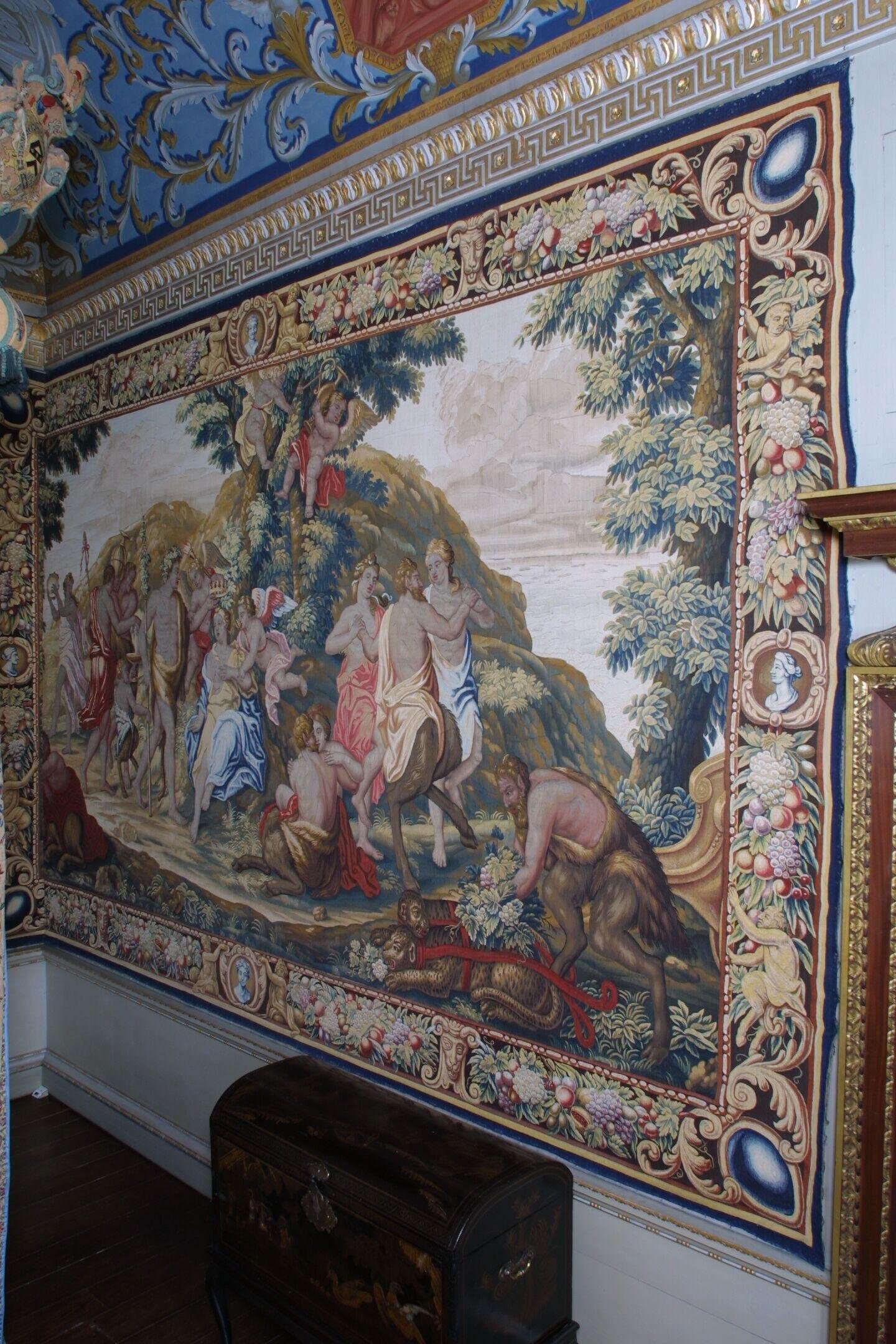
The Story of Bacchus
unknown
- Collection:
- Tapestry
- Source:
- Victoria and Albert Museum
- Rights:
- Rights vary by item — check the source record before reusing this image. Source record ↗
- Recorded as:
- V&A — check rights per item
This tapestry demonstrates how Baroque court culture represented the body and gesture as legible signs in a formal, hierarchical system—a visual principle that directly paralleled the conventions of court ballet and ceremonial dance. The work reveals the aesthetic continuum between static visual art and choreographed movement in seventeenth-century noble culture, where the same vocabulary of posture, spacing, and symbolic gesture served both the painter's canvas and the dancing body.
What you are looking at
This is a large tapestry depicting a classical mythological scene with multiple figures arranged across a landscaped setting. The composition centers on an elevated rocky formation at left where a group of elaborately dressed figures gestures and gazes toward the right side of the composition. The figures wear rich clothing in reds, blues, and pale silks, with drapery that falls in elegant folds. To the right, a solitary male figure in flesh tones reclines or crouches in a pose of submission or repose on the lower ground. The entire scene is framed by an ornamental border of flowering fruit trees and acanthus scrollwork in blues, greens, pinks, and golds. The sky above is pale and atmospheric. The upper portion of the image shows the deep blue decorative frieze typical of tapestry framing, with geometric patterns and foliage ornament in cream and gold.
The dancing
The figures at the elevated left form a processional or gathering group, several standing with arms raised or extended in gestures of greeting, blessing, or invitation. Their postures are upright and formal, with weight evenly distributed in a manner befitting courtly protocol. The solitary male figure at right adopts a contrasting posture—lowered, vulnerable, asymmetrically weighted—suggesting submission, adoration, or the moment of divine transformation. The spacing and directed gazes create a clear narrative axis from the group toward the isolated figure.
The dance depicted
This tapestry most likely illustrates a scene from the mythology of Bacchus (Dionysus), possibly the moment of his recognition, apotheosis, or encounter with mortals or nymphs. While the scene is fundamentally narrative rather than choreographic, the formal arrangement of figures and the gestural language suggests the influence of court ballet and processional dance conventions of the seventeenth century. The raised arms, the processional grouping, and the theatrical framing indicate a moment staged for observation and symbolic reading rather than social dance. No specific dance style is clearly evident, but the composition reflects the aesthetic vocabulary of court spectacle.
How it was made
This is a Baroque tapestry, almost certainly woven in wool and silk on a loom, likely from a French or Flemish workshop. The high quality of the weaving, the complexity of the figural composition, and the rich ornamental border suggest production for a courtly or aristocratic patron. Tapestry was the most prestigious wall hanging of the period, far more expensive and laborious than painting, and indicated both the status of the patron and the importance of the narrative depicted. The technique allowed for narrative complexity, atmospheric depth, and ornamental elaboration that established this as a statement of courtly taste and learning.
About this work
This Baroque tapestry represents a moment from the classical mythological narrative of Bacchus, rendered in the formal visual language of seventeenth-century court art. It combines narrative figuration with courtly gesture and processional arrangement, embodying the aesthetic of the Baroque court where spectacle, mythology, and formal bodily comportment were unified in both art and performance. The work belongs to a tradition in which tapestry served as both interior decoration and a statement of erudition, displaying the patron's knowledge of classical literature and taste for refined artifice. For dance historians, it exemplifies how court culture represented figures and gesture as a visual language at the intersection of ceremonial, mythological, and choreographic conventions.
How to look at it
Attend first to the spatial and gestural dialogue between the group at left and the solitary figure at right—this asymmetry creates the narrative action. Notice the raised and extended arms of the standing figures, which suggest invitation, greeting, or divine authority, and contrast them with the lowered, receptive posture of the reclining figure. The ornamental border, with its profusion of flowering trees and scrollwork, is not merely decorative: it frames the scene as a moment of civilized refinement and courtly artifice, a setting shaped by human cultivation rather than raw nature. The pale atmospheric quality of the sky and the careful gradation of drapery folds indicate Renaissance perspective and modeling, translated into the textile medium.
The artist
The artist is unknown. The work is characteristic of Baroque tapestry production in France or Flanders during the mid-seventeenth century, a period of high technical achievement and courtly patronage. Workshops producing narrative tapestries of classical mythology for the nobility typically employed teams of weavers working from painted cartoons (designs) by court painters, though the specific designer of this composition cannot be identified from the image.
The period
The date of 1660 places this work in the mature Baroque period, during the reign of Louis XIV of France and at a moment when court ballet was reaching its highest development as an art form. The royal court at Versailles was establishing itself as the center of European cultural authority. Tapestries depicting classical mythology were standard commissions for the nobility and reflected the Renaissance humanist interest in Ovid, Apuleius, and other classical sources. The formal arrangement of figures and the elevated treatment of the mythological narrative reflect courtly ideals of order, hierarchy, and civilized refinement that also governed the formal courtly dances of the period.
Where it lives
The work is held as a tapestry in a collection designated as 'va' (likely Virginia). The catalogue record provides minimal provenance information beyond date and medium classification.
Dance in this work
Questions about this work
What story is depicted in this tapestry?
The title indicates a scene from the mythology of Bacchus (Dionysus), likely depicting a moment of divine recognition or transformation. The specific narrative moment is not documented in the available record, but the composition suggests an encounter between a group of attendant or divine figures and a solitary mortal or transitional figure. Classical sources such as Ovid's Metamorphoses provided standard narratives for such tapestries.
Why would a tapestry of a mythological scene matter to dance history?
Baroque tapestries depicting classical narratives reveal how the court understood and represented the human body and gesture as expressive signs. The formal arrangement of figures, the raised arms, and the processional grouping reflect the visual vocabulary of court ballet, which used identical principles of posture and spacing to express meaning. For historians of dance, such images show the aesthetic continuum between painting and choreography in noble culture.
How was this tapestry made?
This is a woven tapestry, created on a loom using wool and silk threads. A painter would have designed the composition in a detailed drawing called a cartoon, which the weavers then followed, color by color, thread by thread. This process was extremely time-consuming and expensive, which is why tapestries were luxury goods owned only by the wealthy and powerful.
Could people actually dance like the figures in this image?
The figures here are arranged for narrative and symbolic effect rather than choreographic accuracy. However, the raised arms, upright carriage, and processional spacing reflect real conventions of court dance and ceremonial movement of the period. The artist drew on visual memory and courtly knowledge to make the scene legible to a noble audience familiar with both classical mythology and formal court behavior.
More dance artwork





