49 works in this view — arrow keys or swipe to move between them.
Dance in Art
Theatre costume
unknown
- Collection:
- Theatre costume
- Source:
- Victoria and Albert Museum
- Rights:
- Rights vary by item — check the source record before reusing this image. Source record ↗
- Recorded as:
- V&A — check rights per item
These objects are direct witnesses to how historical dancers moved. Unlike paintings or prints that interpret dance through an artist's eye, costume artifacts preserve the actual constraints and affordances the dancer experienced—the weight, resistance, and shape of the boot, the support offered to the ankle, the visual silhouette created on stage. They are archaeological evidence.
What you are looking at
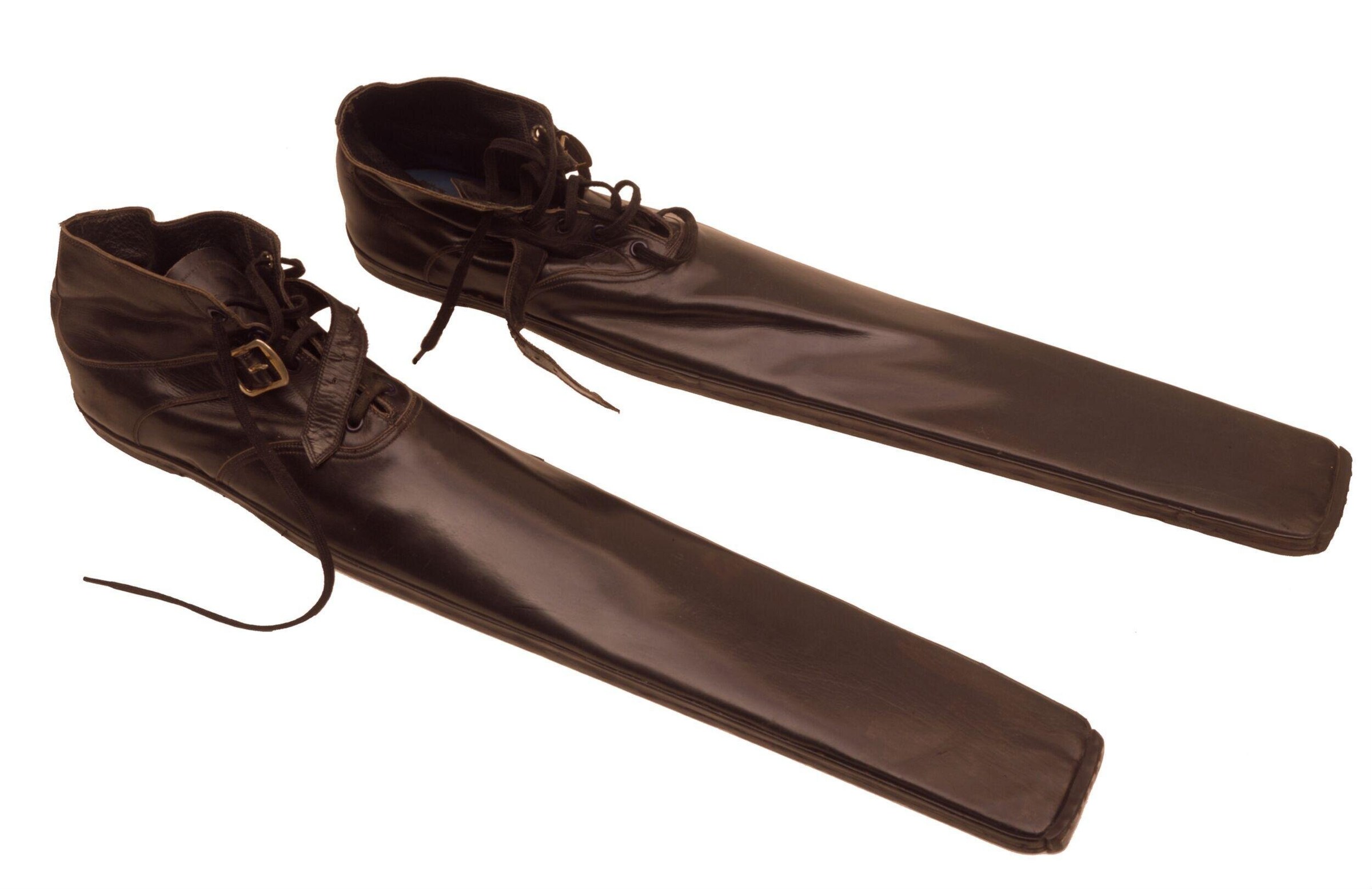
Two brown leather ankle boots with lacing stand upright, each paired with an elongated brown leather leg covering or stocking that extends from the foot. The boots feature decorative buckled straps across the ankle and appear to be period footwear, likely from the 18th or 19th century. The associated leg coverings—drawn or stuffed to maintain their tubular shape—suggest these are either display pieces or costume components laid out for examination or preservation. The leather is well-preserved and uniform in color throughout. The arrangement is clinical and frontal, presented against a plain white background as if for a museum catalogue or documentation photograph.
The dancing
These are not worn by dancers but displayed as objects. However, their form and construction reveal information about how the wearer would have moved: the fitted ankle and laced closure would have provided secure support for turning movements, while the elongated leg coverings suggest either stockings pulled high or integrated leg wraps used in performance. The boots appear designed to accommodate pointed or articulated footwork, with a relatively flat, firm sole consistent with theatrical use rather than street wear.
The dance depicted
These are theatrical boots and leg coverings from an unknown performance tradition. The construction suggests European theatrical dance of the 18th or 19th century—the buckled ankle strap and fitted leather upper are consistent with ballet pointe preparation or with the boots worn in pantomime and comedic dance. The elongated leg covering may represent either a rolled stocking, a leg wrap, or a component of stage costume designed to extend the visual line of the leg during performance. Without inscription or context, the specific dance form cannot be determined with certainty.
How it was made
These are original leather artifacts—working costume pieces rather than artistic representations. They are constructed from soft brown leather with hand-stitched seams, buckled fastenings, and a relatively light sole, indicating handmade manufacture typical of theater wardrobe production before industrial standardization. The leg coverings appear to be either shaped leather or linen stocking forms, preserved as costume museum pieces. Photography here serves a documentary function: to record the three-dimensional form, material, and construction detail of working dance costume.
About this work
These are theatrical boots and associated leg coverings preserved as costume artifacts from an unknown era and performance tradition. They represent the physical infrastructure of historical dance—the specialized footwear that enabled and shaped movement on stage. The quality of construction and specificity of design suggest professional rather than amateur use, and the survival of the paired set suggests they held sufficient value to preserve as historical documentation. They belong in a gallery of dance imagery not as art made about dance, but as material evidence of how dancers prepared their bodies and what tools they used to perform.
How to look at it
Examine the ankle support and lacing system: notice the buckled strap and how it would have held the foot stable during rotation and elevation. Look at the sole—relatively flat and thin compared to modern shoes, suggesting a dancer trained to work closer to the floor and to feel the stage beneath the foot. The leg covering reveals how the visual line extended upward from boot to thigh, and whether it was a tight wrap (suggesting control and definition of the leg line) or a loose stocking (suggesting a softer, longer silhouette).
The period
Theater costume archives from the 18th and 19th centuries are fragmentary; most working costume was used up and discarded. When boots or stockings survive, they typically come from significant institutional productions or wealthy households that kept records. The construction and materials here suggest European theatrical use during the period when ballet was professionalizing and pantomime was a major stage form.
Where it lives
Held in a theater costume archive, these are working costume pieces from an institutional or professional production. The collection designation 'Theatre costume' suggests they were acquired and preserved as historical documentation of stage dress, though the specific performance, company, and date are not recorded.
Dance in this work
Questions about this work
What dance style is this costume from?
The catalogue record does not specify. The boot design—fitted ankle with buckled strap and light sole—is consistent with late 18th or 19th-century European theatrical dance, possibly ballet or pantomime, but without documentation, the exact tradition cannot be confirmed. If you recognize the style, please contact the collection.
Are these boots original or reproductions?
Based on the leather patina, hand-stitching, and style of hardware, these appear to be original artifacts from the period when they were worn. The documentation does not confirm date or maker, but they are preserved as historical costume pieces rather than modern reconstructions.
Could these be from ballet?
The construction is consistent with early professional ballet footwear—before the modern ballet pointe shoe as standardized by manufacturers. The light sole and fitted ankle support would suit a dancer training in the Italian or French method during the 19th century. However, the same design would also work for pantomime or comedic theater dance.
More dance artwork





