49 works in this view — arrow keys or swipe to move between them.
Dance in Art
Poster
Unknown
- Collection:
- Poster
- Source:
- Victoria and Albert Museum
- Rights:
- Rights vary by item — check the source record before reusing this image. Source record ↗
- Recorded as:
- V&A — check rights per item
For dancers and choreographers, this poster documents how the field marketed itself and what values it claimed publicly at a pivotal moment—the late 1980s, when contemporary dance was establishing institutional legitimacy in Britain. The formal language of the design (fragmentation, inversion, abstraction) is inseparable from the choreographic aesthetics it was promoting. For designers and historians of graphic culture, it exemplifies how contemporary dance posters used photomontage and conceptual typography to signal avant-garde seriousness and to differentiate dance promotion from commercial entertainment or classical ballet marketing.
What you are looking at
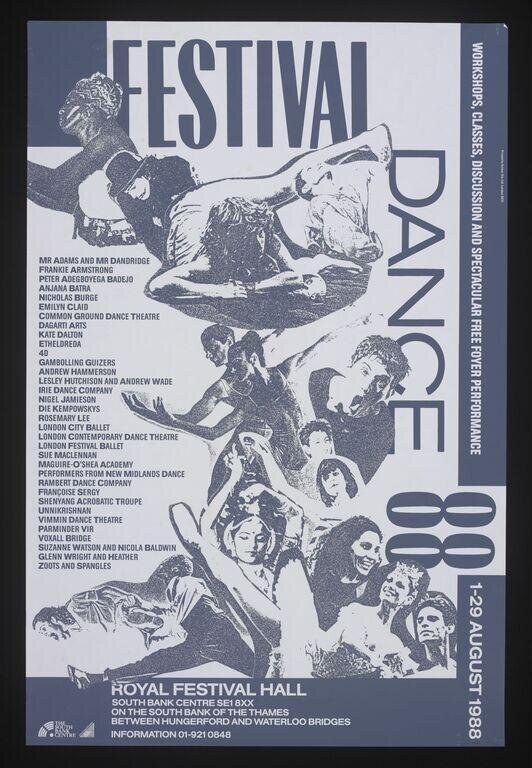
This is a festival poster for contemporary dance, printed in black and white with a photomontage composition that dominates the upper half. The design arranges multiple photographic fragments of dancers—some upside down, some at angles—creating a dynamic, disorienting visual rhythm that echoes the energy of modern dance itself. The figures are caught in various poses: a dancer reclines, another appears mid-leap or mid-fall, others are cropped or layered so their bodies fragment across the page. The typography is bold and architectural, with "DANCE" in large sans-serif letters running down the right margin and "FESTIVAL 88" angled across the center. At the bottom, practical information is laid out in smaller text: venue details (Royal Festival Hall, South Bank Centre), dates (22-31 August 1988), and a phone number. The entire composition is printed on what appears to be white or cream stock with heavy black ink, a technique suited to high-volume poster production and street display.
The dancing
The photographic fragments show dancers in contemporary positions: horizontal and diagonal lines of the body, extended limbs, asymmetrical weight distribution, and postures that suggest release-based or gravity-engaged movement rather than turned-out classical positioning. Some figures appear inverted or rotated, disorienting the viewer's sense of ground and sky—a visual metaphor for the experimental territory of contemporary dance. The layering and cropping mean no single dancer is legible as a complete figure; instead, the poster reads as a collision of bodies and energies. This fragmentation is deliberate: it suggests multiplicity, ensemble work, and the formal innovation of the avant-garde.
The dance depicted
The festival name and the photographic language point squarely to contemporary dance and the experimental choreographic practices of the 1980s. The poster was designed to promote an international survey of contemporary work—the list of participating companies and artists (visible in the smaller text) confirms this. The fragmented, disorienting composition mirrors the aesthetic values of contemporary choreography itself: anti-narrative movement, investigation of the body's full range of possibility, and a break from the ethereal, decorative body ideal of classical ballet. The inversion and cropping of the dancers' images are not technical accident but conceptual choice, reflecting how contemporary dance questioned and reimagined the dancing body.
How it was made
This is a lithographic or photolithographic poster, a technology that allowed high-quality reproduction of photographic imagery combined with bold graphic typography. The technique was standard for large-format promotional printing in the 1980s and was ideal for concert and festival marketing: durable, economical at quantity, and capable of arresting visual impact on streets and in foyer displays. The black-and-white palette and the heavy contrast between image and ground are characteristic of the period's design sensibility—a deliberate move away from color photography toward graphic abstraction and conceptual boldness. The medium shaped the work's circulation: this was meant to be seen pasted to walls, in bus shelters, and in dance venue lobbies.
About this work
This is a promotional poster for the Dance Umbrella Festival 1988, a survey of contemporary dance held at the Royal Festival Hall in London. Dance Umbrella was (and remains) a major platform for new choreography and experimental practice in the UK. The poster's photomontage language—fragmented, disorienting, spatially complex—was itself a statement about contemporary dance's formal concerns in the 1980s: the interrogation of the body, the rejection of narrative and virtuosity-display in favor of investigation, and the embrace of ensemble and collaborative work. The typography and layout mark it as a serious artistic statement, not mere announcement. It appeared at a moment when contemporary dance was consolidating its identity as a distinct practice, separate from both classical ballet and commercial entertainment.
How to look at it
Attend to the disorientation created by the inverted and rotated figures: the poster deliberately unsettles the viewer's orientation, forcing active looking rather than passive consumption. Notice how the cropping fragments the bodies—no complete figure is visible—which mirrors how contemporary dance often worked against the classical ideal of the whole, legible body. The contrast between the photographic realism of the individual fragments and the abstract, almost Constructivist overall composition creates a productive tension: the dancers are real bodies, but the design abstracts them into pure formal elements. This collision between documentary and abstraction is itself a statement about how 1980s contemporary dance thought about the body.
The period
The 1980s were a watershed decade for contemporary dance in Britain. The creation of Dance Umbrella in 1978 and its expansion into a major festival by 1988 reflected a growing institutional recognition of experimental choreography as worthy of public subsidy and cultural value. Internationally, the influence of American postmodern dance (Cunningham, Graham, release-based techniques) had reshaped British practice. The photomontage aesthetic on this poster echoes graphic design trends of the period—the influence of punk and post-punk visual culture, the adoption of conceptual art strategies into commercial design, and the use of photography as a carrier of meaning rather than mere illustration. The festival surveyed work by major figures like Pina Bausch, Karole Armitage, and British innovators; the poster's visual language announces that this is art-world dance, not entertainment-world dance.
Where it lives
This is a original promotional poster for Dance Umbrella Festival 1988, held at the Royal Festival Hall, London (22–31 August). It would have been produced in quantity for street display, venue lobbies, and arts listings. The poster is held in the V&A collection, which holds extensive holdings of British design and performance ephemera.
Dance in this work
Questions about this work
What was Dance Umbrella?
Dance Umbrella is a London-based festival and commissioning organization founded in 1978 to promote contemporary dance and experimental choreography. By 1988, when this poster was created, it had become a major platform for new work and an annual survey of international practice. It remains one of Europe's leading contemporary dance festivals.
Why are the dancers fragmented and upside down?
The photomontage composition is both a design strategy and a conceptual statement. It reflects the aesthetic values of 1980s contemporary dance—the investigation of the body's full range of possibility, the rejection of classical ballet's decorative ideal, and the embrace of abstraction and formal experiment. The disorientation mirrors how experimental choreography asks dancers to move in ways that challenge classical training.
Is this a reproduction of a painting or drawing?
No. This is a lithographic or photolithographic poster, made by combining photographic images with typography and printing them as a single design. The medium allowed high-quality reproduction suitable for large-scale street display while keeping production costs manageable for a festival of this size.
How did contemporary dance differ from ballet in 1988?
By the 1980s, contemporary dance had developed distinct aesthetics: release-based movement (weight flowing through the body rather than being lifted upward), pedestrian gesture mixed with virtuosity, ensemble and collaborative work over solo display, and abstraction over narrative. The fragmented, conceptually driven poster design announces these values to potential audiences.
More dance artwork





