49 works in this view — arrow keys or swipe to move between them.
Dance in Art
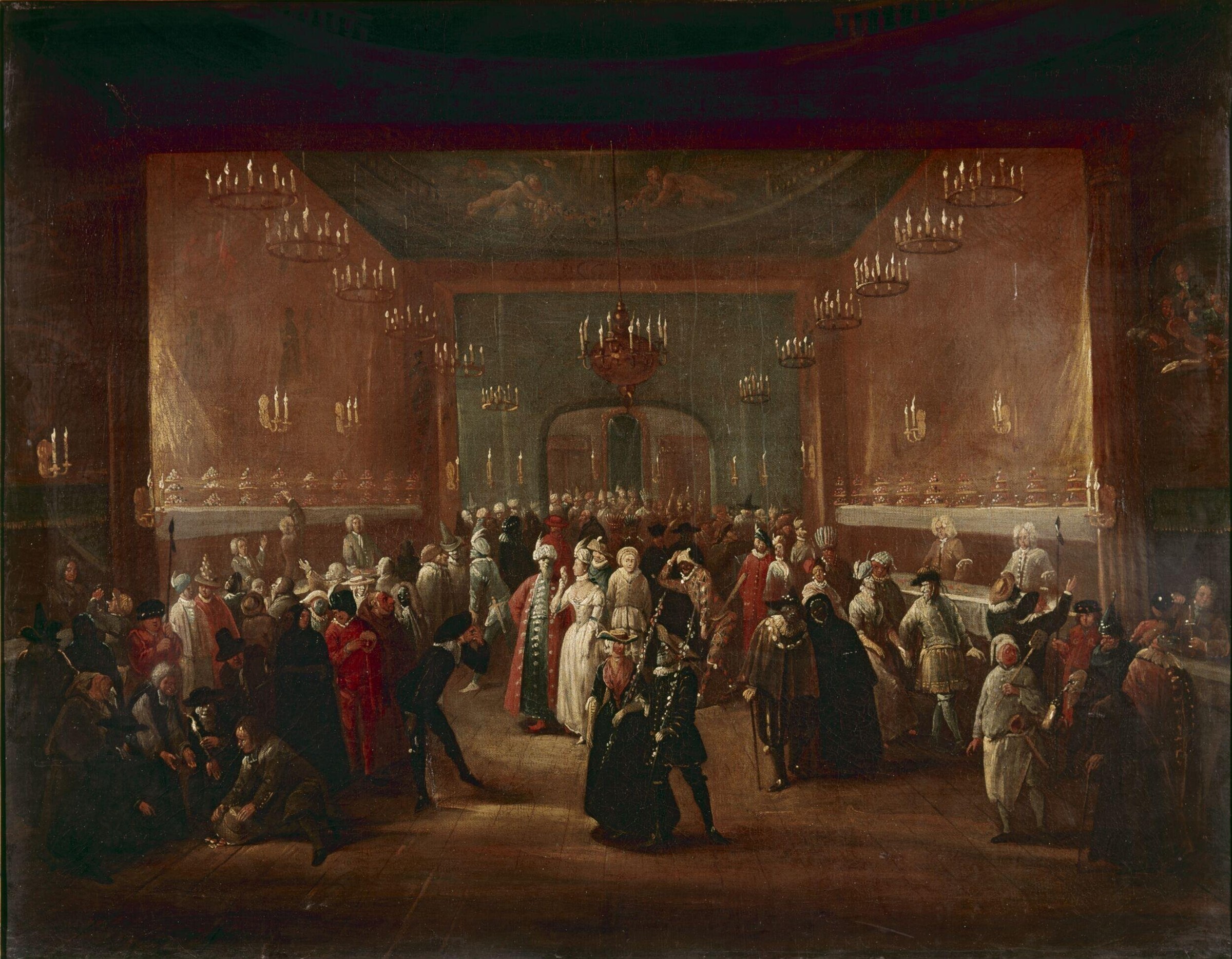
A Masquerade at the King's Theatre, Haymarket
Grisoni, Giuseppi
- Collection:
- Painting
- Source:
- Victoria and Albert Museum
- Rights:
- Rights vary by item — check the source record before reusing this image. Source record ↗
- Recorded as:
- V&A — check rights per item
This is one of the few surviving visual records of an actual masquerade assembly, offering documentary evidence of the setting, scale, and social composition of these events. For dance historians, it shows how public masked balls were staged as theatrical spectacles and how formal dancing was only one element of a larger social performance involving costume, architecture, and visual display.
What you are looking at
A grand masquerade ball in an ornate theatre, rendered in oils with warm terracotta walls and a theatrical green ceiling. Dozens of elaborately costumed figures—some in silks and jewels, others in red and cream formal dress—circulate through a vast columned hall lit by dozens of candelabras. The composition creates dramatic depth through a central archway framing a second chamber beyond. Figures are scattered throughout: some stand in conversation, others move through the space in pairs or small groups. The atmosphere is one of spectacle and social pageantry—this is a public performance as much as a private dance, with the assembled company as both participants and audience. The warm lighting casts shadows that emphasise the three-dimensional recession of the hall.
The dancing
Bodies are upright and formally arranged rather than actively dancing; most figures stand in conversational groupings or process through the space in pairs. Dress is uniform and stiff—the women in long pale silks and the men in formal coats and breeches—which constrains the torso and creates formal posture throughout. No visible holds are close or intimate; the few couples who might be dancing occupy the central floor and are distant enough that no footwork or specific frame can be discerned. The overall effect is of parade and ceremony rather than active partner dancing.
The dance depicted
This depicts a masquerade ball in a theatre setting, a fashionable 18th-century social form. The absence of visible active dancing and the formal processing of figures suggests this captures the promenade or social circulation phase of such an event rather than choreographed couple dances. The title identifies this as the King's Theatre, Haymarket—a London venue—which was indeed a site for public masquerades and fashionable assemblies. The scale, costume, and theatrical setting are consistent with the elaborate masquerade entertainments that were popular among the English aristocracy in the 1720s, though no specific named dance can be identified from the composition.
How it was made
This is an oil painting, a medium that allowed the artist to render the complex interplay of candlelight across silk, jewels, and architectural surfaces with subtle gradation of tone. The scale and finish suggest this was a commissioned record of a significant social event—likely created for a patron connected to the theatre or to the masquerade world. The theatrical framing and use of perspective are painterly techniques that emphasise the event's status as spectacle.
About this work
This painting documents a masquerade assembly at the King's Theatre, Haymarket, in London in the early 18th century. Masquerades were elaborate social and theatrical entertainments that combined costume, music, dancing, and public spectacle, and they occupied an important place in fashionable society from the 1710s through the mid-century. This work records not the dance itself but the social world in which dance took place—the formal dress, the architectural luxury, the assembled company. It is evidence of how dancing was embedded in theatre, costume, and social ritual in this period, and of the visual culture surrounding these events.
How to look at it
Observe the architecture first: the painting uses the colonnade and archway to create a sense of theatrical space—this is a stage, not a ballroom. Note the distribution of light from the candelabras and how it breaks the space into zones of gathering and movement. Look at the edges of the crowd to see figures arriving or departing; the central open floor suggests that specific moments of dancing or ceremony occur in the middle of the assembled company. The painting is a record of an event's social geography rather than a dance composition—it documents how people used the space, how costume and masquerade identity worked, and the role of light and architecture in creating the spectacle.
The artist
Giuseppe Grisoni (c.1699–1769) was an Italian painter who worked in London from the 1720s onward. He specialised in theatrical and society scenes, particularly masquerades and elaborate social events. He was closely associated with the King's Theatre, Haymarket, and created multiple paintings of masquerade assemblies and theatrical entertainments for London's fashionable patrons. His work is an important visual record of 18th-century London theatre and aristocratic social life.
The period
Masquerades were a craze in fashionable London society from the 1710s onward, particularly under the patronage of the nobility and the theatre world. They combined elements of Venetian carnival culture with English theatre and London's emerging consumer culture. The 1720s saw masquerades become more elaborate and more frequented; they were controversial—moralists condemned them as occasions for vice and social disorder—but they were also celebrated as fashionable entertainment. Dancing at masquerades was typically country dances, cotillions, or minuets, executed in the formal style of the period within the constraints of heavy costume and ornate dress. The theatrical setting was integral to their appeal; masquerades were as much about spectacle and display as about dance itself.
Where it lives
The work is held in the V&A collection. It is catalogued as a painting, though medium is not formally recorded in the archive. It represents the type of commemorative theatre and society painting that was produced for London's fashionable patrons in the mid-18th century.
Dance in this work
Questions about this work
Was this a real event or an invented scene?
The title identifies this as a masquerade at the King's Theatre, Haymarket, a real London venue that hosted fashionable assemblies in the 1720s. Grisoni painted multiple masquerade scenes, and these appear to be documentary records of actual events or composite scenes based on typical masquerade practice. Whether this depicts a specific evening or an ideal type of masquerade is not certain, but the specificity of setting and scale suggests it was connected to an actual occasion.
What dances would have been performed at a masquerade like this?
Masquerades featured country dances, cotillions, minuets, and occasionally newer French dances. Dancers would have moved in the formal style of the period, with upright posture, small steps, and ornate arm gestures. The heavy costume—silks, jewels, masks, often trailing skirts—constrained movement and favoured processional or line dances over close couple dances.
What is Grisoni trying to show us?
Grisoni is documenting the social spectacle of the masquerade: the costumes, the architecture, the assembled company, the role of light and theatre in creating an atmosphere of luxury and transgression. For his patrons, this painting would have been a record of fashionable society and a way of displaying knowledge of and access to these exclusive events.
More dance artwork





