49 works in this view — arrow keys or swipe to move between them.
Dance in Art
[Masquerade]
Baynes, Thomas Mann
- Collection:
- Paper peepshow
- Source:
- Victoria and Albert Museum
- Rights:
- Rights vary by item — check the source record before reusing this image. Source record ↗
- Recorded as:
- V&A — check rights per item
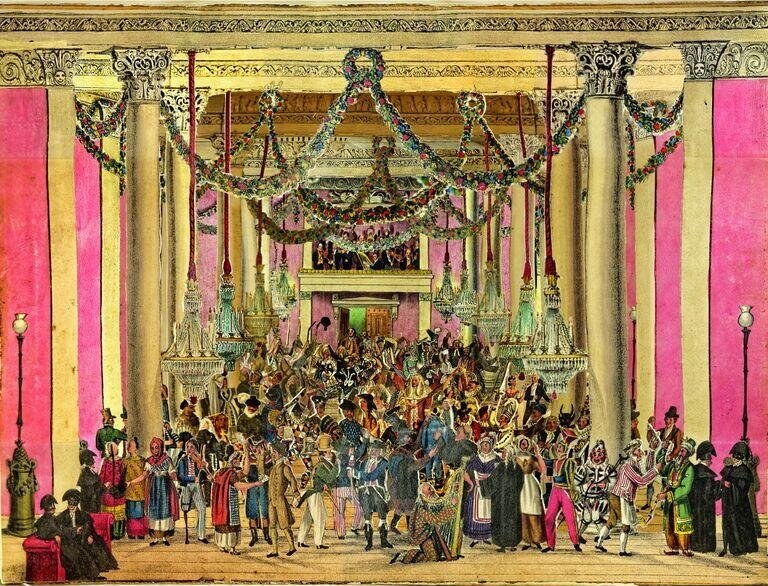
The image is a primary document of Regency-era dance in its social context: we see the bodies, the dress, the spatial arrangement, and the sheer sociability that constituted a fashionable ball. It also records how dance culture was mediated and consumed—a three-dimensional optical toy allowed people far from London ballrooms to experience a version of aristocratic entertainment. The peepshow as medium tells us as much about dance history as the scene itself.
What you are looking at
A grand masquerade ball unfolds in a palatial interior with soaring Corinthian columns and a richly decorated ceiling. The space is festooned with swags of greenery and garlands looped between the columns, creating an intimate theatrical atmosphere within the monumental architecture. Hundreds of masked and costumed figures crowd the floor, their bright silks and satins rendering a kaleidoscopic effect—reds, blues, golds, and earth tones intermingle. The figures range from the formally dressed to the elaborately fantastical: some wear domino masks and tricorne hats, others sport full fancy dress and theatrical costumes. In the foreground, couples and groups are actively dancing, their bodies turning and swaying in the space, while around them others stand, converse, promenade, or watch from the edges. The space recedes toward a raised platform or dais at the far end, where musicians or an orchestra may be positioned. The perspective is carefully constructed to draw the eye inward and upward, making the viewer feel present within the crush and energy of the event. Warm light bathes the scene, catching the texture of fabrics and creating a sense of candlelit festivity.
The dancing
Dancers move in pairs and small groups across the floor in relaxed but engaged postures. Most visible couples stand in closed or semi-closed positions, with bodies angled toward one another. Arms are generally free or lightly placed, not in the tight classical frame of later ballroom dancing. The weight distribution suggests a light, gliding quality to movement rather than sharp articulation—hips and torsos sway gently as figures progress through the space. No visible pointe work or elevated jumps; the dancers keep close to the floor. The costume—long gowns for women, breeches and stockings for men—constrains the range of motion, and the dancers accommodate this with an easy, aristocratic deportment.
The dance depicted
This depicts a masquerade ball, a social dance event rather than a performance or theatrical spectacle. The dances would have been the standard courtly and ballroom forms of the Regency era: the cotillion, quadrille, country dances, and Scotch reel, with waltzes likely present if this is post-1815. The masquerade setting allowed dancers greater liberty of costume and deportment than everyday balls; the masks and fancy dress are the event's defining feature, not the dance vocabulary itself. The image captures the social function of dance—courtship, display, sociability, and entertainment—rather than a specific technique or choreography. The sheer density of figures and the emphasis on costume over footwork confirms that this is a spectacle of social mingling and collective revelry.
How it was made
This is a paper peepshow—a three-dimensional optical toy constructed from layered sheets of paper cut and painted to create depth and theatrical perspective when viewed through a small aperture. The technique was popular from the 18th century into the 19th as a form of entertainment and travel souvenir. The hand-coloring and fine detail visible here (the individual figures, the architectural elements, the fabric textures) suggest careful draftsmanship and labor-intensive assembly. Peepshows were affordable but not cheap; they were aimed at a genteel audience curious about fashionable society and exotic or grand events. The format allowed the maker to compress a vast, crowded scene into a small object while maintaining convincing spatial recession.
About this work
This is a record of a masquerade ball—one of the most celebrated and fashionable social events of Regency England—captured in the form of a paper peepshow by Thomas Mann Baynes around 1826. Peepshows were optical toys that offered middle-class viewers a privileged glimpse into aristocratic entertainments and continental spectacles. This example documents both the dance culture of the period and the theatrical apparatus by which that culture was consumed and circulated among the public. The scene is crowded, glittering, and unmistakably about display: dancers and spectators alike are dressed for observation, and the format—a miniature stage viewed through a lens—replicates the voyeuristic pleasure of attending such an event.
How to look at it
Notice the scale: this is a miniature, yet Baynes has rendered hundreds of individual figures with distinct dress and posture. Look at the moment chosen—dancers are mid-motion, but the image is not frozen at a climactic leap or dramatic turn. Instead, the artist captures the continuous, flowing social action of the event: dancing, standing, watching, promenading. The deep perspective and the strategic placement of columns create a sense of being inside the crush. The bright coloring and the density of figures convey the sensory excitement of the masquerade—the visual richness of costume and light. Pay attention to the interplay between the fixed architecture and the mobile human figures; the ball is a social drama played out within a monumental, timeless space.
The artist
Thomas Mann Baynes was an English engraver and maker of peepshows active in the early 19th century. Peepshows were a competitive trade, and makers like Baynes produced scenes of topical interest, travel destinations, theatrical events, and fashionable society gatherings. His work would have required skill in both the engraved or lithographic production of individual sheets and the hand-coloring and assembly of the three-dimensional structure. Little biographical information survives, but the quality and detail of his output indicates he was a professional craftsman catering to an urban, educated market.
The period
The Regency era (roughly 1811–1820, but extending in cultural terms into the 1830s) was a high point of English ballroom culture. The waltz, still scandalous for its close embrace, was gaining acceptance; quadrilles, cotillions, and country dances remained staples. Masquerade balls—balls where masks and fancy dress were worn—carried connotations of transgression, liberty, and European sophistication; they were glamorous but also slightly risqué in the eyes of strict moralists. This was also the great age of the peepshow as a consumer commodity. The format was at the height of its popularity in the 1820s, catering to a growing middle class eager to consume images of luxury and fashion. Baynes's work sits at the intersection of this enthusiasm for optical entertainments and the social centrality of dance in Regency life.
Where it lives
This work is held as part of a paper peepshow collection. The catalogue identifies it as a product of a holding recorded as 'va' (likely a regional archive or private collection), though the specific provenance details are not recorded. Peepshows survive in variable condition and in scattered collections; the survival of this example intact is noteworthy.
Dance in this work
Questions about this work
What is a paper peepshow?
A peepshow is a three-dimensional optical toy made from layered sheets of painted and cut paper, assembled so that when you look through a small aperture or lens, you see a scene in convincing perspective. The format was popular from the 18th century through the 19th as an affordable form of entertainment and travel souvenir. They were often hand-colored and depicted fashionable events, exotic locations, or theatrical scenes.
What dances are being performed here?
The specific dances are not identifiable from the image, but the setting and period suggest the standard ballroom forms of Regency England: cotillions, quadrilles, country dances, and possibly waltzes. The emphasis in peepshows like this one was on the social event—the crowd, the costume, the atmosphere—rather than on capturing the technical detail of any particular dance.
Why would people want to look at a peepshow of a masquerade ball?
Peepshows offered a form of entertainment and education to people who might never attend such an event themselves. Masquerade balls were glamorous, fashionable, and carried an air of excitement and transgression. A peepshow allowed viewers to experience a version of that spectacle—to see how the wealthy dressed, danced, and socialized—in miniature and in the privacy of their own homes or a fairground.
What does this tell us about dance in the 1820s?
It shows that dance was fundamentally a social activity embedded in large, crowded events where fashion, courtship, and display were as important as the movement itself. The image captures not choreography or technique but the cultural meaning of the ball: an occasion for seeing and being seen, for mingling across social lines (even if the masquerade's anonymity was itself an illusion), and for collective participation in fashionable leisure.
More dance artwork





