49 works in this view — arrow keys or swipe to move between them.
Dance in Art
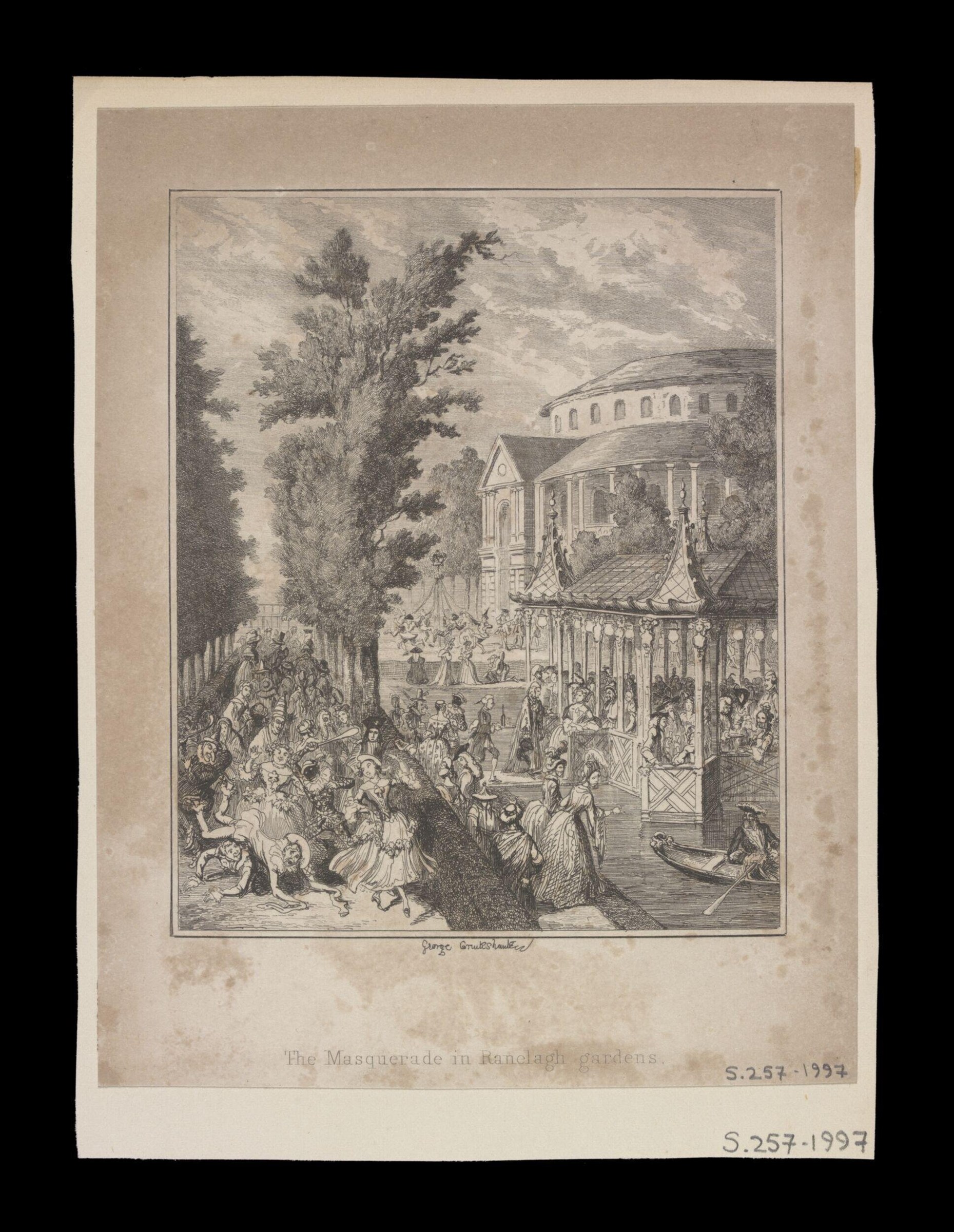
The Masquerade in Ranelagh gardens
Cruikshank, George
- Collection:
- Source:
- Victoria and Albert Museum
- Rights:
- Rights vary by item — check the source record before reusing this image. Source record ↗
- Recorded as:
- V&A — check rights per item
Ranelagh Gardens were to 18th-century London what nightclubs are to modern cities: the premier public venue for music, dancing, and social mixing across class lines (albeit still among the paying public). This image preserves a moment of that culture with unprecedented detail, showing actual bodies in actual movement, costumes, and social interaction—invaluable evidence for historians of dance practice, fashion, and public leisure. The masquerade setting also illuminates how dance functioned as a form of social transgression and freedom, not mere etiquette.
What you are looking at
A crowded masquerade in the gardens of Ranelagh, a famous pleasure ground on the outskirts of London, captured in this engraving with remarkable detail and social observation. The composition is anchored by a classical pavilion with a domed roof and Corinthian columns, where musicians perform on a platform while masked revellers throng the grounds below. The foreground swarms with dozens of figures in 18th-century dress—women in elaborate gowns and high heels, men in coats and breeches, many wearing masks and dominoes (hooded cloaks). The scene radiates outward: a long pergola or colonnade runs along one side, densely packed with spectators; a water-feature or canal runs at the right edge with a small boat visible; tall poplar or cypress trees frame the left side, their verticality contrasting with the human bustle below. The light is dappled and atmospheric, suggesting late afternoon or early evening, with clouds breaking overhead. The whole scene crackles with movement and social interaction—figures pause, converse, gesture animatedly, promenade. This is not a formal dance floor but a garden of pleasure where dancing, flirtation, and spectacle coexist.
The dancing
The figures are predominantly upright and social rather than formally postured. Most are in the genteel postures of 18th-century promenade—women with arms at their sides or gesturing conversationally, men bowing or leaning in to speak. A few pairs appear to be dancing or on the verge of it, but the hold and frame are loose and informal, consistent with country dancing or the social minuet rather than any rigid ballroom technique. The costumes—satins, silks, high heels for women; coats and waistcoats for men—indicate this is fashionable society. The masks and dominoes are essential: they permit the transgression of normal social hierarchy, allowing servants and nobles, respectable matrons and adventurers, to mix and flirt without immediate recognition.
The dance depicted
This depicts the social dancing and promenade culture of the mid-to-late 18th-century pleasure garden, specifically Ranelagh (which operated 1742–1803 in Chelsea, London). The dances here would have been country dances, cotillions, and minuets, typically led by musicians and learned by all participants—hence no specialist dancers but fashionable amateurs. The masquerade element is crucial: masked balls were occasions for social licence and flirtation, where the usual rules of decorum were suspended. The image captures the *social* dance, not the *theatrical* dance—this is where ordinary genteel people danced for pleasure, exercise, and courtship, not performance. The pavilion structure and open-air setting were typical of London pleasure gardens that offered music, dancing, refreshments, and spectacle as commercial entertainment.
How it was made
This is an engraving, executed with fine parallel lines (hatching) and cross-hatching to create tone and shadow—a technique that allows tremendous detail and nuance. The artist has signed the plate at lower left. The medium's precision and reproducibility made such engravings ideal for circulation among the literate and leisured classes as prints, souvenirs of fashionable amusement, or documentary records of social life. Engraving was also the standard medium for topographical and genre prints in 18th-century England, and this work sits squarely in that tradition: it documents a real place and real practice, not invented fantasy. The technique's requirement for control and planning shows in the careful composition and the orchestration of dozens of figures without chaos.
About this work
This is a finely detailed engraving of Ranelagh Gardens during a masquerade, one of the most celebrated pleasure gardens of 18th-century London. It records the culture of social dancing, promenade, and spectacle that characterized fashionable leisure in the period. The work is a primary document of how dance functioned in public space—not as theatrical performance by professionals, but as a mixed social practice where music, movement, courtship, and carnival transgression coexisted under open sky. As a medium, engraving allowed such images to be widely circulated and preserved, making them essential to understanding the visual and social history of the period. For a dance historian, the work reveals how ordinary genteel people moved, dressed, and behaved in social dance, and how pleasure gardens organized and commodified that experience.
How to look at it
The viewer should trace the eye across the composition from the pavilion (the anchor of authority and spectacle) outward to the garden, observing how the artist has arranged figures to suggest continuous movement and interaction across the space. Notice the progression from the musicians and their attendants on the platform, through the promenading couples, to the clustered spectators along the colonnade, and finally to the solitary figures at the water's edge. The masquerade masks and dominoes are everywhere, but rendered individually—each costume and pose is distinct, suggesting that the artist worked from observation or recollection. The dances themselves are understated: this is not a scene of vigorous movement but of poised, social grace. The light and atmosphere, created through fine hatching, evoke the pleasurable haze and anonymity of the evening masquerade—a moment when respectable society permitted itself to behave with unusual freedom.
The artist
George Cruikshank (1792–1878) was one of the most prolific and celebrated caricaturists and engravers of 19th-century England. He excelled at social and political satire, using the engraving medium to capture the absurdities, pleasures, and follies of English life with wit and technical mastery. However, the catalogue records the artist as Cruikshank without specifying which member of the family; the handwriting on the plate appears to read "Cruikshank," but the style and subject matter—a topographical pleasure-garden scene—might also suggest his father John Cruikshank (1756–1811) or an earlier printmaker in the genre. The attribution should be verified.
The period
Ranelagh Gardens opened in 1742 and quickly became a fashionable resort for London society, rivalling the older Vauxhall Gardens. The mid-to-late 18th century saw a boom in commercial pleasure gardens offering music, dancing, refreshments, and spectacle to a paying public. These gardens were sites of relative social freedom: mask and domino permitted anonymity, class boundaries loosened, and heterogeneous publics mingled. This engraving likely dates to the later 18th century, during the gardens' peak popularity, though the catalogue record does not confirm the date. The aesthetic and social values evident here—the celebration of polite leisure, the picturesque arrangement of architecture and nature, the spectacle of fashionable dress and movement—are characteristic of the Georgian period and its culture of refined amusement.
Where it lives
This print is held in the Victoria and Albert Museum's collection (accession S.257.1994). It is catalogued as a print, consistent with the engraving medium evident from the image. The museum's catalogue record is sparse and does not record the date, artist attribution, or medium with full certainty.
Dance in this work
Questions about this work
Was Ranelagh a real place?
Yes. Ranelagh Gardens occupied a site in Chelsea, London, from 1742 to 1803. It was one of the most fashionable public pleasure gardens of the 18th century, offering music, dancing, fireworks, and refreshments to paying visitors. The rotunda (the building visible in this print) was its most famous feature. Ranelagh was immortalized in literature and visual art as the epitome of fashionable leisure.
What dances would people have danced at Ranelagh?
Country dances, cotillions, and minuets were the standard dances of the period. These were not specialist dances but social dances that any genteel person was expected to know. The music would have been provided by a small band of musicians, and a dance master or experienced dancer would often call the figures. Dancing at Ranelagh was a social practice, not a performance.
Why were masks and dominoes worn?
Masquerades were occasions for social licence and anonymity. The mask and hooded cloak permitted people to move through society without immediate recognition, suspending the usual rules of decorum and hierarchy. This allowed for flirtation, conversation across class lines, and behaviour that would have been improper in daytime or unmasked settings. Masquerades were thrilling precisely because they permitted transgression.
Is this an accurate historical record or romantic fantasy?
The engraving is detailed and observant enough to be a reliable document of costume, setting, and social practice, though it is also composed for aesthetic effect and may compress or idealize certain elements. Engravings of pleasure gardens were a recognized genre in 18th-century popular prints and were valued as records of fashionable life. This work sits in that tradition and should be read as a primary source for understanding how people dressed, moved, and socialized in public spaces.
More dance artwork





