49 works in this view — arrow keys or swipe to move between them.
Dance in Art
Fancy dress costume design
Jules Helleu
- Collection:
- Fancy dress costume design
- Source:
- Victoria and Albert Museum
- Rights:
- Rights vary by item — check the source record before reusing this image. Source record ↗
- Recorded as:
- V&A — check rights per item
The work exemplifies the inseparability of costume from dance practice in the ancien régime. The exaggerated proportions of the train, the constructed posture, and the elevated headdress all determined how a wearer would move, what steps were possible, and how the body would be perceived in motion. For historians of dance and dress, this sketch is evidence of how the material conditions of courtly and theatrical fashion shaped the physicality and visual language of eighteenth-century dance.
What you are looking at
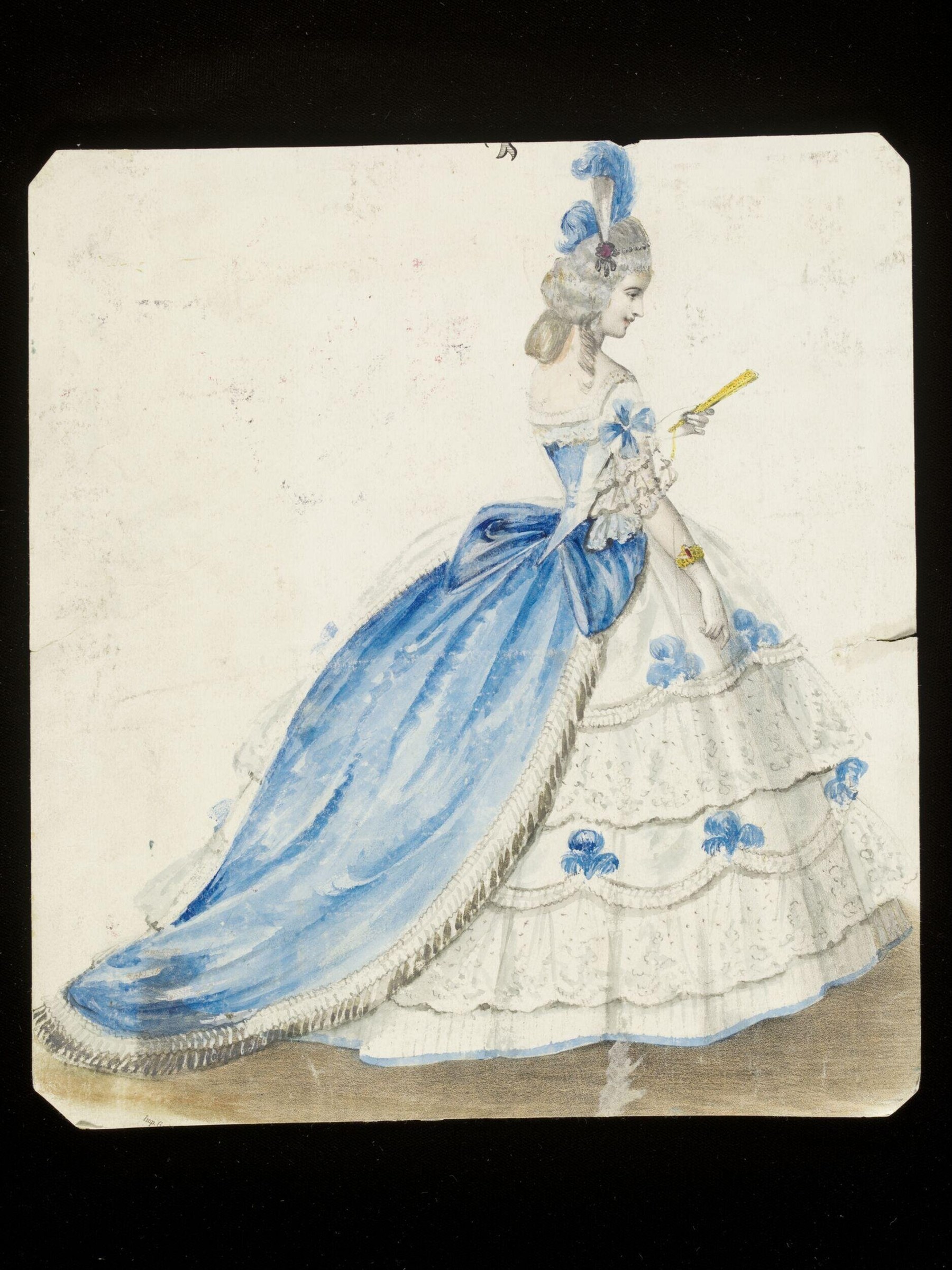
A young woman in elaborate eighteenth-century court dress is shown in three-quarter profile, posed as if mid-movement. She wears a white silk gown with a deeply scooped neckline and short sleeves, decorated with blue ribbon bows down the bodice. The skirt is voluminous, constructed in tiers of white silk with decorative scalloped edges and adorned with sprays of small blue flowers. Most striking is the long blue satin train or overdress that sweeps dramatically behind and to the left, lined with pale silk and edged in braid or fringe. Her pale hair is styled high and crowned with an elaborate headdress of blue ostrich plumes. She holds a small fan or similar ornament in her right hand, extended as if gesturing. The figure is set against a plain cream background, with a warm tan-brown strip suggesting a ground line at the bottom of the composition. The watercolor or gouache medium creates soft gradations of color, particularly in the blue fabrics and the delicate shading of the skin.
The dancing
The single figure stands in an elegant contrapposto, her weight resting on one leg while the other is slightly advanced, the kind of posed stance that suggests courtly bearing rather than active dancing. Her right arm extends outward at about shoulder height, the hand held gracefully. Her spine curves slightly, and her gaze is directed away to the right in profile. The posture is one of display and ceremony—the body arranged to show the dress rather than to demonstrate movement or footwork. There is no indication of contact with a partner or of weight commitment to actual steps.
The dance depicted
This appears to be a design for theatrical or carnival costume rather than a representation of an actual dance. The dress and headdress are consistent with eighteenth-century French or Austrian court fashion, suggesting either a ball costume or a character costume for a masquerade or theatrical production. The exaggerated scale of the train and the decorative elaboration suggest a woman of high rank or a theatrical character meant to evoke nobility. While the poised stance and extended gesture might reference courtly dances such as the minuet or quadrille—dances that emphasized elegant bearing and ceremonial positioning—the image does not depict a specific dance style or technique. It is a fashion study more than a dance document.
How it was made
The work is executed in watercolor and gouache (or possibly ink and wash) on paper, a technique that allowed for rapid, nuanced rendering of fabric textures and subtle color relationships. The medium was ideal for costume design work, as it permitted both detailed rendering of embellishment and soft tonal work that would help a maker or performer visualize the drape and movement of silk. The technique was standard for theater and costume design documentation in the eighteenth and nineteenth centuries, and suggests this was a working design, possibly for a theater wardrobe or for a prestigious commission.
About this work
This is a costume design study depicting a woman in elaborate eighteenth-century court or theatrical dress. The figure is posed in a graceful, ceremonial stance suited to display of rank and dress rather than the execution of a specific dance step. Although the work is titled as a 'fancy dress costume design,' it belongs in a dance archive because costume and dress are fundamental to how eighteenth-century courtly and theatrical dances were performed and understood: the silhouette, weight distribution, and gestural possibilities of a garment shaped what a dancer could do. The image documents not just a costume but the ideals of bodily presentation and movement that the dress embodied.
How to look at it
Attend to the posture: the figure is not caught in the middle of a step, but posed for display, a moment of stillness and presentation. Note how the extended arm and turned head create a spiral or contrapposto line through the body—a pose that would have been taught to both dancers and society women of the period as an emblem of grace and rank. Observe the construction of the dress itself: the multiple layers, the precise placement of ornaments, the drama of the train. In eighteenth-century dance, especially the minuet, such elaborate dress was not incidental; the skirt's width, weight, and texture determined the dancer's stride length, posture, and the visible arc of the lower body. The artist has chosen to show the dress as it would appear in a moment of formal presentation, which is itself a kind of dance.
The artist
Jules Helleu (1821–1884) was a French painter and decorative artist known for fashion illustrations, theatrical designs, and society portraiture. He worked in the mid-nineteenth century and was prolific in documenting the dress and social life of the French upper classes and theatrical world. His watercolor studies of costume were widely circulated and respected for their precision and elegance.
The period
The costume depicted is designed in the style of eighteenth-century court dress, but the work was created in 1860, during the Second Empire in France. This was a period of intense historical revivalism and theatrical fancy dress. Ball costumes and theatrical designs frequently drew on earlier styles—particularly the elegance of the ancien régime—as a means of invoking courtliness and distinction. The mid-nineteenth-century fascination with eighteenth-century aesthetics was also connected to Romantic-era nostalgia for an imagined pre-revolutionary aristocratic culture. Such designs were made for both theatrical productions and for the masquerade balls and costume galas that were fashionable among European high society.
Where it lives
The work is part of a collection of theatrical and costume design drawings, indicated by the holding as 'Fancy dress costume design.' The source is noted as 'va,' which likely refers to the Victoria and Albert Museum in London, a major repository of costume design studies and fashion history materials.
Dance in this work
Questions about this work
Is this a picture of an actual dance, or a design for a costume?
It is a costume design study, not a depiction of a dance in progress. The figure is posed for display rather than caught in motion. However, in eighteenth-century culture, the distinction was not sharp: the way a person stood and moved in such a dress was itself understood as a kind of graceful, coded behavior closely related to courtly dances like the minuet. Costume and dance were inseparable.
Why are the proportions of the dress so exaggerated?
The enormous width of the skirt and the length of the train were typical of formal eighteenth-century court dress and theatrical costume. For a masquerade or ball costume in 1860, such exaggeration would have been even more pronounced as a deliberate evocation of ancien régime splendor. The silhouette was part of the costume's meaning—it signaled rank, occasion, and historical reference.
What would a wearer actually do in this dress?
Movement would be constrained to slow, deliberate steps. The width of the skirt and the long train meant the wearer could only move forward or sideways in controlled, measured ways. The posture enforces an upright carriage. Such constraints made the wearer move with the gravity and ceremony of a courtly dance, even in stillness.
More dance artwork





