49 works in this view — arrow keys or swipe to move between them.
Dance in Art
Dawn
Léon Sault
- Collection:
- Fancy dress costume design
- Source:
- Victoria and Albert Museum
- Rights:
- Rights vary by item — check the source record before reusing this image. Source record ↗
- Recorded as:
- V&A — check rights per item
This drawing preserves the visual language of mid-Victorian theatrical spectacle and fancy dress, contexts in which professional and amateur dancers regularly performed. The radical silhouette and construction—particularly the pleated radiating bodice and layered skirt—reveals period constraints on movement and the primacy of visual display over kinetic range. For historians of costume, theatrical production, and the material culture of performance, the work documents what was worn, how it was constructed, and the aesthetic priorities of its moment.
What you are looking at
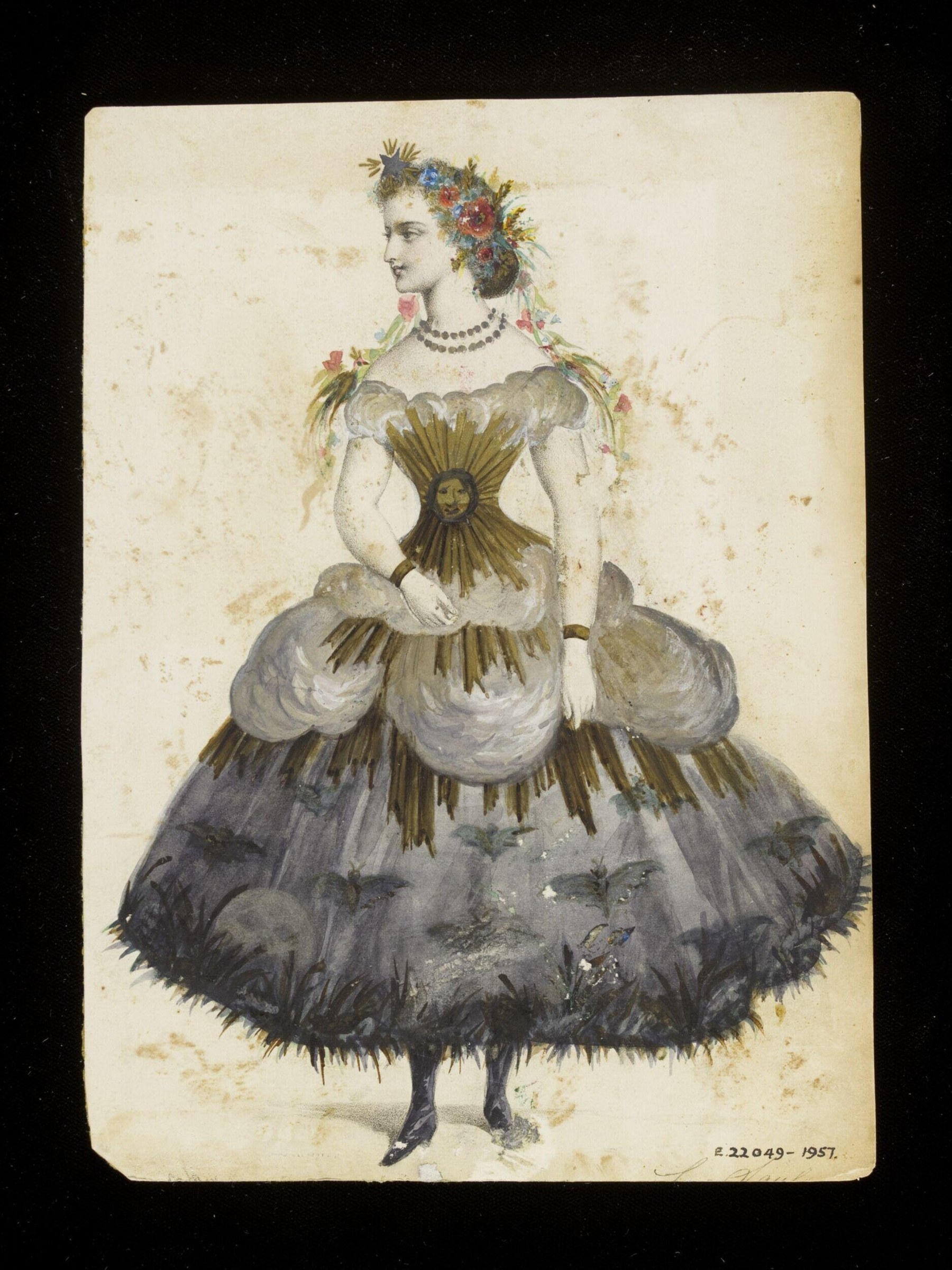
A single female figure stands in profile against a cream background, posed as if in mid-performance or formal presentation. She wears an elaborate ball gown whose skirt dominates the composition: the upper portion is constructed from large radiating pleats in olive and gold tones, creating a shell or fan effect across the bodice and hips, while the lower skirt billows outward in graduated layers of pale grey and white fabric with black feathering or fur trim at the hem. Her hair is crowned with a elaborate arrangement of flowers—roses, cornflowers, and other blooms in red, blue, and gold—with additional floral garlands draped across her shoulders. She wears a pearl necklace and carries herself with the formal bearing of theatrical or ballroom display. The figure's stance suggests statuary or pageant rather than active dance movement.
The dancing
The single figure is drawn in strict profile, standing upright with minimal weight shift or bodily articulation. Her arms hang naturally at her sides, and her posture is frontal and presentational rather than dynamic. There is no suggestion of active movement, partnering, or the bent knees and weight distribution typical of performed dance. The figure appears designed to display the costume rather than demonstrate technique or motion.
The dance depicted
This is a costume design, not a record of dance in motion. The work functions as a fancy-dress or theatrical garment study: the title 'Dawn' and the elaborate floral crown suggest allegorical or mythological character design, possibly for a masquerade, pantomime, or theatrical spectacle popular in mid-nineteenth-century European entertainment. The figure is posed as a model would be to display the garment's construction and effect. While such costumes were worn in dance contexts—particularly in romantic ballet, court spectacle, or carnival entertainment—the image itself documents the dress object rather than the dancing body or technique.
How it was made
This is a hand-colored fashion or costume design drawing, likely lithographed or chromolithographed from an original sketch. The technique employs watercolor or gouache over printed outlines, evident in the fluid application of color and the slightly translucent quality of the washes, particularly in the grey and white fabrics and the floral details. The cream paper and hand-applied color suggest a luxury object designed for circulation among professionals—theatres, costumers, or wealthy patrons—rather than mass publication. The delicate line work and precise botanical rendering of the flowers indicate a skilled designer with training in both fashion and botanical illustration.
About this work
This is a mid-nineteenth-century fancy-dress or theatrical costume design attributed to Léon Sault, titled 'Dawn.' The work documents a single elaborate ball gown conceived as an allegorical character costume, likely for theatrical or masquerade performance. The figure is presented as a display object rather than a dancing body: standing in profile in formal pose, the model serves to showcase the garment's radical construction—a pleated and radiating bodice flowing into a voluminous skirt trimmed with feathering—and its ornamental detail, particularly the floral crown and garland. The work belongs to the tradition of theatrical and festive costume design in the 1860s, when such spectacles blended dance, pantomime, and visual display.
How to look at it
Attend to the radical construction of the skirt: the sharp radiating pleats that spring from the bodice like a sunburst or fan. This geometric severity contrasts with the flowing, draped lower layers and the feathering, creating visual dynamism even in a static pose. Notice how the pleats would catch and move with any bodily motion—how they would billow, settle, and ripple. The floral crown and garlands are botanically precise rather than purely decorative; together with the title 'Dawn,' they signal an allegorical or mythological character. The profile pose was standard for fashion plates and costume drawings of the period, allowing a clear reading of the garment's silhouette and detail.
The artist
Léon Sault was a Parisian costume and fashion designer active in the mid-nineteenth century, working for theatrical productions, opera, and high society. Little is recorded of his biography, but his work exemplifies the specialist practice of theatrical costume design as a distinct discipline, separate from both fashion illustration and stage direction. The precision and botanical detail in his floral rendering suggests training in both practical tailoring and fine art.
The period
The 1860s saw an explosion of theatrical fancy-dress spectacle in Europe, particularly in Paris. Romantic ballet had peaked a decade earlier, but its aesthetic—ethereal, otherworldly, allegorical—persisted in carnival, masquerade, and stage entertainment aimed at wealthy audiences. The silhouette here—the extreme skirt, the corseted waist, the emphasis on ornament—reflects the mid-Victorian fashion of the period. Simultaneously, lithography and chromolithography made costume designs increasingly visible to theatre professionals and were traded, collected, and circulated as reference objects.
Where it lives
The work is held as part of a collection of fancy-dress costume designs. The accession number suggests institutional acquisition; the source code indicates it comes from the Victoria and Albert Museum collection or a similar archive of applied design.
Dance in this work
Questions about this work
Is this a painting or a print?
This is a hand-colored lithograph or chromolithograph—a printed design that has been finished by hand with watercolor or gouache. The technique was standard for theatrical costume designs in the nineteenth century, allowing for precise line work and subtle color gradation while remaining relatively economical to produce and distribute.
Was this costume actually worn?
Almost certainly. Costume designs in this format were working documents created for theatre wardrobe departments or private fancy-dress occasions. The precision of the construction details and the presence of a historical record suggest this design was realized as an actual garment, though no surviving example has been documented.
What does the title 'Dawn' refer to?
Most likely an allegorical or mythological character—Aurora (goddess of dawn) or a personified embodiment of morning. The floral crown, garlands, and the radiant pleating all support this interpretation, suggesting a theatrical or pantomimic role rather than a named character from a specific narrative.
Could someone dance in this dress?
With difficulty. The extreme width and weight of the skirt, combined with the tight corseting implied by the silhouette, would severely restrict leg movement and weight shifts necessary for anything beyond processional, statuary, or heavily supported choreography. The costume prioritizes visual spectacle over kinetic range.
More dance artwork





