49 works in this view — arrow keys or swipe to move between them.
Dance in Art
H Beard Print Collection
Hogarth, William
- Collection:
- Source:
- Victoria and Albert Museum
- Rights:
- Rights vary by item — check the source record before reusing this image. Source record ↗
- Recorded as:
- V&A — check rights per item
The engraving documents the social context and visual culture of early eighteenth-century ballroom assembly and masquerade—crucial to understanding how dance was experienced, observed, and valued in this period. It shows that masquerades were architectural and theatrical spectacles as much as occasions for dancing, revealing how dance was embedded in larger social performances of fashion, wit, and display. Hogarth's satirical eye and mass-produced format mean this image shaped and recorded public understanding of dancing and social assembly for a broad audience.
What you are looking at
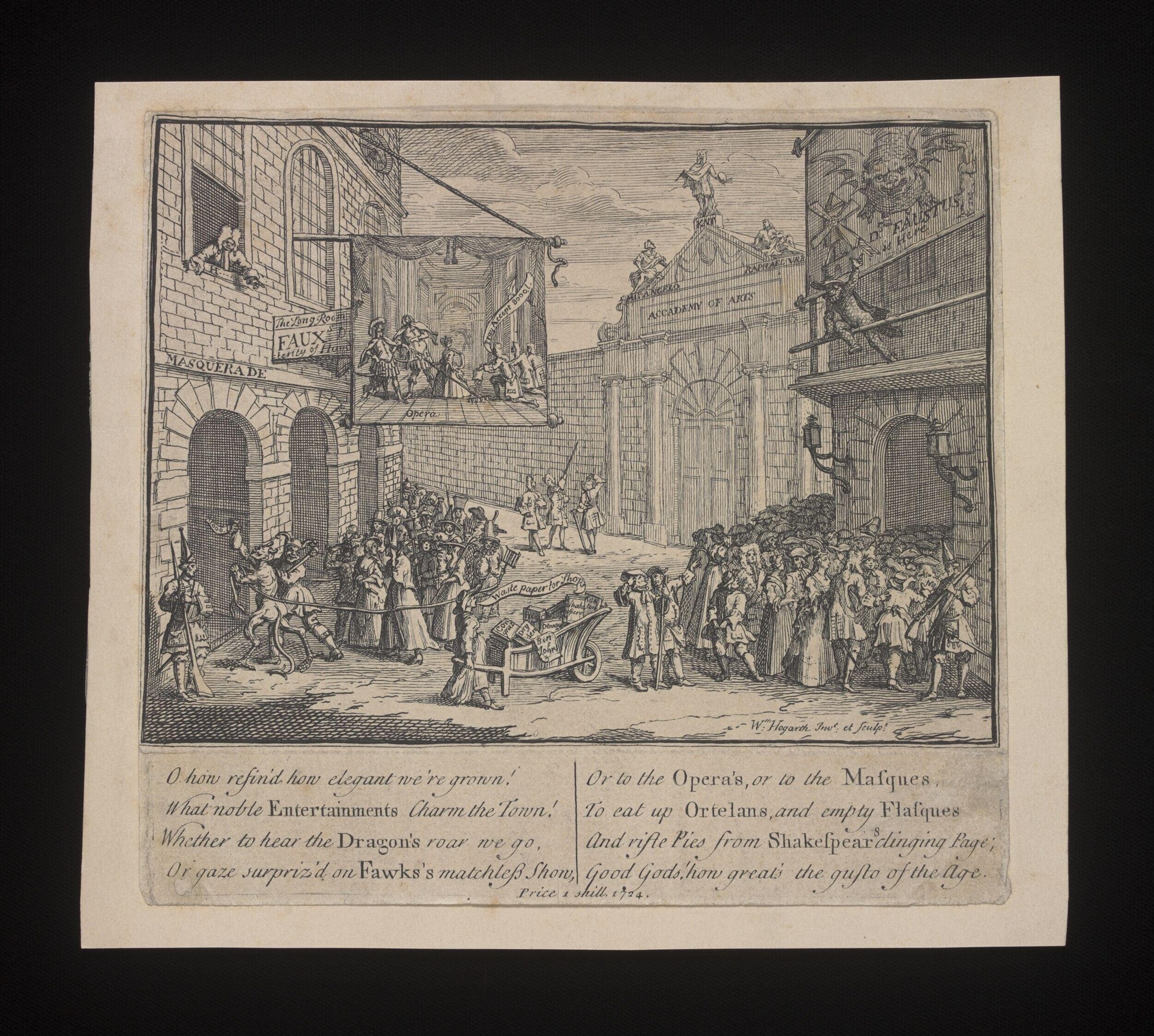
An engraved cityscape depicts a crowded public square in early eighteenth-century London, with architecture including arched gates, a masquerade house (marked "MASQUERADE" on the left), and ornamental buildings topped with statuary. The square teems with figures in fashionable dress: women in wide skirts and men in coats and wigs, many moving through the space in animated conversation and social interaction. In the center foreground, a wheeled vehicle or prop—possibly a theatrical set piece—sits surrounded by crowds. The composition uses depth and perspective to show multiple layers of activity: figures emerge from arched doorways, cluster in conversation, and move across the plaza in what appears to be a lively public entertainment or carnival scene. The engraving's hatching technique creates shadow and atmosphere, with people distributed across the space in a bustling, almost processional arrangement.
The dancing
The figures are dressed in formal early eighteenth-century costume: women wear hooped skirts, tight bodices, and headdresses; men wear knee breeches, coats with skirts, and wigs. Most stand or walk upright in social groupings rather than in formal partnered positions. The bodies are oriented toward each other in conversation and social exchange; hands gesture expressively but do not show the closed holds or extended arm lines of choreographed dance. The composition suggests observation of social movement and promenade rather than structured partnered dancing or individual technique.
The dance depicted
This engraving documents the social and theatrical culture of a masquerade assembly or carnival entertainment rather than a specific dance form. Masquerades were fashionable social events in early eighteenth-century London where guests in costume gathered to dance, converse, and move through decorated public spaces. The image shows the promenade and mingling typical of such events rather than the performance of a particular dance style. The verse beneath (referencing opera, Fawkes's matchless show, and theatrical pleasures) suggests this depicts a specific London entertainment venue, likely Hogarth's commentary on fashionable society's love of public amusement and spectacle.
How it was made
This is an engraving, as identified by the artist's signature "W. Hogarth, Invt. & Fecit" at lower right—a technique that allowed wide circulation and commenting on contemporary London life. The fine linear hatching creates spatial depth and surface texture; the clarity of detail, from architecture to costume, suggests careful observation of social types and settings. As an engraving rather than a painting, it was reproducible and affordable, making it a vehicle for Hogarth's satirical social commentary aimed at a broad audience of urban viewers familiar with London's public entertainments.
About this work
This engraving by William Hogarth documents the social world of early eighteenth-century London masquerades—public entertainments where fashionable society gathered in costume to dance, converse, and see theatrical spectacles. Rather than depicting a specific choreographed dance, it shows the social movement, promenade, and mingling that characterized such assemblies, with figures in formal dress moving through an ornate urban setting. The work combines architectural precision, social satire, and vivid observation of contemporary manners, using the density and variety of figures to comment on the fashionable world's appetite for novelty and public display. As a widely circulated engraving, it served as a record of how social dancing and assembly culture functioned in Georgian London, capturing the moment when dancing was becoming an increasingly public and commercialized entertainment.
How to look at it
Observe how Hogarth distributes figures across the entire composition without centering a focal couple or performance moment—the interest lies in the aggregate of social movement rather than in any single dance or gesture. Notice the elaborate costume and architectural detail, which convey the idea that masquerades were as much about spectacular display and fashionable dress as about dancing itself. The engraving's dense, parallel-line technique creates an impression of bustling activity and social mixing; attend to the layers of space and the variety of poses and groupings, which convey the event's social rather than formally choreographic character.
The artist
William Hogarth (1697–1764) was an English painter and printmaker celebrated for his satirical engravings of contemporary London life. Working in the early eighteenth century, he developed a distinctive narrative style that used dense, observed detail and moral or social commentary to critique fashionable society, vice, and folly. His engravings—cheaper and more widely circulated than paintings—made him one of the most influential visual chroniclers of Georgian England. Though known for moral narratives like A Rake's Progress and Marriage A-la-Mode, he also recorded contemporary entertainments, fashions, and social spaces, using formal precision and wit to expose both the pleasures and absurdities of urban society.
The period
In the 1720s and 1730s, masquerades and public assemblies were fashionable new entertainments in London, offering urban society a commercial venue for dancing, socializing, and costume play. These events, often held in specially decorated assembly rooms, represented an emerging culture of public, commercialized leisure and helped establish dance as a visible, fashionable pursuit. Simultaneously, the minuet was becoming formalized as the dominant court and ballroom dance of the period, though social dancing remained more varied and improvisational than later codified ballroom forms. Hogarth's engagement with these subjects reflects his interest in documenting how contemporary social life was organized and performed, particularly the role of public spaces and commercial entertainments in shaping modern urban culture.
Where it lives
This work is part of the H Beard Print Collection, held as a print (medium not further specified in the catalogue record but identifiable as an engraving from Hogarth's hand and signature). The collection appears to focus on satirical and social commentary engravings of the Georgian period.
Dance in this work
Questions about this work
Is this a record of a specific dance being performed?
No. This engraving documents the social and architectural world of a masquerade assembly—a fashionable public entertainment—rather than a particular choreographed dance. It shows the promenade, social interaction, and mingling typical of such events, with figures in costume moving and conversing rather than executing a formal dance style. The image is valuable as evidence of how social dancing was practiced, observed, and valued in early Georgian London.
Who is the artist and why would he depict a masquerade?
William Hogarth (1697–1764), one of England's most celebrated satirical printmakers, frequently observed and critiqued fashionable London society. Masquerades were novel, commercially successful entertainments that attracted both the wealthy and the curious; they embodied the period's fascination with costume, display, and public amusement. Hogarth's satirical interest in social behavior, fashion, and the follies of contemporary life made masquerades ideal subjects for his commentary.
What can this tell us about dance in the 1720s?
The engraving shows that public dancing in this period was increasingly commercialized and embedded in larger social spectacles. It suggests that social dance involved promenade, conversation, and costume as much as formal partnered movement. The image also demonstrates that dance was a public, observable, and fashionable activity worthy of artistic and satirical attention—evidence of dance's growing cultural visibility and commercial value in early eighteenth-century urban society.
More dance artwork





