49 works in this view — arrow keys or swipe to move between them.
Dance in Art
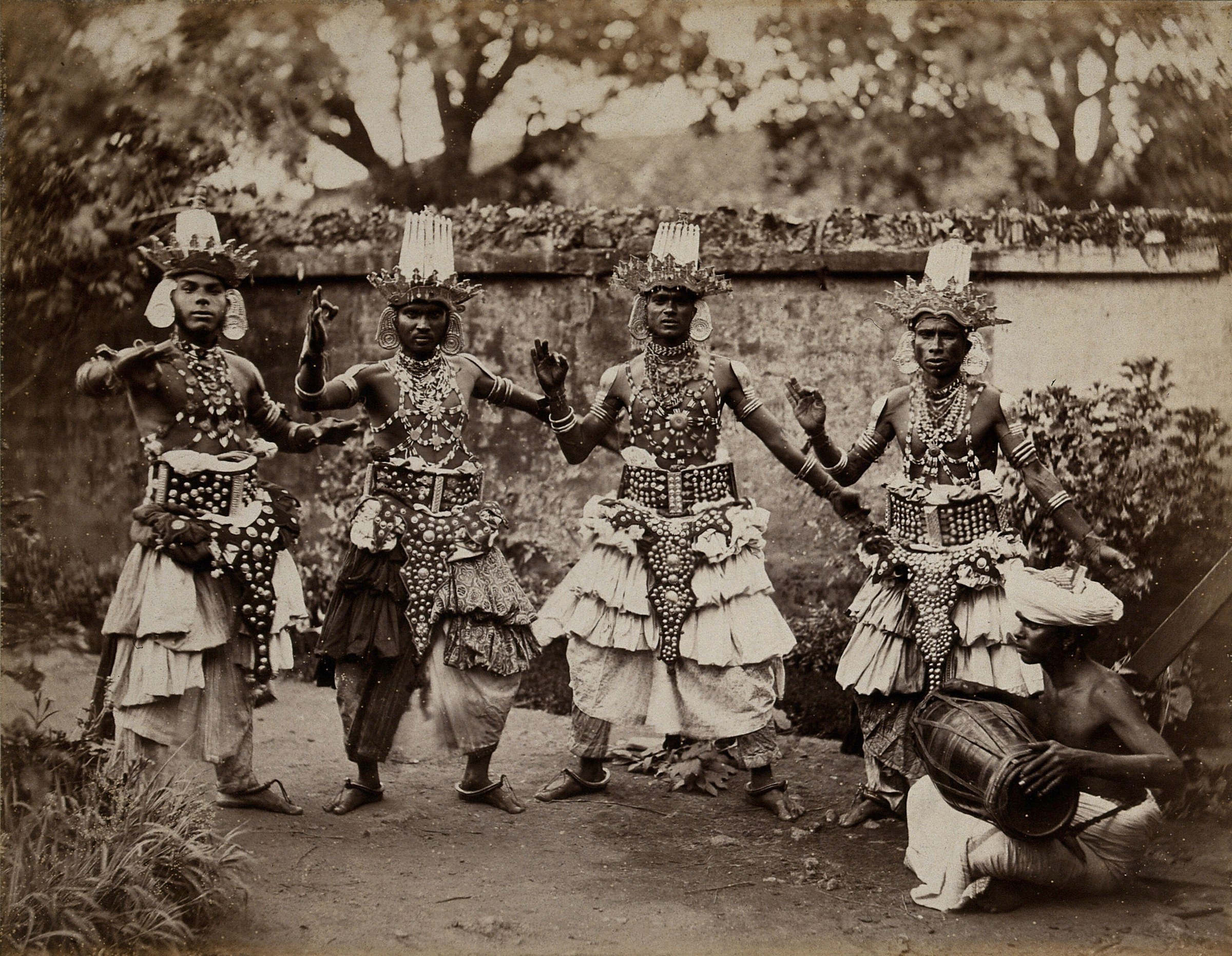
Sri Lanka: traditional 'devil dancers' in costume. Photograph, ca. 1860.
Unknown artist
- Source:
- Wellcome Collection
- Rights:
- Public domain — free to use, share and adapt.
- Recorded as:
- Public Domain Mark
This image documents a living sacred performance practice at the precise moment when colonial photography was beginning to shape how non-Western dance traditions were seen and understood in Europe. It preserves the physical vocabulary, costume detail, and ritual staging of Sanni performance in direct visual form, making it essential evidence for historians of South Asian ceremonial movement and for understanding how colonial-era photography both recorded and distorted indigenous practices through the lens of 'exotica.'
What you are looking at
Four figures stand in an outdoor garden setting, posed formally before a stone wall draped with flowering vines. Massive fruit or shade trees anchor the composition behind them. The photograph captures them mid-performance or in ceremonial stance, each figure wearing elaborate, nearly identical costumes: tall cylindrical headdresses wrapped in white cloth with ornate crowns, heavily beaded or studded chest plates and bodices in geometric patterns, wide cummerbunds, and layered white fabric skirts or lower garments. Their arms are raised or positioned outward in stylized gestures—some with palms facing upward, others with hands curved or gesturing sideways. A fifth figure, partially visible at the right edge, appears to be seated and holding a large drum or cylindrical instrument. The photograph is monochrome and shows the soft focus and tonal range characteristic of albumen or wet-collodion processes from the 1860s.
The dancing
Four standing dancers are arranged in a shallow line, each with raised or extended arms suggesting a synchronized or processional movement vocabulary. The arm positions vary—some lifted to shoulder height with palms open, others in curved or downward gestures—indicating a structured but expressive upper-body vocabulary. The torso remains relatively upright and frontal, with weight appearing planted rather than transferred. The layering and weight of the costume—particularly the heavy beaded plates and voluminous skirts—would restrict hip and leg mobility, suggesting a movement vocabulary centered in the arms, shoulders, and head.
The dance depicted
The catalogue identifies this as 'devil dancers' from Sri Lanka, a translation referencing the Sanni Yakuma or masked exorcism ceremonies of Sinhalese tradition, though the term 'devil dancer' reflects 19th-century colonial naming conventions rather than indigenous classification. The elaborate headdresses, dense beadwork, and ritualized arm gestures are consistent with Sanni masked performance, a therapeutic ceremonial practice involving trance, healing, and the propitiation of malevolent spirits. The presence of a drum player and the formal staging suggest this may document either an actual performance or a posed representation created for a European audience. The heavy costume ornamentation and structured arm vocabulary are characteristic of South Asian ritual movement systems that emphasize symbolic gesture and spiritual presence over ballistic movement.
How it was made
This is a photographic print, most likely an albumen print, from approximately 1860—a period when wet-collodion and albumen printing dominated travel and documentary photography. The soft tonal range, slight blurring of fine detail, and even exposure are consistent with albumen printing from a collodion negative. The photograph was likely taken by a commercial photographer working in colonial Ceylon, possibly for the Cabinet Card or stereoscopic view market that circulated images of colonized territories to European audiences. The presence in the Wellcome Collection suggests it may have arrived as ethnographic or medical documentation, reflecting the colonial scientific gaze of the era.
About this work
This photograph documents Sanni Yakuma masked ceremonial performers from Sri Lanka in the mid-19th century, capturing four elaborately costumed figures in a formal garden setting. The image preserves the visual vocabulary of Sinhalese ritual healing performance—the tall cylindrical headdresses, densely studded breastplates, and structured arm gestures—at a moment when such practices were being documented, classified, and circulated to European audiences. As a photograph rather than a drawing or description, it provides direct evidence of how these sacred costumes and performance stances appeared in practice, making it a rare visual record of South Asian ceremonial movement from the colonial period.
How to look at it
Notice the careful symmetry and formality of the pose—this is not a candid moment but a deliberate presentation to the camera. The raised arms and frontal orientation of the figures echo how performers might have positioned themselves during ritual, but the garden setting and the camera's distance suggest a studio arrangement. Look closely at the costume details: the geometric precision of the beaded patterns, the height and construction of the headdresses, and the multiple layers of the skirts reveal the technical skill required to create and wear these objects. The presence of the drum player hints at the aural dimension of the performance that the photograph cannot capture.
The artist
The photographer is unrecorded. The image was likely made by a commercial photographer working in Ceylon (Sri Lanka) in the 1860s, possibly attached to a studio producing cartes de visite, stereoscopic views, or Cabinet Cards for the European market. These studios employed both European photographers and trained local assistants, and while the photographer's identity is lost, the framing and composition reflect the conventions of mid-Victorian ethnographic and travel photography.
The period
The 1860s saw an explosion of travel photography and ethnographic image-making from the British colonies. Camera technology made such documentation faster and apparently more objective than painting or drawing, and photographs of 'native customs' and 'exotic peoples' became highly marketable in Europe. Simultaneously, colonial administrators and missionaries were documenting and attempting to suppress or reform local religious practices. Sanni Yakuma, a pre-Buddhist animistic healing ritual, was particularly subject to this scrutiny and regulation. This photograph sits at the intersection of these forces: it may document a performance that was itself staged for the camera, or it may represent a rare capture of actual ceremonial practice before such documentation became systematized and controlled.
Where it lives
The photograph is held in the Wellcome Collection, which acquired ethnographic and medical images from colonial territories, often as documentary evidence of 'exotic' or 'primitive' practices. The collection's provenance records for this work are sparse, reflecting the casual acquisition practices of the era when such images were treated as interchangeable ethnographic documents.
Dance in this work
Questions about this work
What are 'devil dancers' and why is that term problematic?
'Devil dancers' is a colonial English term for performers in Sanni Yakuma, a Sinhalese ceremonial healing practice involving masked figures believed to represent malevolent spirits. The term reflects 19th-century European misunderstanding and Christian missionary classification of non-Christian ritual as demonic. Contemporary scholarship prefers 'Sanni performers' or the Sinhalese names for specific masked roles. The term reveals as much about colonial attitudes as it does about the practice itself.
Is this a real performance or staged for the camera?
It is likely both: the formality of the pose and the garden setting strongly suggest staging for the photographer, but the costumes, headdresses, and performance vocabulary reflect actual ceremonial practice. Colonial photographers often arranged 'specimens' of cultural practice for documentation, and subjects sometimes cooperated or were coerced into reproducing ritual for the camera. It is impossible to say whether this represents a live Sanni performance or a reconstruction, but either way it documents real costume and movement traditions.
What does this teach us about the movement vocabulary of Sanni performance?
The photograph shows that arm and upper-body gesture dominate the movement vocabulary, with arms raised, curved, and extended in stylized positions. The heavy costume—beaded breastplate, wide cummerbund, layered skirts—restricts hip and leg mobility, suggesting that Sanni movement emphasizes controlled, symbolic gesturing over athletic or traveling movement. The frontal body orientation and the formal spacing between performers suggest a vocabulary of presence and ritual presence rather than dynamic spatial interaction.
Why is this in a dance collection rather than a museum of ethnography?
Sanni Yakuma is a dance tradition in the broadest sense: it combines movement, rhythm, costume, and ritual intent. While the Wellcome Collection classified it as ethnographic or medical documentation, the photograph is equally valuable as a historical record of how movement vocabularies were created, taught, and performed in 19th-century Sri Lanka. Dance history must include ritual and ceremonial movement, and must also include the colonial history of how such practices were photographed and circulated.
More dance artwork





