49 works in this view — arrow keys or swipe to move between them.
Dance in Art
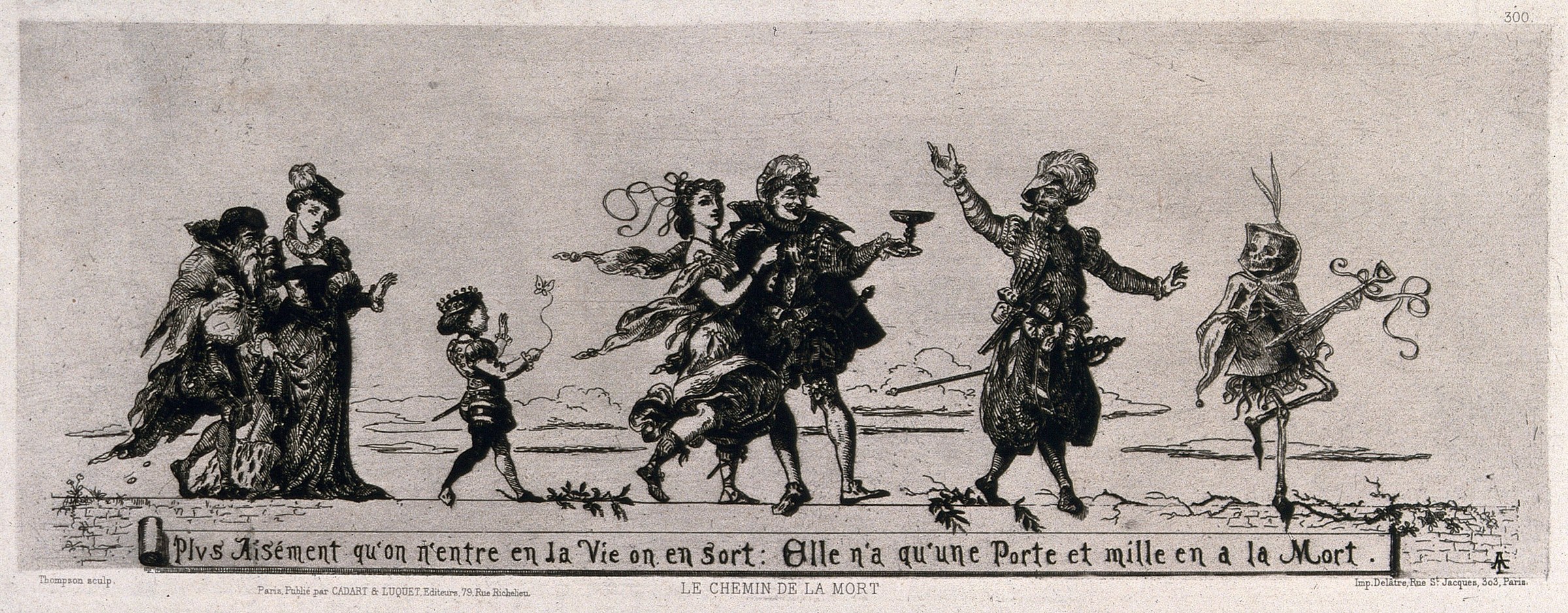
A procession of dancers following a music-making Death. Etching by A.W. Thompson, 1867.
Unknown artist
- Source:
- Wellcome Collection
- Rights:
- Public domain — free to use, share and adapt.
- Recorded as:
- Public Domain Mark
The danse macabre is a foundational artistic tradition in which the language of choreography and ceremonial movement becomes a vehicle for expressing profound theological and social truth. This print demonstrates how dance imagery transcended mere entertainment or documentation of social practice and entered the realm of allegory and memento mori. Understanding this tradition is essential for recognizing how dance has always served as a metaphor for power, order, transgression, and the fragility of human pretense.
What you are looking at
A procession of seven figures moves left to right across a barren landscape, each engaged with Death as a skeletal musician. Death, rendered as a grinning skull-faced figure in tattered dress, leads the group while playing a stringed instrument. The other figures—representing various social classes from what appears to be 16th or 17th-century Europe, including a wealthy couple, a soldier, a nobleman, a child, and others—follow in a grotesque parody of a dance or ceremonial procession. Each figure gestures wildly or reaches toward Death; their clothing is ornate and period-specific, rendered in fine cross-hatching. The ground is spare, with minimal vegetation, and the sky blank. The composition reads as a visual sermon: the inevitability of Death's call across all ranks of society. A French inscription at the bottom translates roughly: "There is but one door by which one enters Life; there are a thousand by which one leaves it to Death."
The dancing
The figures do not hold one another in any formal dance position; instead, each stands or moves independently, oriented toward Death. Their gestures are emphatic and expressive—arms raised, bodies twisted, some lunging toward the skeletal musician. The child appears smallest and most vulnerable; the wealthy woman's elaborate dress and headdress catch the eye. Death itself occupies the center of attention, slightly elevated in bearing, the pivot around which the others arrange themselves. The weight of each figure is unbalanced, caught mid-step or mid-gesture, creating an impression of helplessness rather than controlled movement.
The dance depicted
This is a memento mori or danse macabre—a medieval and Renaissance artistic tradition representing Death as an inevitable, leveling force that calls all living souls regardless of status. The work is not depicting an actual dance form but rather a procession of the doomed, using the vocabulary of dance and ceremony to express theological and social themes. The danse macabre tradition peaked in visual art between the 14th and 17th centuries and often appeared in prints, murals, and engravings. While styled as a procession or courtly dance, the figures move without technique or grace, emphasizing the grotesque and chaotic nature of mortality rather than the elegance of actual ballroom or court movement.
How it was made
This is an etching, a printmaking technique in which an image is incised into a metal plate (usually copper) with an acid-resistant needle, then bitten by acid to create recessed lines that hold ink. Etching allows for fine detail and tonal variation through careful cross-hatching, visible here in the drapery, faces, and ground. The technique was economical for multiple impressions and well-suited to theological and satirical subjects aimed at a broad educated audience. The fineness of line and the narrative clarity suggest this was meant for circulation among an urban, literate public in the 16th or 17th century, likely in France or the Low Countries.
About this work
This is a danse macabre—a visual sermon on mortality rendered as a grotesque procession led by Death himself playing a stringed instrument. Rather than depicting actual ballroom or court dance, it appropriates the formal language of courtly procession and ceremony to deliver a memento mori message: that Death is the universal master and all ranks of society must answer his call. The work belongs in a dance gallery not because it shows a real dance form, but because it uses the visual grammar of choreographed movement and formal grouping to create meaning. It is an artwork *about* the body, about bodies moving together, and about the loss of bodily control in the face of an inexorable force.
The danse macabre tradition was one of the most pervasive visual metaphors in European art from the late Middle Ages into the Baroque period, and prints like this one were instruments of both artistic ambition and popular religious instruction. It reveals how deeply dance and procession were embedded in the cultural imagination as metaphors for social order, and what happened to that order when Death disrupted it.
How to look at it
Observe how each figure, despite their social rank (marked by costume and bearing), is bound to the same grotesque movement toward Death. The artist freezes a moment of surrender, not triumph—the bodies are not graceful or controlled, but pulled, twisted, and disordered. Notice the contrast between the ornate detail of the living figures' dress and the crude simplicity of Death's form: Death needs no costume, only the skull and the instrument. The procession reads like a negative image of a courtly dance or ceremonial march: same formal structure, but evacuated of all dignity and order.
The artist
The catalogue lists the artist as A.W. Thompson and the date as 1867. However, the style, composition, and thematics of the danse macabre tradition suggest this may be a much earlier work, a Renaissance or early modern etching, or possibly a 19th-century revival or reproduction of an earlier design. The danse macabre was a popular subject for reproduction and reissue across centuries. Without access to the original plate or more detailed documentation, the artist attribution and date remain uncertain.
The period
The danse macabre visual tradition flourished in the 14th–17th centuries in response to recurring plague, warfare, and religious anxiety. Artists including Holbein, Dürer, and Cranach created influential versions. By the 16th century, printed danse macabre scenes circulated widely across Europe as both moral instruction and artistic prestige. The tradition diminished after the Baroque but experienced periodic revivals, including in the 19th century when earlier prints were reissued and reinterpreted. This work, whether original or revival, reflects the enduring power of the danse macabre as a vehicle for expressing social commentary and the leveling force of death.
Where it lives
The work is held by the Wellcome Collection, a major repository of prints and photographs documenting the history of medicine, anatomy, and public health, as well as cultural responses to mortality and disease. The Wellcome's inclusion of danse macabre imagery reflects the collection's interest in how visual culture has engaged with themes of death, disease, and the body.
Dance in this work
Questions about this work
Is this actually a dance?
No. This is a danse macabre—an allegorical procession in which Death summons the living regardless of rank. It uses the visual language and formal structure of courtly ceremony and procession, but it is not depicting a real dance form or technique. It is a moral and theological image that exploits dance-like movement and grouping to make its point about human vulnerability.
Why does Death play music?
In the danse macabre tradition, Death often appears as a musician or piper, a figure of mockery and control. The music summons the living; it is the irresistible call that even the powerful cannot refuse. This inverts the normal hierarchy of courtly music, where musicians serve the noble patron. Here, Death's music is the master voice.
When was the danse macabre most popular?
The visual danse macabre tradition flourished from the late 14th century through the 17th century in Northern Europe, especially in response to plague, war, and religious upheaval. The theme experienced periodic revivals, including in the 19th century when earlier prints were reissued and collected. This particular print may be either an original Renaissance etching or a 19th-century reprint or revival.
What does the inscription mean?
The French text translates: "There is but one door by which one enters Life; there are a thousand by which one leaves it to Death." It expresses the central theme of the danse macabre: that all life is singular in origin but plural and unpredictable in its ending. Death has infinite avenues of approach.
More dance artwork





