49 works in this view — arrow keys or swipe to move between them.
Dance in Art
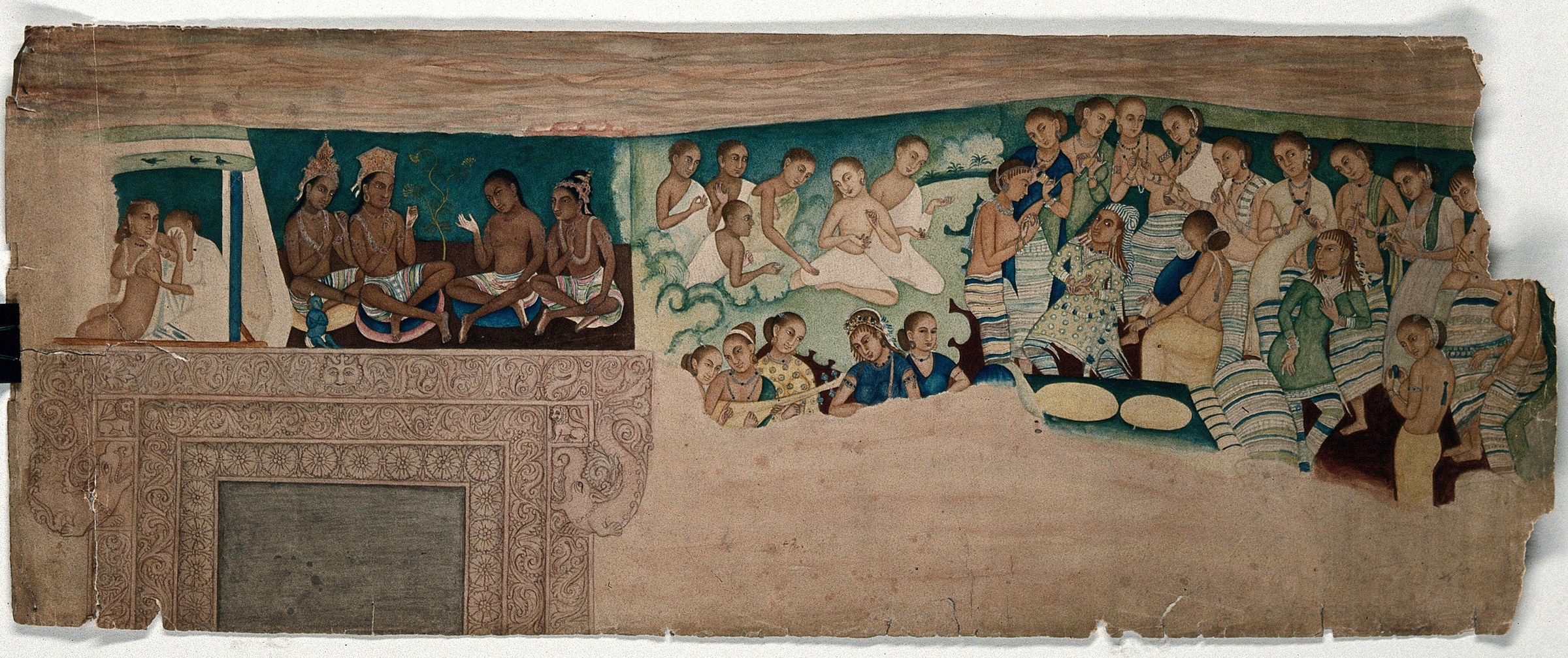
Cave paintings; a group of female musicians and dancers and Buddhist monks (?) of Indo-African origin. Gouache painting by an Indian painter.
Unknown artist
- Source:
- Wellcome Collection
- Rights:
- Public domain — free to use, share and adapt.
- Recorded as:
- Public Domain Mark
This painting is an eyewitness record of a performance tradition that has left little other visual documentation. It shows how dance, music, and religious or courtly ceremony intersected in practice, and it preserves details of costume, instrument, and bodily movement that clarify how these arts were actually performed rather than theorized. The mention of Indo-African and Buddhist figures indicates a cosmopolitan cultural exchange and performance context that complicates Western narratives of dance history.
What you are looking at
This gouache painting depicts a complex interior scene organized across two registers, separated by an ornate border pattern characteristic of Indian court art. The lower register shows a rectangular pool or tank with two large circular floating vessels and several figures seated around its edge in discussion or attendance. The upper register overflows with figures—men, women, and children—many partially clothed or nude, engaged in diverse activities: some play musical instruments (visible wind and string instruments), others dance, sit in conversation, or recline. The palette is muted—ochres, greens, browns—with touches of blue and gold in garments. The upper left shows a figure within a pavilion or structure with architectural framing. The composition is densely populated but organized with some spatial logic, though the perspective is flattened in the manner of Indian manuscript painting. The entire work shows significant age and wear, with areas of paint loss and discoloration.
The dancing
Bodies throughout are rendered in the conventions of Indian painting: flat profiles or three-quarter views, with careful attention to costume and ornament but minimal anatomical modeling. Several figures in the upper register are actively dancing—some with arms raised, some in profile with one leg extended or bodies twisted in movement. The musicians play instruments held in characteristic positions. Figures are not in partnered closed holds; instead they move individually or in loose groups, with clear spatial separation between them. Some appear to be in devotional or ceremonial posture. The work shows an artist familiar with observing dance but working within a formal, non-naturalistic vocabulary.
The dance depicted
The dance content is difficult to identify with certainty. The setting, abundance of musicians, devotional or ceremonial framing, and the nature of the movements suggest this may depict temple dance, court entertainment, or religious ritual rather than social dance. The upper register's proliferation of figures—many semi-clothed or nude—and their varied activities suggests either a scene of worship, celebration, or instruction. The presence of what appear to be Buddhist or Hindu religious figures (mentioned in the title) indicates this is likely documenting a specific tradition of sacred or courtly performance, possibly Devadasi temple dance or court entertainment in South India or Southeast Asia. Without clearer identifying marks, the specific dance tradition remains uncertain.
How it was made
Gouache on paper, a technique that produces a matte, opaque finish and allows for both broad areas of flat colour and precise linear detail. The work shows the typical characteristics of Indian manuscript painting: careful draftsmanship in pen or brush line, local colour applied in flat washes rather than modeling through light and shade, and an organization of space that is conceptual rather than perspectival. Gouache's opacity permitted corrections and layering, and its portability made it suitable for court or temple documentation. The technique suggests circulation within Indian artistic and patronage circles rather than for European viewing, though the subject matter and archival history indicate eventual European collection.
About this work
This is a gouache painting in the Indian manuscript tradition depicting a complex scene of musicians, dancers, and attendants arranged around an architectural and aquatic setting. The work documents performance culture—likely sacred, courtly, or institutional—with careful attention to costume, instrument, gesture, and spatial organization. The title suggests the figures include Buddhist monks and performers of Indo-African origin, indicating the artist was recording a cosmopolitan court or temple setting. The painting belongs in a gallery of dance imagery because it preserves a moment of performance practice in a tradition and setting otherwise sparsely documented in visual form.
As a work of Indian art-historical significance, it offers evidence of how dance and musicians were represented, valued, and integrated into religious or courtly life. The specific tradition, date, and provenance remain to be established, but the work is valuable precisely as a record of actual performance—who danced, what they wore, who played, and how the moment was choreographed and framed.
How to look at it
Attend first to the organizing principle: the division into two registers separated by a decorated border suggests a formal, composed scene rather than a snapshot. In the upper register, locate the actively dancing figures and observe their isolation from one another—no partnered holds, no chorus line, but individual or small-group movement. Note the instruments: their types and the hands that hold them may clarify the musical tradition. Look at the ornament and fabric of garments, which often indicated rank, role, and regional origin. Finally, observe the artist's choice to fill the frame densely with figures rather than to isolate a central moment, suggesting this is a documentation of a gathering or ceremony rather than a single climactic pose.
The period
Indian court and temple painting from roughly the 16th–19th century frequently documented performance as part of devotional, ceremonial, or courtly life. Dance was integral to temple ritual (particularly the Devadasi system in South India), to court entertainment across the subcontinent, and to festivals and religious observance. Such paintings served as records of patronage, piety, and cultural refinement. The apparent presence of multiple ethnic or geographic groups in this scene reflects the historical reality of Indian courts as cosmopolitan centers attracting musicians, dancers, and performers from across Asia and beyond. The style suggests this work may date from the Mughal, Rajasthani, or South Indian court tradition, though certainty requires further research.
Where it lives
The work is held by the Wellcome Collection, historically assembled as a collection of images related to the history of medicine and science, though it includes ethnographic and cultural material beyond strict medical scope. The cataloguing as 'Cave paintings' in the title appears to be erroneous or metaphorical.
Dance in this work
Questions about this work
What tradition of dance is this?
The painting is not yet conclusively identified. The style and iconography suggest it may document Devadasi temple dance, court entertainment, or religious ceremony from South India or Southeast Asia, possibly with Buddhist elements. The presence of what may be multiple ethnic groups suggests a cosmopolitan context. Further research into the artist, provenance, and any inscriptions is needed.
Why are there so many figures, and why are many partially nude?
The proliferation of figures suggests this documents a gathering, ceremony, or celebration rather than a single performance. Semi-nudity may indicate ritual context, high status, or the conventions of the artistic tradition in representing bodies at ease or in devotion. In Indian temple and court contexts, partial undress often carried spiritual or hierarchical meaning rather than indicating informality.
What does 'Indo-African origin' mean in the title?
This phrase in the catalogue suggests the artist recorded performers or attendants identified as having African or mixed-race heritage. This would indicate the painting documents a cosmopolitan court or temple setting, consistent with historical Indian courts that attracted musicians and performers from across the Indian Ocean world. It is a valuable record of cross-cultural performance exchange.
How old is this painting?
The catalogue record provides no date. The style and technique are consistent with Indian court painting from the 16th to 19th centuries. Closer study of the paper, pigments, and any inscriptions would be required to narrow the date.
More dance artwork





