49 works in this view — arrow keys or swipe to move between them.
Dance in Art
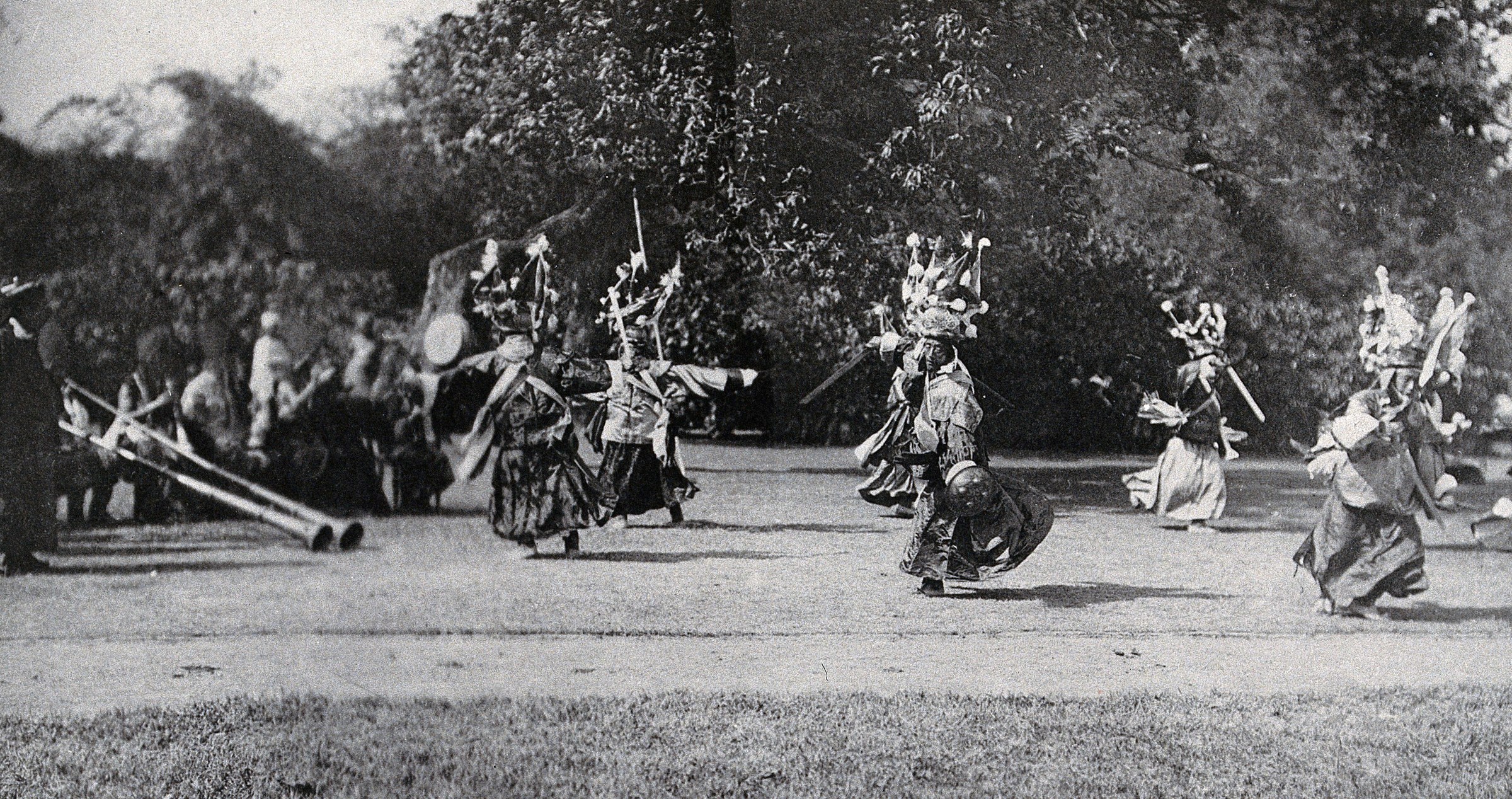
The Maidan park, Calcutta, India: traditional Sikkim Devil dancers performing for King George V and Queen Mary (then the Prince and Princess of Wales) on their visit in 1906. Photograph, 1906.
Unknown artist
- Source:
- Wellcome Collection
- Rights:
- Public domain — free to use, share and adapt.
- Recorded as:
- Public Domain Mark
For historians of South Asian ritual practice, this is one of the earliest photographic records of Cham dance in performance, preserving details of costume, mask design, and performance scale that inform understanding of the tradition. For scholars of colonial photography and display, it is evidence of how indigenous performance was staged, documented, and presented to justify imperial narratives of 'civilization' and to provide spectacle for royal visitors. The image reveals the tension between the sacred, monastic origins of these dances and their commodification as entertainment for state occasions.
What you are looking at
A ceremonial performance unfolds in an open clearing in Maidan Park, Calcutta, with dense foliage forming a dark backdrop. Multiple figures in elaborate costume and headdress are arranged across a paved ground in a dispersed formation rather than a tight ensemble. The performers wear what appears to be intricately decorated masks, tall feathered or ornamental headdresses, and textured garments suggesting ritual dress. The photograph captures the performers mid-movement, with varied body positions and arm gestures suggesting dynamic action. The lighting is natural and even, typical of daylight outdoor performance. The composition suggests this is a formal, state occasion rather than an everyday performance—the space is ceremonial, the arrangement deliberate, and the elaborate costume speaks to significance.
The dancing
The performers are distributed across the space with no fixed formation—some are closer to the camera, others receding into the middle distance. Their postures vary significantly: some appear to be in dynamic, lunging or crouching positions; others stand more upright with raised arms. The arm gestures are varied and expressive, held at different heights and angles. The body weight appears to shift between legs in ways suggesting traveling or turning movement. Without closer detail, it is difficult to discern specific footwork, but the overall deportment suggests a dance with significant spatial coverage and varied directional focus rather than a stationary or processional form.
The dance depicted
The catalogue identifies these as Sikkim Devil dancers (or masked demon dancers), a form of ritual performance from the Himalayan Buddhist tradition. These are not dancers in the Western theatrical sense but ritual performers enacting spiritual narratives, typically associated with Cham dances performed in monasteries and at religious festivals. The elaborate masks, ornamental headdresses, and textured costumes are central to the tradition, which emphasizes symbolic transformation and sacred narrative over virtuosity or pure movement form. The outdoor daytime performance in an urban park is unusual for this tradition—these dances are typically performed in monastery courtyards or at specific religious occasions—suggesting this was a specially commissioned demonstration for visiting dignitaries, which would account for the formal arrangement and deliberate documentation.
How it was made
This is a black-and-white photograph, almost certainly gelatin silver print given the date and source (Wellcome Collection), a medium well-suited to documentary work and formal record-making. The crisp focus and even exposure suggest professional or semi-professional photography, likely made by or for an official party accompanying the royal visit. The photograph would have been one of several documentary images made during the visit and entered institutional archives—in this case, a medical/scientific institution, suggesting the image was collected as a record of colonial encounter and cultural documentation rather than as art photography. The technical clarity allows detail of costume and formation to be read clearly.
About this work
This is a documentary photograph of a Sikkim Buddhist ritual dance performed as part of an official state ceremony during a 1906 royal visit to British India. The image records not the performance in its traditional context but a formal display arranged for Western dignitaries, making it a document of both the dance itself and the colonial-era practice of presenting indigenous performances for imperial audiences. The photograph preserves evidence of how a sacred Buddhist ritual was adapted and presented to foreign observers in an urban European-style park, and it captures the visual spectacle of the tradition—the masked performers, elaborate costume, and dynamic spatial movement—that would be lost in written description.
How to look at it
Focus on the variety of body positions across the frame—the dancers are not in synchrony but in varied, individualized gestures, which is characteristic of Cham performance where different masked figures enact distinct narrative roles. Notice the elaborate headdresses and masks: these are not incidental costume but central to the meaning of the performance, with each figure likely representing a specific deity, demon, or narrative character. The outdoor daytime setting, with the performers arranged in an open clearing rather than in a monastery courtyard or enclosed ritual space, is the key contextual note: observe how the formally distributed arrangement and clear sightlines suggest this is a performance designed for external viewing rather than the more enclosed, participatory ritual context in which these dances originated.
The artist
The photographer is unrecorded. The image is held in the Wellcome Collection, a medical and scientific archive, suggesting it was acquired as documentary evidence of life in colonial India. Photographs from this period of royal visits were typically made by official or semi-official photographers commissioned to document the visit and distribute images to newspapers and archives; this one was likely made by or under the direction of such a photographer working within colonial institutional frameworks.
The period
In 1906, when the Prince and Princess of Wales visited British India, Calcutta was a major administrative and cultural center of the Raj. The visit was a state occasion designed to reinforce imperial authority and showcase the British presence in India. Cham dances, traditionally performed in Sikkim's monasteries as part of Buddhist religious practice, were being increasingly documented and displayed for Western audiences during this period. Photography itself was a technology of colonial documentation—used to record, classify, and archive the colonized world for metropolitan consumption. This moment marks a transition in how these dances were perceived: from internal sacred ritual to exotic spectacle staged for foreign viewing.
Where it lives
The image is held in the Wellcome Collection (Wellcome Library, London), a major archive of medical and scientific materials with substantial holdings in colonial-era documentary photography. It was likely acquired as part of systematic documentation of the 1906 royal visit or as part of broader Wellcome collecting practices around colonial India.
Dance in this work
Questions about this work
What are Sikkim Devil dancers?
They are ritual performers from the Buddhist tradition of Sikkim (a region in the eastern Himalayas), performing Cham dances that enact spiritual narratives and invoke protective deities. The 'devil' in the English name reflects early Western misinterpretation of the masks and dynamic movement; these are sacred performances within Buddhist practice, not demonic displays. Traditionally performed in monastery courtyards during religious festivals, they combine masked performance, elaborate costume, percussion, and movement to embody spiritual forces.
Why were they performing in a public park for the British royals?
The 1906 visit of the Prince and Princess of Wales was a major imperial state occasion. Colonial authorities arranged cultural performances and displays to showcase the Raj's reach and to provide entertainment and ethnographic interest to the royal visitors. This required removing the dances from their monastic and religious context and staging them as spectacle in a formal European-style public space—a practice that was common in late colonial India.
How does this photograph change our understanding of these dances?
It provides one of the earliest visual records of Cham performance, showing costume, masks, and spatial arrangement in detail. However, it also documents the moment when these sacred rituals began to be appropriated, commodified, and presented as 'exotic' entertainment to foreign audiences—a shift that shaped how these traditions are now understood and performed globally.
More dance artwork





