49 works in this view — arrow keys or swipe to move between them.
Dance in Art
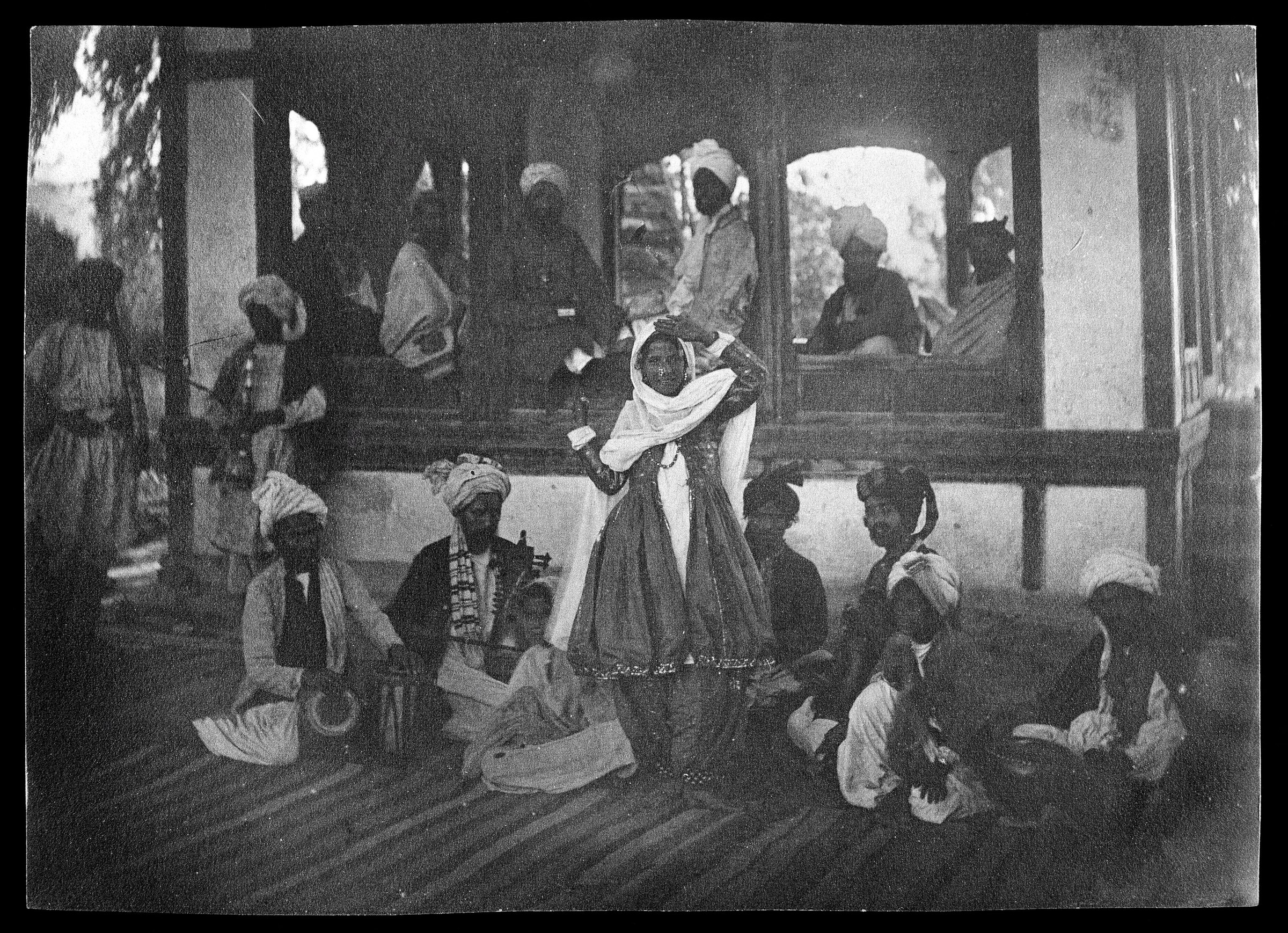
Musicians and lady dancer
Unknown artist
- Source:
- Wellcome Collection
- Rights:
- Reusable with conditions: credit the creator. Source record ↗
- Recorded as:
- Attribution 4.0 International (CC BY 4.0)
This photograph is one of the earliest visual records of a non-Western female performer's technique, captured at a time when such documentation was rare and when dance was seldom preserved in any form. The image reveals the vocabulary of extension, elevation, and expressive arm work in a tradition that predates modern notation and video, making it an irreplaceable primary source for understanding how these dances were actually performed in the early 20th century.
What you are looking at
A performance or social gathering unfolds in what appears to be an interior courtyard or covered space with colonnaded architecture visible in the background. A woman stands centrally in an exuberant pose, one leg extended and arms raised expressively, her body captured mid-movement in a dynamic arabesque or similar extension. She wears a dark dress with a white head covering or turban. Around her, seated on the ground in the foreground, are approximately five to seven figures in period dress—some wearing turbans or wrapped head coverings, others in dark garments. Several appear to be musicians: a man in the left foreground holds what looks like a stringed instrument, and others nearby seem positioned as if playing or about to play. The background contains more standing figures, partially obscured by shadow and the photograph's age, suggesting an audience or additional participants. The lighting is theatrical, with bright areas illuminating the central dancer and darker passages receding into the space, characteristic of interior performance conditions.
The dancing
The central dancer occupies an extended, open position with weight shifted to one leg while the other extends upward or outward in a vertical or diagonal line, arms raised in an expansive frame. This is not a closed partnered position but rather a solo display of elevation and extension. The musicians and attendants are arranged in profile or three-quarter views, seated or kneeling, with relaxed posture suggesting accompaniment rather than synchronized participation. The dancers' costume—a fitted dark dress with the exposed movement of limbs—contrasts sharply with the wrapped or turbaned dress of the musicians and onlookers.
The dance depicted
The image most likely documents a Middle Eastern, North African, or South Asian dance tradition, given the architectural setting, the style of dress and head coverings, the presence of live musicians with period string instruments, and the solo female dancer's extended postures and expressive arm work. The extended leg position, the elevated frame, and the performer's central isolation suggest a classical or semi-classical solo form—possibly a variant of Raqs Sharqi (belly dance), a regional folk form, or a courtly dance tradition. The photograph captures what appears to be a performance or demonstration for an audience, not a casual social dance.
How it was made
This is a black-and-white photograph, likely from the late 19th or early 20th century, taken in available or carefully managed interior light. The grain, tonal range, and the slight softness of the image are consistent with early photographic processes. The photograph's survival in the Wellcome Collection suggests it may have been collected as ethnographic or documentary evidence rather than as fine art. The grainy texture and moderate contrast are typical of photographs from this period that were either printed from glass plates or early nitrate film stock, and the image's condition suggests it has not been significantly retouched.
About this work
This photograph documents a solo female performer—likely a professional or courtly dancer—executing an extended movement in the presence of live musicians and an assembled audience in what appears to be a covered courtyard or interior performance space. The setting, costume, instruments, and body positions indicate a non-Western dance tradition, most probably from the Mediterranean, Middle Eastern, or South Asian regions, captured during the height of anthropological and travel photography. The work belongs in a dance gallery because it preserves a moment of technical performance—the extended leg line, the raised arms, the centered focus on the dancer—and demonstrates how dance was documented and circulated in the early photographic era, when such images often served both as souvenirs and as ethnographic records.
How to look at it
Observe the moment the photographer chose: the dancer at the peak of an extension, weight fully committed, the body open and displayed. Notice how the musician in the foreground with the stringed instrument anchors the composition, suggesting a musical partnership rather than background accompaniment. The seated and standing attendants frame the performer, their stillness and attention contrasting with her dynamic position. The architectural setting—the columns and deep shadow—suggests this was a significant performance space, not an improvised or casual gathering.
The artist
The photographer is not recorded. The photograph's presence in the Wellcome Collection indicates it was likely gathered as part of early anthropological or travel documentation rather than commissioned as fine art. Early photography of dance was often undertaken by travelers, colonial administrators, or ethnographic collectors rather than by artists specializing in performance documentation.
The period
This photograph dates to an era when photography was becoming the primary method for recording non-Western cultures and when European and American collectors were actively documenting dance and music from colonized or newly accessible regions. In the Western theatrical world, the same period saw growing fascination with 'Oriental' dance (often filtered through European imagination), while in the regions depicted, such performances were embedded in courtly, religious, or social traditions with centuries of history. The image sits at the intersection of documentation and exoticization—a record of an actual performance made visible through the lens of early photographic technology.
Where it lives
This photograph is held in the Wellcome Collection, a repository of historical medical, ethnographic, and cultural material formed in the early 20th century by pharmaceutical magnate Henry Wellcome. Objects in this collection were often acquired as examples of non-Western cultures and practices, and the photograph likely reflects the collecting practices and perspectives of that era.
Dance in this work
Questions about this work
What dance tradition is this?
The costume, instruments, architectural setting, and movement vocabulary suggest a Middle Eastern, North African, or South Asian dance tradition, but the photograph does not carry identifying information. The extended leg line, raised arms, and solo display format are consistent with classical or courtly forms such as Raqs Sharqi or regional variants, though without documentation of the original context, identification remains provisional.
Is this a professional performance or a social dance?
The central isolation of the dancer, the arranged seating of musicians, the apparent audience, and the quality of the movement all suggest a formal or courtly performance rather than social dance. The presence of a photographer also indicates this was a documented, possibly commissioned event.
Why is this photograph in the Wellcome Collection?
The Wellcome Collection was assembled to document global cultures, medical practices, and social life. Dance and music were collected as evidence of non-Western traditions, often with ethnographic intent. This photograph likely entered the collection as a record of a cultural practice rather than as fine art.
How old is this photograph?
The photographic technique, grain, and tonal quality suggest the late 19th or early 20th century, though no date is recorded. The style of dress and the photographer's equipment are consistent with the 1890s–1920s period.
More dance artwork





