49 works in this view — arrow keys or swipe to move between them.
Dance in Art
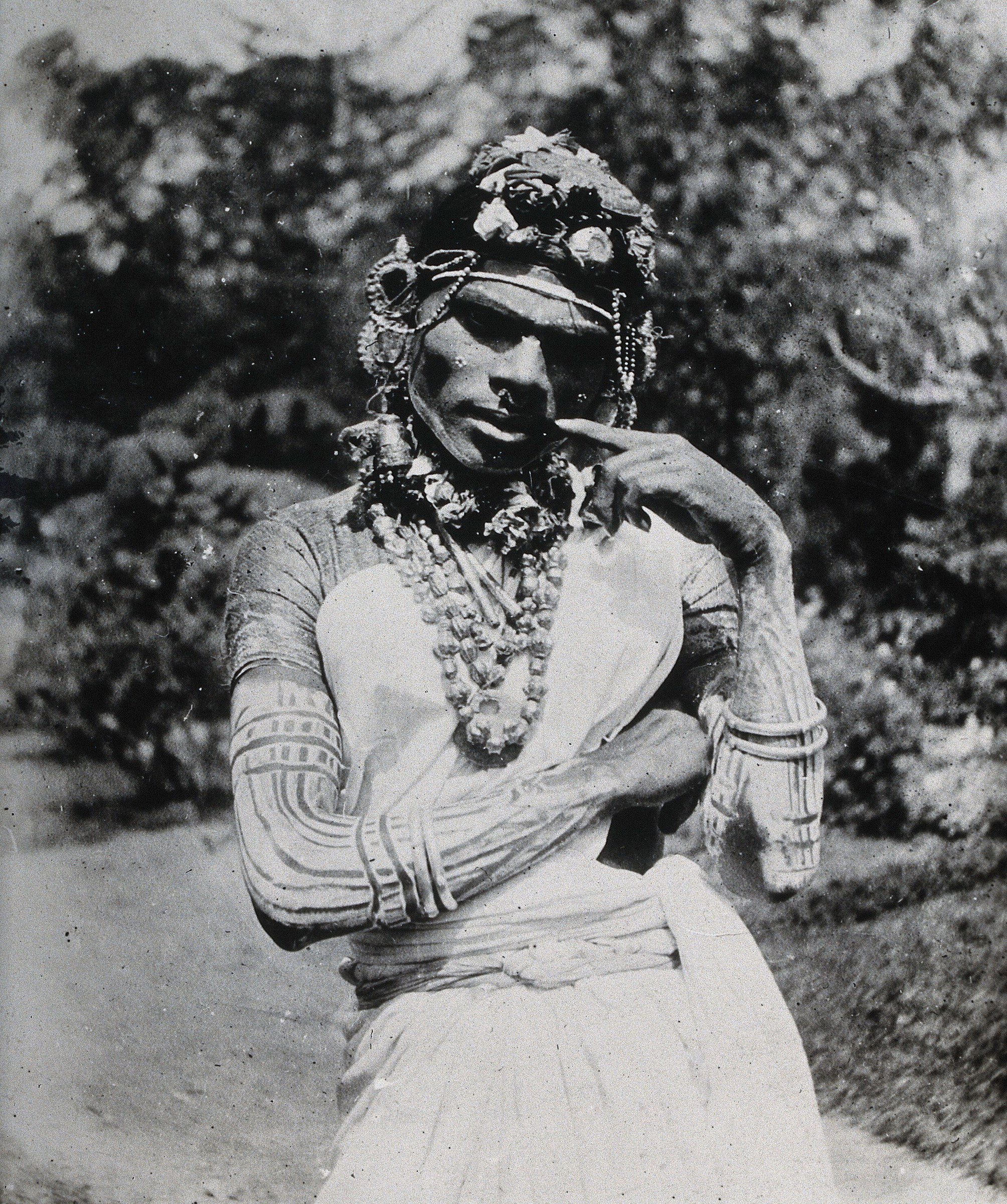
Ceylon: Tamil devil dancer. Photograph, ca. 1906.
Unknown artist
- Source:
- Wellcome Collection
- Rights:
- Rights reserved by the holding institution — do not reuse without permission. Source record ↗
- Recorded as:
- In copyright
The photograph documents a living tradition of South Asian ritual performance largely effaced or transformed under colonialism, and it preserves specific information about the material culture, costume, and adornment practices of Tamil devil-dancing. It also exemplifies the way early ethnographic photography framed non-Western dance as exotic spectacle or ethnographic object, a framing that shaped how such traditions were understood and circulated in the West—a critical concern for any genealogy of how dance has been documented and consumed.
What you are looking at
A single figure stands outdoors against a softly focused backdrop of foliage and trees, posed frontally and gazing slightly upward. The person wears a light-colored short-sleeved tunic or upper garment over white lower clothing, bound at the waist. They are extensively adorned with ritual ornament: a large headdress or crown decorated with flowers and natural materials sits atop their head; multiple strands of beads, garlands, and floral wreaths drape across the chest and shoulders; bands encircle the upper arms; and similar ornamental binding wraps the forearms and wrists. The photograph is grainy, consistent with early 20th-century printing, and the figure's pose is still and ceremonial rather than captured mid-movement. The composition emphasizes the totality of the costume and adornment rather than the body in motion.
The dancing
The single figure stands upright with weight evenly distributed, one arm raised and bent at the elbow across the body in a gesture of restraint or composure. The posture is formal and presented—not a caught moment of dance but a display stance. The face is composed and directed upward, suggesting a trance-like or spiritually focused state rather than performance for an audience. The extensive binding of the arms and the careful draping of ornament suggest restricted, controlled movement rather than the large, free gestures typical of social dance.
The dance depicted
The photograph documents a ritual specialist or performer associated with devil-dancing traditions in Tamil regions of colonial Ceylon (Sri Lanka), a performance form centered on propitiation, exorcism, and interaction with supernatural forces. The figure's stillness, spiritual demeanor, and elaborate ornament are consistent with preparatory or concluding moments of such ceremonies rather than active dance. Tamil devil-dancing traditions involve masked or costumed practitioners who undergo possession or trance as part of healing or protective rituals; the beaded and floral adornment visible here represents part of the ritual apparatus. The image captures costume and regalia but not choreographed movement.
How it was made
This is a black-and-white photograph, likely an albumen or gelatin silver print from around 1906, showing the characteristics of early documentary photography: grainy tonal gradation, soft focus in the background, and the compressed spatial perspective typical of period lens technology. The photograph was made during the height of European ethnographic image-collecting in colonial territories. The Wellcome Collection's holding of this image reflects its original purpose as an ethnographic document—a record of 'exotic' ritual practice for circulation among medical, anthropological, and general European audiences in the early 20th century.
About this work
This photograph documents a Tamil devil-dancer or ritual specialist in colonial Ceylon, captured in full ceremonial dress and ornamentation around 1906. The image presents not a moment of choreographed dance but rather the costumed body at rest or in ritual preparation—a display of the material culture and spiritual apparatus associated with Tamil devil-dancing traditions, which involved exorcism, healing, and propitiation ceremonies. The photograph is one of many early ethnographic images produced for European audiences, presenting non-Western ritual specialists through the framework of colonial observation.
How to look at it
The viewer should attend to the photograph as a document of colonial ethnography rather than a dance photograph: the pose is presentational and static, not choreographic. The extensive ornament—the beads, flowers, headdress, arm bands—is the work of the image; the photographer has arranged the figure to display material culture and costume. Note the difference in gaze and bearing from a performer captured mid-movement: the upward focus and composed stillness suggest spiritual or ritual significance rather than entertainment or display for spectators. The softness of the background and the formal frontality of the composition reflect the studio or staged ethnographic photograph rather than documentary photography of actual performance.
The artist
The photographer is not recorded. The image belongs to the Wellcome Collection, a major accumulation of medical, scientific, and ethnographic photographs assembled by Sir Henry Wellcome (1853–1936) from around the world. Wellcome's collections were made through colonial and commercial networks and reflect the visual culture of early-20th-century European ethnography and medical illustration. The photograph's lack of attributed authorship is typical of such institutional collections, where individual photographers were often not credited and images were valued for their documentary or curiosity content rather than artistic authorship.
The period
The photograph dates to the height of European colonial rule in Ceylon and the peak of ethnographic photography as a method of cataloguing and displaying non-Western peoples and practices for metropolitan audiences. In the early 1900s, devil-dancing and other South Asian ritual traditions were being intensively photographed and exhibited in Europe, often through medical and anthropological institutions. This coincided with the consolidation of racial hierarchies and the establishment of 'folklore' and 'ethnography' as disciplines—frameworks that positioned non-Western ritual specialists as historical remnants or exotic subjects rather than as living practitioners within their own cultural systems.
Where it lives
The photograph is held by the Wellcome Collection, a major research library and museum in London housing ethnographic, medical, and historical images acquired through colonial and commercial networks in the late 19th and early 20th centuries. It was sourced to LODance from the Wellcome Collection's digital holdings.
Dance in this work
Questions about this work
What is a devil-dancer?
In Tamil ritual traditions, a devil-dancer (or devil-exorcist) is a ritual specialist who conducts ceremonies to propitiate, appease, or exorcise supernatural forces believed to cause illness, misfortune, or harm. The ceremonies involve music, costume, adornment, and often trance or possession states. The term 'devil-dancer' is a colonial-era label; the practices are embedded in Hindu, folk, and regional religious frameworks and serve protective and healing functions within communities.
Is this person actually dancing?
The photograph captures a posed, still moment rather than active dance. The figure is in full ritual dress and ornament, likely either preparing for ceremony or positioned for documentation. While devil-dancing traditions do involve movement and choreographed gestures, this particular image freezes the body in a display stance meant to show costume and regalia to the camera.
Why is this in the Wellcome Collection?
The Wellcome Collection assembled ethnographic and medical photographs from around the world in the early 20th century, treating non-Western ritual, healing, and performance traditions as objects of scientific and curious interest for European audiences. Ethnographic images of this kind were circulated among medical institutions, museums, and general collectors as documents of 'exotic' or 'primitive' practices.
When and where was this made?
The photograph dates to around 1906 and was taken in Ceylon (now Sri Rica), likely during the British colonial period. The catalogue record does not specify the exact location or photographer, and the image does not bear a visible signature or inscription. The date and location are inferred from the style of the photograph and the colonial context of the Wellcome Collection's holdings.
More dance artwork





