49 works in this view — arrow keys or swipe to move between them.
Dance in Art
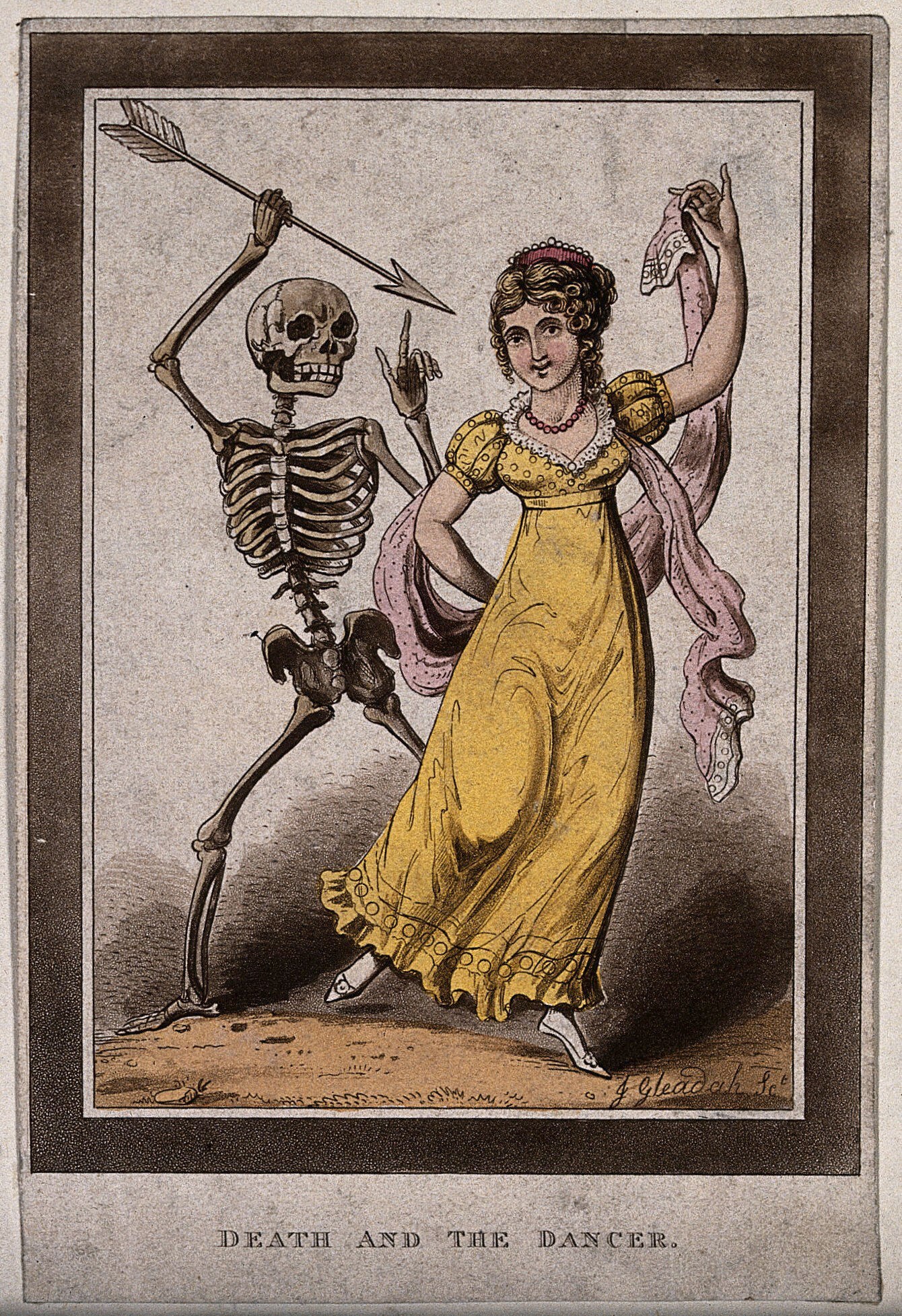
Death points an arrow at a female dancer. Aquatint by J. Gleadah, 1822.
Unknown artist
- Source:
- Wellcome Collection
- Rights:
- Public domain — free to use, share and adapt.
- Recorded as:
- Public Domain Mark
This work sits at the intersection of popular visual culture, theatrical imagery, and centuries-old memento mori tradition. For historians of dance, it reveals how the figure of the dancer—particularly the graceful, theatrically dressed woman—became a symbol through which to contemplate mortality and the brevity of human pleasure.
What you are looking at
A skeletal figure of Death, rendered as an anatomical skeleton in black line, stands at the left holding a feathered arrow aimed at a young woman in a classical yellow Empire-waist dress. The woman faces forward with one arm raised, holding a delicate handkerchief or scarf aloft, while her other hand gestures expressively. Her curled hair is crowned with a red ornament, and she wears classical gold shoulder ornaments and a pearl necklace. The skeleton towers over her, arrow drawn as if to strike, creating a memento mori composition of danse macabre tradition. The setting is minimal—a sandy or dusty ground beneath them, neutral background, framing the encounter as timeless rather than localized.
The dancing
The woman's body is in a frontal, open stance with her weight lightly distributed, suggesting she is unaware of or untroubled by the threat of Death behind her. Her raised arm and the flowing fabric she holds create an upward diagonal line; her gesture is graceful and deliberate rather than defensive. The skeleton, by contrast, is rigid and angular, its articulated joints and vertebrae clearly delineated. The compositional relationship places Death as an active pursuer and the woman as a dancer absorbed in her own movement.
The dance depicted
This is a danse macabre—a visual memento mori tradition that uses dance as a metaphor for mortality's inevitability. The woman appears to be a figure of youth or revelry, and her stance and arm positions suggest balletic or theatrical movement, though the image does not specify a named dance form. The tradition of depicting Death dancing with or pursuing the living was widespread in European visual culture from the medieval period onward; by the early 19th century, it had become a stock subject in popular prints and engravings. The woman's classical dress and theatrical bearing suggest a connection to Romantic-era theatrical practice.
How it was made
This is a hand-coloured aquatint, a printmaking technique that combines etching with tonal aqueous washes to create subtle gradations of tone. Aquatint was particularly suited to popular prints and allowed for wide distribution at relatively low cost. The attribution to J. Gleadah (or Gleedah) in 1822 suggests this was a commercial print, likely produced for a broad audience interested in memento mori imagery, theatrical subjects, or both. The careful hand-colouring—particularly the brilliant yellow of the dress and the rosy tones of the woman's face—would have made each impression a small artefact of labour.
About this work
This aquatint belongs to a long tradition of danse macabre imagery, here given a Romantic-era theatrical inflection through the woman's classical costume and balletic gesture. Death and the Dancer addresses an audience already familiar with the convention: Death pursuing mortals through the metaphor of an unwilling or oblivious dance partner. The artist has chosen a moment of graceful absorption—the woman mid-gesture, unaware of her pursuer—to heighten the poignancy of the memento mori message. By 1822, when this print was made, the danse macabre remained a potent symbol of mortality even as theatrical dance itself had become increasingly associated with earthly pleasure and spectacle.
How to look at it
Notice how the artist has rendered the woman's body entirely unaware of Death's presence—her gaze forward, her gesture open and undefensive. This is the key to the image's power: she dances, or is about to dance, with no knowledge of her pursuer. The skeleton's rigid anatomy is drawn with anatomical precision, creating a strong visual and conceptual contrast with the woman's soft, draped fabric and flowing hair. The artist has chosen the moment just before contact, preserving the woman in a state of ignorant pleasure.
The period
The danse macabre enjoyed a resurgence of popularity in the late 18th and early 19th centuries, even as Enlightenment rationalism and Romantic sentiment offered new ways of thinking about death. The same decades saw the rise of the Romantic ballet—works like La Sylphide (1832) were soon to appear—in which ethereal, otherworldly figures danced against mortal, earthbound ones. This print predates those canonical works but shares their visual language: the classical dress, the raised arm, the sense of a body caught in a moment of graceful motion. The combination of classical theatrical dress with the memento mori tradition creates a specifically Romantic tension between aesthetic pleasure and moral warning.
Where it lives
The work is held by the Wellcome Collection, which holds historical images related to medicine, science, and human experience. This particular print appears in the Wellcome as part of its visual culture holdings.
Dance in this work
Questions about this work
What is a danse macabre?
A danse macabre is a traditional European artistic theme in which Death (usually personified as a skeleton) dances with the living. It emerged in medieval art and literature as a memento mori—a reminder that death comes for everyone, regardless of rank or station. By the 18th and 19th centuries, the trope had become more theatrical and less explicitly moralistic, though it retained its symbolic force.
Is this a real dance?
No—this is not a depiction of a named, practiced dance form. Rather, it uses the visual metaphor of dance to explore the relationship between life and death. The woman's graceful posture suggests theatrical or balletic movement, but the work is allegory rather than ethnography or dance documentation.
What does the yellow dress tell us?
The yellow Empire-waist dress, the curled hair, and the classical ornaments mark her as a figure of theatrical elegance and refinement—likely a representation of a dancer, actress, or allegorical figure of Youth or Beauty. This dress style was fashionable in the Regency era and carried associations with neoclassical taste and theatrical performance.
More dance artwork





