49 works in this view — arrow keys or swipe to move between them.
Dance in Art
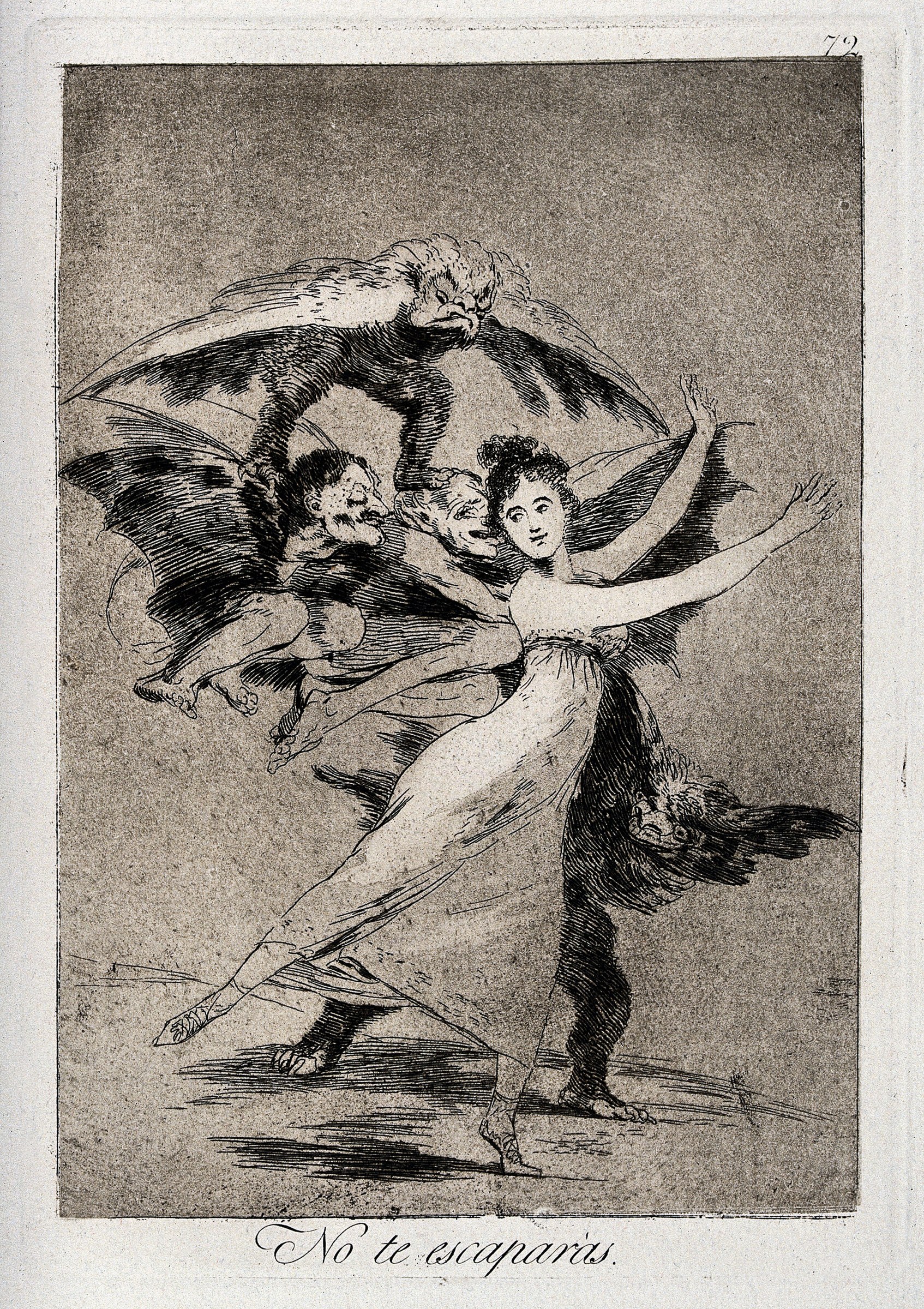
A young dancer trying to escape winged figures with men's heads. Etching by F. Goya, 1796/1798.
Unknown artist
- Source:
- Wellcome Collection
- Rights:
- Reusable with conditions: credit the creator; non-commercial use only. Source record ↗
- Recorded as:
- Attribution-NonCommercial 4.0 International (CC BY-NC 4.0)
This work is significant because it shows how the visual vocabulary of late 18th-century ballet—the extended limb, the arched back, the lifted and suspended body—was appropriated by a major printmaker to represent not a scene of ordered theatrical pleasure but one of supernatural danger and female vulnerability. It documents the emergence of Romantic iconography in which dance, flight, and the female body became intertwined as expressions of the imagination and the irrational. For historians of dance imagery, it reveals how balletic vocabulary was understood and absorbed into fine art print culture.
What you are looking at
A young woman in a flowing white chemise and dark skirt is depicted mid-leap or flight, her body arched dramatically backward and upward. She is attended by three winged figures with men's heads—demons or fantastical creatures—who surround and appear to pursue or support her. The woman's right arm extends upward in an arc; her left leg kicks backward. The composition is vertical and dynamic, the figures arranged around a central void. The etching is executed in fine parallel lines that create tonal depth, with heavy cross-hatching in the wings and background. The woman's drapery is rendered with delicate parallel strokes that emphasize movement and weightlessness. The scene is set against a plain ground line and neutral background, giving the figures no architectural or naturalistic context—this is a scene of the imagination or the supernatural.
The dancing
The central dancer's body is highly extended and arched, with her torso lifted and her legs in a scissor position—one knee bent and drawn up, the other leg stretched behind her. Her arms are raised asymmetrically, one reaching upward and the other extended outward for balance or expression of alarm. The three demonic attendants are positioned at varying heights around her: one above her head, two flanking her sides. Their postures are active and angular, their wings spread to frame the central figure. The woman's weight appears to be neither fully supported nor in contact with the ground; the artist has captured a moment of suspension or displacement from the earth.
The dance depicted
This is not a depiction of a recognizable social, theatrical, or folk dance, but rather a fantastic scene drawing on the visual language of Late 18th-century Spanish Romantic printmaking. The woman's extreme arch, elevated position, and the supernatural context suggest a ballet vocabulary—the extended leg and arched back are consistent with the Romantic ballet aesthetic that was dominant in Spain in the 1790s—but the work is not illustrating a specific ballet or choreography. Instead, it depicts a supernatural or allegorical moment: a woman attempting to escape or being carried away by demons. The gestural intensity and the muscular effort visible in the woman's body suggest an interpretation of struggle, flight, or possession rather than the formal pleasure of balletic movement. The work belongs to the broader category of Romantic imagery in which dance, flight, and supernatural encounters were represented as expressions of the female body in extremis.
How it was made
This is an etching, a printmaking technique in which an image is incised into a copper plate using a needle, then inked and printed. Etching allowed for fine linear detail and tonal variation through the depth and density of hatching, which is exploited here to create dramatic contrasts between the woman's pale, lightly hatched body and the heavily worked dark wings and background. The technique was well-suited to the rapid circulation of prints among educated viewers and collectors, and this work belongs to the tradition of Spanish satirical and Romantic printmaking that flourished in the late 18th century. The inscription 'No te escamarás' (You will not escape, or No one escapes) at the foot of the print suggests this is one of a numbered series of such compositions.
About this work
This is a late 18th-century Spanish etching depicting a young woman in a posture of balletic extension and distress, attended by three winged demonic figures. The work belongs to the Romantic tradition of supernatural and allegorical imagery, in which the female body—especially in motion or extremity—became a vehicle for expressing states beyond the rational or the social. The artist's use of the extended, arched form and the language of balletic gesture suggests familiarity with contemporary theatrical dance, even though the work is not an illustration of a specific ballet or story. The print circulated among educated collectors and viewers in Spain and was part of a broader European discourse about the relationship between the body, flight, the supernatural, and the possibilities of feminine expression through movement.
How to look at it
The viewer should attend first to the moment of suspension captured in the woman's body: she is neither on the ground nor securely in the air, but caught in a moment of extremity and effort. Her arch is so pronounced that it suggests both balletic training and desperation; the artist has fused the language of theatrical grace with the language of struggle. Notice how the three demonic attendants frame and anchor the composition: they give the woman nowhere to flee, and their placement at different heights creates a vertiginous space around her. The etching technique itself—with its fine parallel lines and dramatic contrasts—amplifies the sense of turbulence and supernatural energy. Finally, read the inscription at the foot: 'No te escamarás' is a Spanish phrase suggesting inescapability or inevitability, turning the image into a comment on fate, desire, or danger as much as it is a depiction of a supernatural encounter.
The artist
The catalogue record attributes this work to F. Goya, and the style, technique, and subject matter are consistent with the Spanish Romantic printmaker Francisco Goya (1746–1828). Goya was a prolific etcher and aquatinter, known for his satirical and imaginative print series, of which the most famous are the Caprichos (Caprices), a series of 80 prints published in 1799 that depicted witchcraft, ignorance, superstition, and folly. Goya's prints often featured supernatural and fantastical scenes, rendered with extraordinary technical skill and psychological intensity. This print, with its demonic attendants and allegorical female figure, is consistent with Goya's practice of using printmaking to explore the irrational, the forbidden, and the subversive dimensions of Spanish society and imagination.
The period
This work was created in the 1790s, at the height of the Romantic movement in Europe and during a period of significant transformation in ballet. In Spain and across Europe, ballet was moving away from the rigid formalism of the Baroque and Classical periods toward the more emotionally expressive and narrative-driven Romantic ballet that would dominate the 19th century. At the same time, printmaking was the primary medium through which artistic ideas about the supernatural, the irrational, and the female body circulated among educated viewers. Goya's contemporaries were exploring similar themes of flight, enchantment, and female vulnerability in both high art and popular prints. The late 18th century was a moment of anxiety about female sexuality, bodily autonomy, and the power of the imagination, and such themes found expression in both theatrical and visual culture.
Where it lives
The work is recorded in the Wellcome Collection, a major research collection of prints, manuscripts, and artifacts related to the history of medicine and science, though it belongs to the broader tradition of Spanish Romantic printmaking. The catalogue record is minimal and does not provide accession information, location within the collection, or detailed provenance.
Dance in this work
Questions about this work
Is this a scene from a ballet?
Not a specific ballet, but the woman's posture and the extended, arched form are consistent with the balletic vocabulary of the late 18th century. The artist has used the language of ballet—the lifted body, the extended leg, the arched back—to depict a supernatural and allegorical scene rather than a scene of theatrical performance.
What does the inscription mean?
'No te escamarás' is Spanish for 'You will not escape' or 'No one escapes.' It suggests that this image is part of a series exploring themes of inescapability, fate, or the power of supernatural forces over human will.
What is the subject of the print?
The subject is uncertain and likely allegorical or satirical. The three winged demonic figures pursuing or surrounding a young woman suggest themes of seduction, enchantment, possession, or the dangers of female sexuality—common subjects in Romantic-era printmaking. The woman's attempted escape and her body's expression of distress are central to the composition.
Who made this print?
The catalogue record attributes it to F. Goya, which is consistent with the style and technique, but the attribution is not confirmed in the metadata provided. Goya was known for such supernatural and satirical scenes, especially in his Caprichos series.
More dance artwork





