49 works in this view — arrow keys or swipe to move between them.
Dance in Art
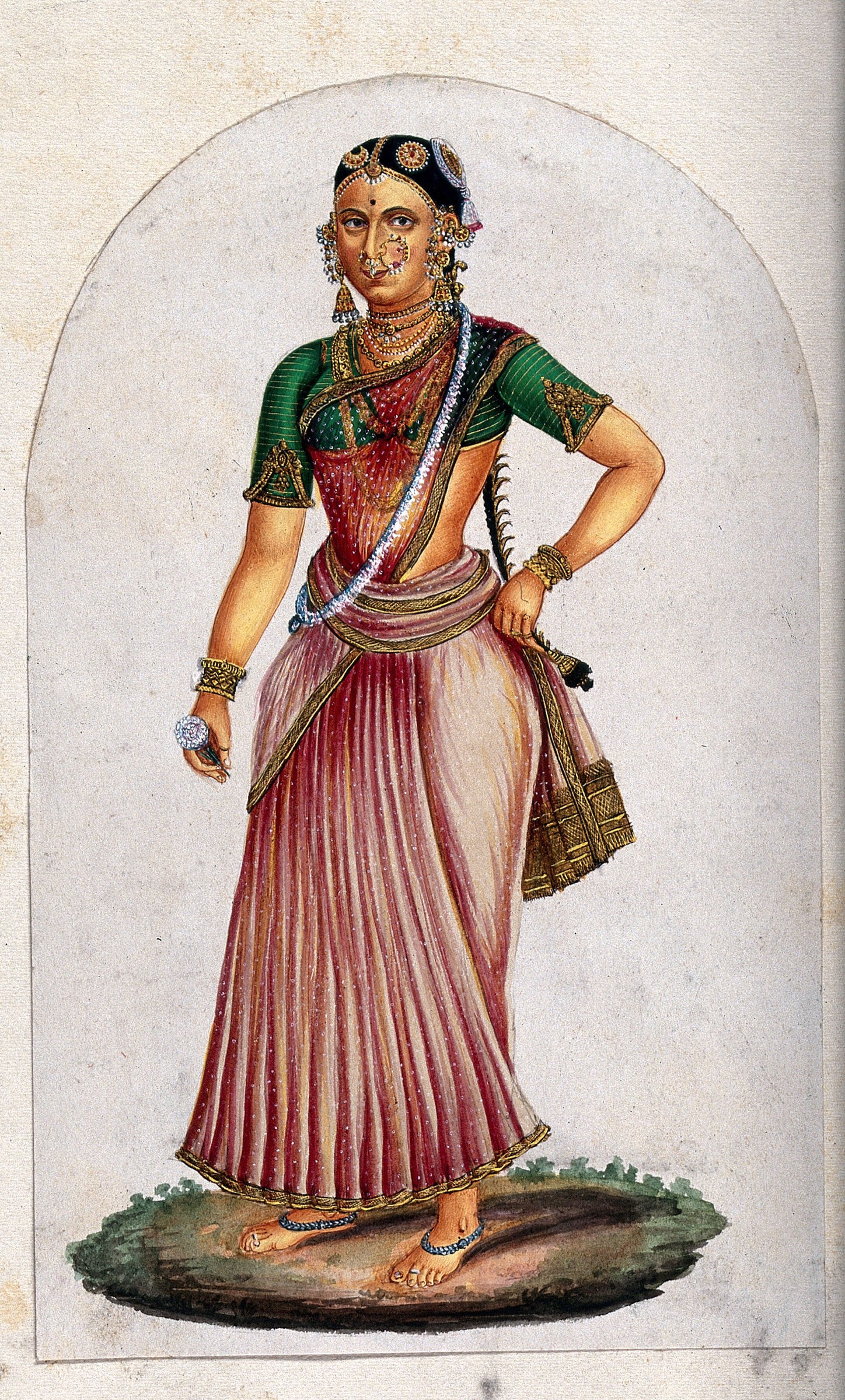
A Indian woman dancer, holding a flower in one hand. Gouache painting by an Indian artist.
Unknown artist
- Source:
- Wellcome Collection
- Rights:
- Public domain — free to use, share and adapt.
- Recorded as:
- Public Domain Mark
For historians of Indian classical dance, this image provides rare visual documentation of costume detail, jewelry arrangement, and facial ornamentation in the colonial period, at a time when these traditions were being suppressed and redefined. For art historians, it exemplifies the genre of ethnographic costume documentation that proliferated in nineteenth-century collections, revealing both what Europeans chose to document and how Indian dancers were visually presented to European audiences as exotic, ornamental subjects rather than as artists.
What you are looking at
A woman stands barefoot in a three-quarter pose against a plain cream ground, positioned on a small earthen platform suggested by ochre and green tones at the base. She wears elaborate South Asian classical dance costume: a deep crimson pleated skirt (likely a dhoti or similar wrapped lower garment) with gold brocade edging, a short green silk upper garment with gold embroidery at the chest and sleeves, and multiple layers of gold-bordered fabric at the waist. Her body is ornamented with heavy jewelry—a multi-stranded choker, large circular pendant earrings, bangles on both wrists, and a ring visible on her left hand. Her face is marked with bindi and facial decorations characteristic of classical Indian dance; her dark hair is crowned with an ornate jeweled headdress featuring circular gold elements. She holds a single flower delicately in her right hand, and her left hand rests at her hip. The pose is frontal and composed, displaying the full costume with the figure's gaze directed outward. The image is rendered in gouache with careful attention to textile pattern, jewelry detail, and skin tone, framed by a faint arched border suggestive of an archival or documentary presentation.
The dancing
The dancer's posture is upright and formal, with weight evenly distributed on both feet; the stance appears symmetrical and stationary rather than caught mid-movement. Her arms are held simply, one hand relaxed at the hip and the other extended downward holding the flower—a gesture of offering or ornamentation rather than a dynamic movement phrase. The body displays no clear weight shift, twist, or spatial extension into the space. The pose reads as presentational and frontal, typical of ethnographic or costume documentation rather than a moment of dancing action.
The dance depicted
This is a costume study or ethnographic document of a classical Indian female dancer, most likely from the early nineteenth century based on the style of rendering and the archival provenance. The jewelry, facial marking, and wrapped skirt are consistent with Bharatanatyam or another major classical Indian dance tradition, though the formal, stationary presentation of the figure makes it difficult to identify the specific dance or movement vocabulary being performed. The image appears to document costume and adornment rather than capture a step, mudra sequence, or recognizable choreographic phrase. The flower may indicate a character type or thematic role, but without contextual information the specific narrative or performance context cannot be determined.
How it was made
This is a gouache (opaque watercolor) painting on paper, a medium that allowed for both the fine detail visible in jewelry and facial ornamentation and the flat, bright color characteristic of Indian miniature and documentary painting traditions. Gouache's matte finish and opacity are evident in the solid color grounds and the way highlights catch on gold embroidery and metal. The technique suggests this was made for reproduction or circulation—either as part of a series documenting Indian dance and costume for a British audience, or as an artist's study sheet. The plain background and arched border frame indicate archival or portfolio presentation rather than a narrative composition.
About this work
This is a gouache study of an Indian classical dancer in full costume and jewelry, rendered in a style that bridges European documentation practices and Indian painting conventions. The work is neither a snapshot of performance nor a narrative scene, but rather a formal costume plate—a type of image produced widely in the nineteenth century to record the appearance, dress, and adornment of dancers from colonized regions for European consumption and collection. It belongs in a dance history context both as evidence of how dancers dressed and adorned themselves, and as a document of how European and European-trained artists chose to represent non-Western dance when it was mediated through the archive rather than witnessed in performance.
The painting's value lies not in capturing movement or choreography, but in its meticulous rendering of textile, jewelry, and cosmetic practice. It is an artifact of the meeting between Indian classical dance traditions and nineteenth-century ethnographic representation.
How to look at it
Attend first to the costume and jewelry: the specific arrangement of the skirt, the layering at the waist, the weight and placement of every ornament. These details are rendered with precision and would have been essential for understanding how a classical Indian dancer actually dressed and moved. Notice that the artist chose not to capture movement—the figure is still and frontal, posed for display rather than caught mid-step. This choice tells you something important: this is ethnographic documentation, made to record appearance and costume rather than to convey the experience or artistry of dance performance. The flower in the extended hand is the only gesture; everything else is static presentation.
The artist
The artist is not recorded in the catalogue, but the style suggests either an Indian artist working in a hybrid gouache-and-watercolor medium influenced by European techniques, or a European artist working in India with knowledge of Indian painting conventions. The archival framing and precise attention to textile detail are consistent with commission-based costume documentation produced for colonial collections, institutions, or wealthy patrons. Such work was often collaborative or collective, with individual artists' names lost to archival practice.
The period
This work dates to the early nineteenth century, a period when Indian classical dance traditions including Bharatanatyam were under pressure from colonial administration and missionary activity, yet simultaneously being collected, documented, and exoticized by European institutions. The ethnographic costume plate became a standard form during this period, part of the broader project of visual anthropology that treated non-Western performance, dress, and bodies as specimens for documentation. The gouache medium itself reflects the circulation of Indian painting techniques through European channels, and the careful rendering of jewelry and textile speaks to a moment when such details were being systematically recorded before performance traditions were radically transformed under colonial rule.
Where it lives
The work is held by the Wellcome Collection, a major archive of medical, scientific, and ethnographic imagery. Its presence there indicates it was collected as part of broader documentary projects on Indian society, health, and culture—a context that shaped how such images were categorized and preserved, often separate from dance or performance history.
Dance in this work
Questions about this work
Why does she look so still? Is this actually a dance image?
This is a costume study or ethnographic documentation, not a captured moment of performance. The formal, frontal pose was used to display costume, jewelry, and adornment clearly for the record. For colonial-era documentation, the dancer's body was often stilled and presented as a specimen, which tells us something important about how these images were made and for whom.
What is the jeweled headdress? Is this a specific role?
The headdress and extensive facial marking and jewelry are characteristic of classical South Indian dance, particularly Bharatanatyam, though the precise character or role cannot be determined from this image alone. In classical Indian dance, jewelry and headdress are fundamental to costume and narrative identity, not mere decoration.
Who made this and when?
The artist is not recorded in the catalogue. Based on the gouache technique, the style of costume documentation, and the archival handling, this appears to date to the early nineteenth century and was likely made either by an Indian artist working in a European-influenced medium or by a European artist in India. Such works were often made on commission for collectors or institutions.
What does the flower mean?
In the context of classical Indian dance, flowers carry symbolic meaning and may indicate a character type, emotional state (rasa), or thematic element. However, without additional context, the specific meaning here cannot be determined. It may also have been chosen by the artist or patron as a compositional element to soften the formality of the pose.
More dance artwork





