49 works in this view — arrow keys or swipe to move between them.
Dance in Art
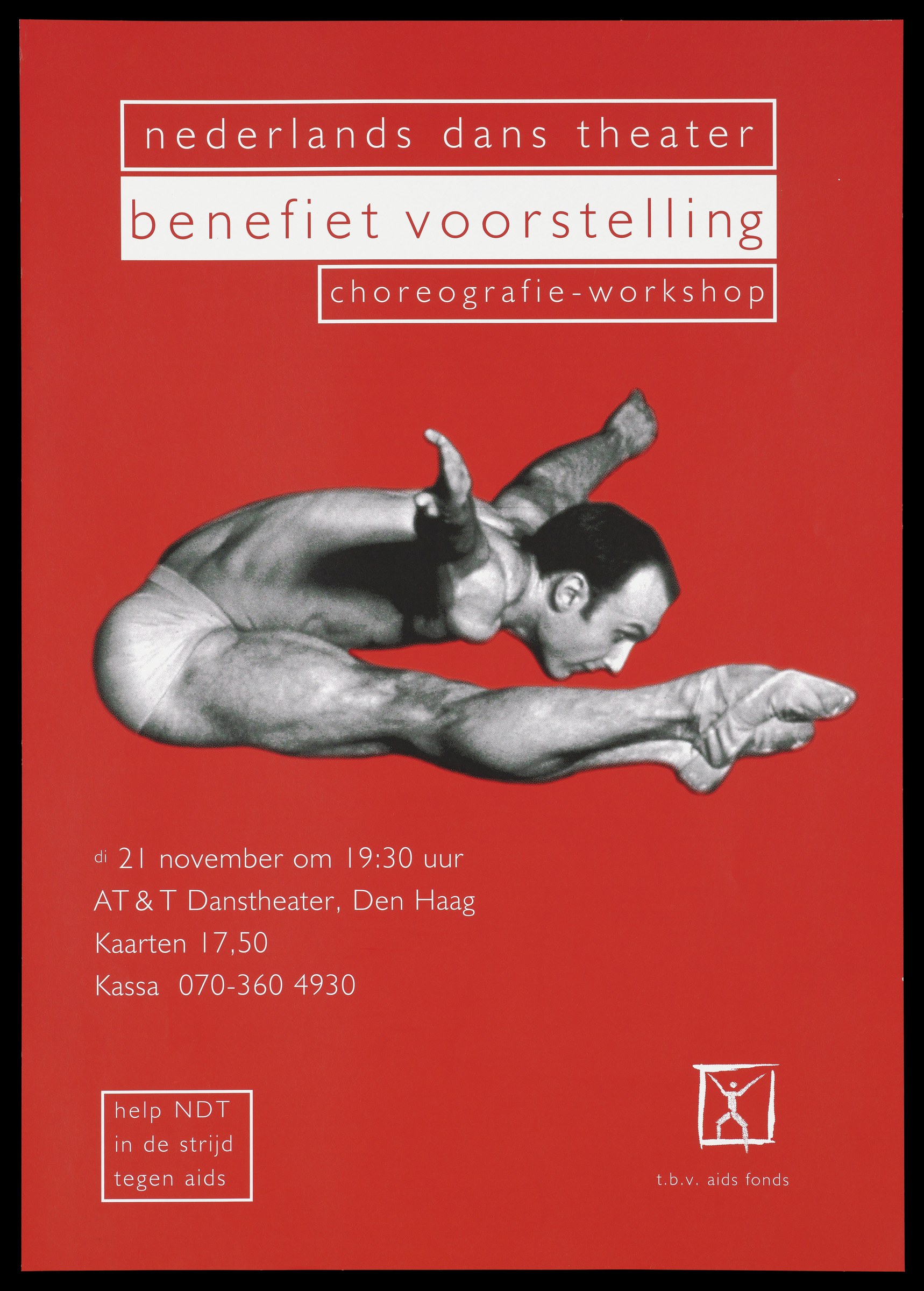
A male dancer jumping with his body and arms horizontal representing an advertisement for an AIDS benefit performance at the AT & T Danstheater, Den Haagh [The Hague] by t.b.v. AIDS Fonds. Colour lithograph.
Unknown artist
- Source:
- Wellcome Collection
- Rights:
- Rights reserved by the holding institution — do not reuse without permission. Source record ↗
- Recorded as:
- In copyright
This work documents the Netherlands Dance Theater at a specific moment of social engagement and artistic confidence, while also testifying to how dance companies and visual artists responded to the AIDS crisis. The image is also a technical study: it shows how a lithographer could render muscular athleticism and airborne suspension in a way that celebrates the dancer's body while serving a serious public health message.
What you are looking at
A male dancer is captured mid-leap against a brilliant red background, his body nearly horizontal in a powerful horizontal jump. His musculature is rendered in bold black and white contrast, emphasizing the athletic extension of his form. He wears minimal costume—a dark tank top or sleeveless shirt and light-colored briefs—allowing full visibility of his trained physique. His arms are extended forward in a streamlined position, and his legs are stretched long behind him, the body aligned in a single extended line from fingertips to toes. This is a promotional lithograph for a benefit performance, with text in Dutch announcing details of the event: a Netherlands dance theater (Nederlands dans theater) benefit performance (benefiet voorstelling) featuring a choreography workshop (choreografie-workshop) at AT&T Danstheater in The Hague on 21 November at 19:30, tickets 17.50 guilders, with contact information for the AIDS Fund (aids fonds).
The dancing
One male dancer, fully extended in a horizontal flying leap. His core is engaged and lifted; his arms reach forward in a streamlined carriage; his legs trail in full extension behind. The frame is entirely occupied by his airborne body, isolating him against the red field. The musculature visible in the black-and-white rendering—particularly in the torso, shoulders, and legs—indicates a body trained in demanding contemporary or modern technique requiring sustained elevation and controlled extension.
The dance depicted
This is contemporary or modern dance of the Netherlands, specifically from the Nederlands Dans Theater (NDT), a company renowned for neoclassical and contemporary work since its founding in 1959. The leap depicted—a horizontal jump with full body extension—is characteristic of NDT's style: athletic, weightless, formally composed, and demanding of extreme control. The image dates to a period when NDT was at the forefront of European contemporary dance, combining classical control with street-level athleticism. The benefit context indicates this was created to raise funds for AIDS awareness, placing it in the 1980s or early 1990s when such benefits became urgent cultural events across Europe.
How it was made
A colour lithograph, which is immediately evident from the flat colour planes, the bold red ground, and the registration of the white text boxes and black photographic image. Lithography allowed for dramatic high-contrast imagery and relatively economical reproduction for promotional use—appropriate for a theatrical benefit where multiple copies would be distributed. The technique's capacity to combine photographic naturalism (in the dancer's rendered musculature) with graphic boldness (the red field, the sans-serif typography) makes it ideal for public health messaging paired with artistic promotion.
About this work
This is a benefit poster for the Netherlands Dins Theater, created to advertise and fund-raise for a choreography workshop and performance event supporting AIDS prevention and treatment (the AIDS Fund, t.b.v. AIDS Fonds). The unknown designer used the dynamic horizontal leap of a trained male dancer to embody both the athletic virtuosity of NDT and the urgent, forward-facing imperative of AIDS activism in the late 1980s or early 1990s. The image is both promotional artifact and historical document: it records a moment in dance history when contemporary dance companies became visible advocates for public health, and it freezes a specific moment of athletic virtuosity—the weightless horizontal jump—as an icon of modern dance's power.
How to look at it
Attend first to the moment of suspension: the dancer is caught at the apex of a horizontal leap, body fully extended and weightless. Note how the lithographer has used black line and musculature rendering to emphasize the work of the body in sustaining that extension—every muscle group is visible and defined. The red background does not recede; it presses forward, making the black-and-white figure vibrate against it. This graphic boldness is the key to the poster's effectiveness: the leap is not naturalistic but iconic, abstract enough to stand as a symbol of both dance's power and the forward momentum demanded by health activism.
The period
The Nederlands Dans Theater was founded in 1959 and by the 1980s had become one of Europe's most influential contemporary dance companies, under the direction of Jiří Kylián. The company blended neoclassical rigor with modern athleticism and often engaged with social and political themes. In the late 1980s and early 1990s, as the AIDS crisis deepened across Europe, many cultural institutions began organizing benefit performances and fundraising events. In the Netherlands, AIDS activism and cultural response were particularly visible, with artists, performers, and designers lending their work to awareness campaigns. This poster sits at the intersection of that activism and NDT's own artistic visibility.
Where it lives
The work is held in the Wellcome Collection in London, which collects objects related to medicine, science, and social history. Its presence there as a health promotion artifact rather than primarily as an artwork reflects its dual nature as both dance promotion and public health messaging.
Dance in this work
Questions about this work
Is this a photograph or a drawing?
It is a colour lithograph, which is a printmaking technique. The artist worked from a photograph of the dancer, but rendered it using lithography, which uses oil and water-based inks on stone. This allowed for the bold red background and sharp graphic impact while preserving photographic detail in the dancer's body. Lithography was economical for making multiple copies for distribution, making it ideal for a promotional poster.
What is Netherlands Dans Theater (NDT)?
NDT is one of Europe's most important contemporary dance companies, founded in 1959. It is known for combining classical ballet training with modern and athletic movement, and for engaging with contemporary social themes. The company has been led by choreographers including Jiří Kylián and Hans van Manen, and it remains influential today.
Why would a dance company create a benefit poster for AIDS?
From the late 1980s onward, the AIDS crisis had devastating impact across Europe, including among performing artists. Many cultural institutions organized benefit performances and fundraising events to support treatment, research, and prevention. This poster advertised both the artistic event (a choreography workshop) and its fundraising purpose for the AIDS Fund (aids fonds).
What dance technique is the leap shown here?
The extended horizontal leap with controlled, suspended airtime is characteristic of contemporary and modern dance, particularly the athletic neoclassicism that NDT is known for. It requires years of training in both ballet (for control, turnout, and the ability to sustain extension) and modern dance (for the freedom of the hip and the explosive power of the leap).
More dance artwork





