49 works in this view — arrow keys or swipe to move between them.
Dance in Art
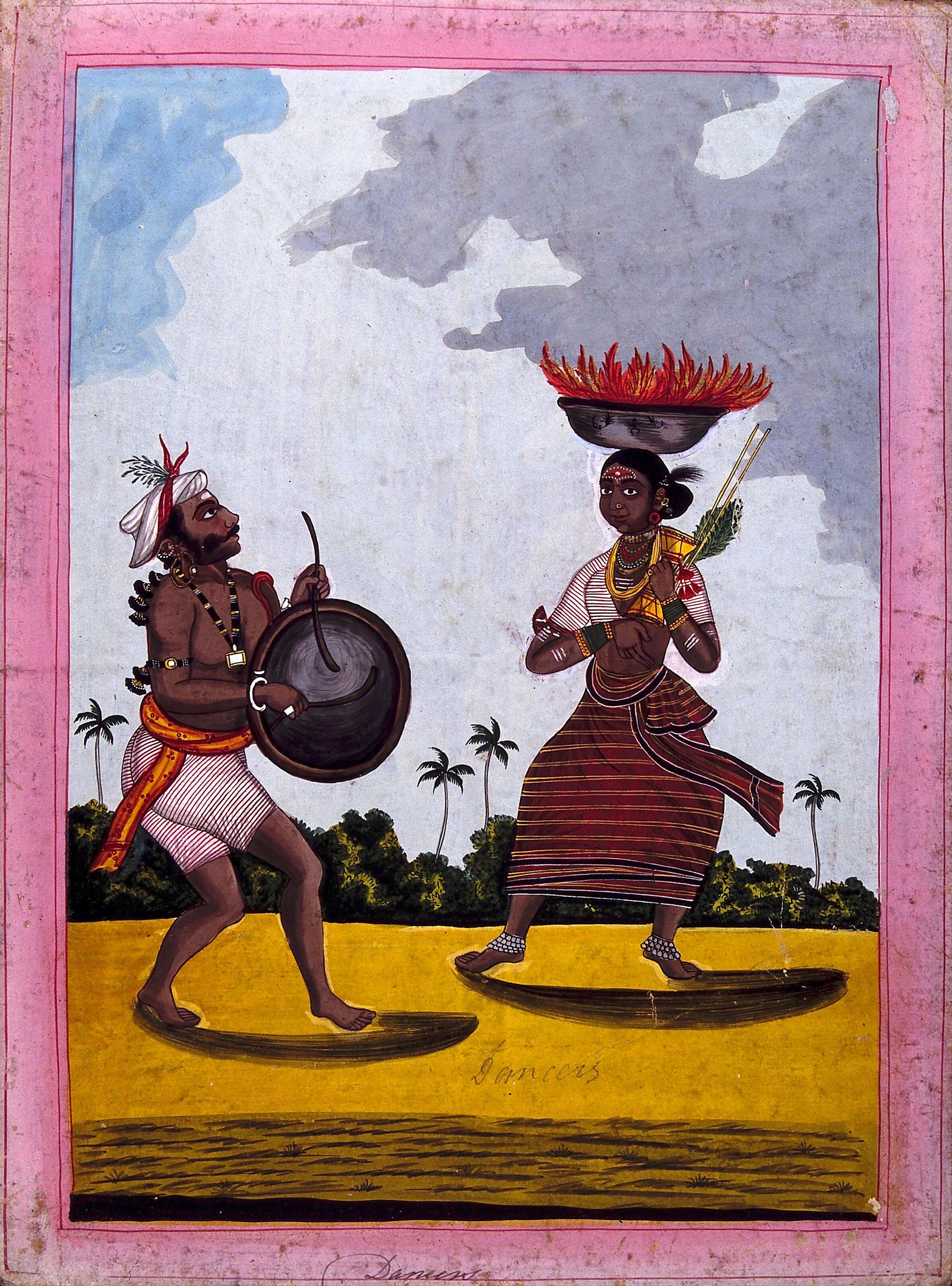
A dancing couple from the Pujari caste. Gouache drawing.
Unknown artist
- Source:
- Wellcome Collection
- Rights:
- Public domain — free to use, share and adapt.
- Recorded as:
- Public Domain Mark
This is one of the few visual records of Pujari caste dance from the period before professional ethnographic film. The specificity of the caste identification in the title and the attention to costume, regalia, and bodily posture make it valuable evidence for understanding regional and ritual performance traditions in South Asia that have since been transformed or displaced. For scholars of colonial visual culture, it documents how European institutions recorded non-European dance, using the caste system itself as the organizing principle of ethnographic observation.
What you are looking at
Two figures in dynamic motion occupy a bright yellow-gold ground beneath a pale cloudy sky. The figure on the left wears a white headwrap with a red feather plume and striped lower garment in orange and white; he holds a large dark circular shield or gong with one hand and a beater or stick in the other, his body twisted in a lunging pose. The figure on the right wears a striped garment in rust and gold tones and carries a substantial red feather arrangement balanced on her head—a large semicircular or fan-shaped ornament of brilliant red plumage—while holding what appears to be a staff or pole in one hand and gesture upward with the other. Both figures wear multiple strands of beads around their necks and shoulders. Palm trees dot the middle ground, situating the scene in a tropical setting. The composition freezes a moment of vigorous movement: both dancers are shown mid-action, their bodies angled and limbs extended, suggesting rapid or bouncing motion. The work is executed in gouache, with crisp outlines in black ink defining the forms against the pale background.
The dancing
Both dancers are shown in dynamic, weight-shifted stances rather than still poses. The male figure's torso is sharply twisted, one leg bent and body leaning forward in a characteristic lunging or bouncing action. The female figure's posture is more upright but energized, with one arm raised and her body poised as though in mid-step or mid-bounce. Neither figure shows a formal ballroom or classical hold; instead, each occupies independent space and moves through individual gesture. The arm positions—one with the gong and beater, the other with staff and raised hand—suggest these are not just dance movements but also percussion or prop work integral to the performance. The weight distribution and bent knees in both figures suggest a style involving rhythmic bouncing or springing action.
The dance depicted
This appears to document a ritual or ceremonial dance practice from South Asia, most likely from a Pujari (priestly or ritual specialist) caste community in India. The palette, costume elements (beads, feathered headdress, striped garments), and the integration of percussion suggest a sacred or festive context. The prominent feathered headdress on the female dancer and the shield/gong held by the male figure point toward a performance tradition integrating movement with sound-making and regalia specific to South Asian ritual or regional performance styles. The bouncing, weight-shifted postures and independent spatial relationship between the dancers suggest this is not a paired ballroom form but a participatory or processional style, possibly connected to festivals, temple observances, or martial traditions. Without additional documentation, the specific style cannot be definitively identified, but the visual evidence points toward global-south-asian folk or ceremonial dance practice.
How it was made
This is a gouache painting on paper, a water-based medium that allows bright, opaque color and crisp definition. The artist has used black ink outlines to define all major forms—the bodies, clothing, headdress, and shield—creating a graphic clarity typical of 18th or 19th-century European illustrated manuscripts documenting non-European peoples and practices. The technique of gouache with ink outlines was commonly used in European ethnographic or naturalistic illustration, especially in colonial documentation. This approach emphasizes color and outline over modeling in light and shadow, making the work legible from distance and suitable for reproduction or circulation as part of a larger ethnographic series. The pink-bordered frame and overall presentation suggest this was one plate in a documented collection of caste or regional dance types.
About this work
This gouache drawing documents a dance performance by members of the Pujari caste, a hereditary priestly community in India. The work captures two dancers in vigorous, bouncing movement, the male wielding percussion (shield or gong) and the female bearing an elaborate red feather headdress, both adorned with beads and regalia suggesting ritual or festive context. The style and costume point toward South Asian sacred or regional ceremonial dance rather than classical forms, executed with the graphic clarity typical of 18th or 19th-century European ethnographic illustration.
This is a primary visual record of a performance tradition that remains poorly documented in dance history. The image preserves not only the visual appearance of costume and regalia but also the bodily posture and weight distribution of the dancers, offering insight into how movement was understood in this tradition. The inclusion of the drawing in a European collection (the Wellcome Collection) reflects the colonial-era practice of documenting "exotic" caste and regional practices, making it both a dance document and a document of how European institutions classified and preserved knowledge of South Asian culture.
How to look at it
Attend first to the posture and weight of the bodies: both dancers are caught in a moment of dynamic action with bent knees and shifted weight, suggesting a performance style built on bouncing, springing, or rhythmic stepping rather than static poses. Notice how the artist has chosen to show the dancers in mid-motion rather than in a standing rest position, which tells us that the movement itself—not mere costume display—was considered important to document. The placement of the percussion instrument (shield/gong) in the male dancer's hands and the feathered headdress balanced on the female dancer's head indicates that regalia and sound-making were integral to the dance form, not separate from it. The independent spacing and gesture of the two figures—no hand-hold, no mirroring—shows that this was a style in which individuals or pairs moved through their own spatial field while possibly coordinating rhythmically.
The period
This work dates to an era—likely 18th or 19th century—when European naturalists and physicians were systematically collecting visual documentation of colonial subjects, including their dress, customs, and performances. The Wellcome Collection, a major repository of such material, contains thousands of similar ethnographic sketches and paintings. During this period, South Asian caste practices and regional performance traditions were being observed and illustrated by European visitors and colonial administrators. The caste system itself was being systematized and documented as a curiosity of Indian society. Dance and music were understood primarily as markers of caste identity and social rank, a framework that shaped how these performances were recorded and presented to European audiences.
Where it lives
The work is held in the Wellcome Collection, a major repository of medical, scientific, and ethnographic visual material accumulated by the British pharmaceutical entrepreneur Henry Wellcome (1853–1936). This drawing appears to be part of the Collection's extensive holdings of Indian caste and occupational documentation, likely acquired during the height of British colonial interest in the visual classification of Indian society.
Dance in this work
Questions about this work
What is a Pujari caste?
Pujari traditionally refers to priestly or ritual specialists in South Asian Hindu communities, often hereditary roles responsible for temple worship and ceremonies. The term can also apply to performers associated with ritual contexts. In colonial ethnographic classification, the term was used more broadly to categorize occupational and social groups.
What is the red feathered object on the dancer's head?
The nature and significance of this regalia is not documented in the available records. It may be a ceremonial crown, a ritual ornament specific to Pujari performance traditions, or a marker of a particular festival or rank. Similar feathered headdresses appear in South Asian martial and festival performance traditions.
Is this a couple's dance?
It appears to be a paired or duo performance, but not in the sense of a ballroom dance with formal holds or synchronized movement patterns. The two dancers occupy independent space and gesture, suggesting either a processional or ceremonial context in which two performers move simultaneously in complementary roles.
How do we know when this was made?
The catalogue record does not specify a date. The gouache technique, the style of ethnographic documentation, the pink-bordered frame, and the European interest in caste classification all suggest an 18th or 19th-century origin, likely during the colonial period. Comparison with other works in the Wellcome Collection would help narrow this range.
More dance artwork





