49 works in this view — arrow keys or swipe to move between them.
Dance in Art
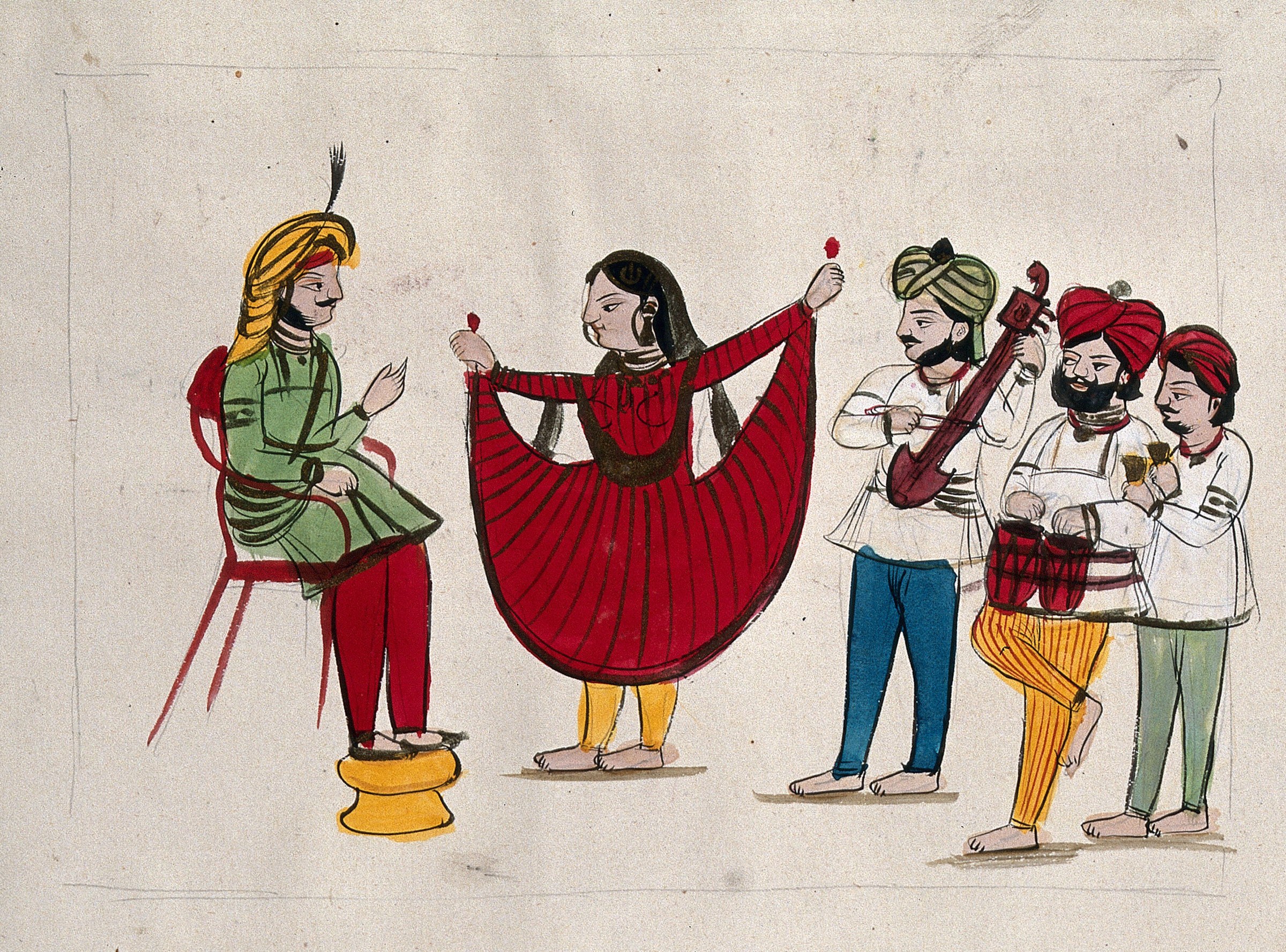
Page 32: a dancing girl with musicians performing. Watercolour drawing.
Unknown artist
- Source:
- Wellcome Collection
- Rights:
- Public domain — free to use, share and adapt.
- Recorded as:
- Public Domain Mark
This image documents a dance tradition and performance context from the pre-colonial or early colonial South Asian court that cannot be identified from surviving textual sources alone. It shows how dance was staged, who performed it, what instruments accompanied it, and how the body was positioned in formal display—knowledge that is otherwise lost. For historians of South Asian dance, this is primary visual evidence of a world before the codification of classical forms.
What you are looking at
A watercolour drawing depicts a performance scene with a central female dancer in a red pleated skirt and striped upper garment, her arms raised in an open, expansive gesture. She stands barefoot on level ground, facing left in profile. To her left sits a male figure on a low golden platform wearing a yellow turban with a tall black plume, a green tunic, and red leggings—he holds a small object to his mouth, possibly a musical instrument. To the right of the dancer stands a group of five male musicians and attendants, also barefoot, wearing white tunics with red and gold accents, turbans in various colors (red, green, gold), and displaying various instruments or ceremonial objects. The composition is shallow and arranged in a frieze-like horizontal band, with minimal background detail. The figures are rendered in a style consistent with Indo-Persian manuscript illustration: flat perspective, jewel-like color, careful pattern work in the garments, and precise black outlines.
The dancing
The central dancer's pose is open and linear: both arms raised or extended, torso upright, weight evenly distributed on both feet in a standing position. Her gesture suggests a moment of display or salutation rather than dynamic movement through space. The musician on the left appears to be producing sound, while the attendants to the right are static, arranged in a loose group. None of the figures show the torsion, flexion, or weight-shift characteristic of South Asian classical dance. The composition emphasizes presentation and hierarchy rather than kinetic momentum.
The dance depicted
This is most likely a depiction of a court or performance context rather than a named classical dance technique. The style—female performer in motion, male musicians, formal setting, and Indo-Persian dress—points toward Mughal or early modern South Asian court entertainment, possibly representing a form of entertainment known in Persian or Urdu sources. The raised-arm posture and open stance do not correspond to Bharatanatyam, Kathak, or other classical Indian forms. The image may document a regional or courtly dance tradition that is no longer widely practiced, or a moment of social or ceremonial performance rather than formal technique.
How it was made
This is a watercolour drawing on paper, executed in the Indo-Persian or Mughal manuscript tradition. The technique relies on transparent washes of color layered over black ink outlines, a method that allowed rapid production and circulation of illustrated manuscripts and single-leaf drawings. The flatness of form, jewel-toned palette (lapis blue-green, vermillion, gold), and careful rendering of pattern and fabric suggest a trained workshop hand. Such works were created for courts, patrons, and collectors, and typically served documentary or entertaining purposes within elite households.
About this work
This watercolour records a moment of court or ceremonial performance in what appears to be a Mughal or early modern South Asian setting. A female dancer in red stands at the center of a formal arrangement of musicians and attendants, her pose open and elevated rather than technically virtuosic. The work is an example of Indo-Persian manuscript illustration applied to dance documentation—a visual record of how performance was staged, dressed, and valued in a particular time and place. Such images are rare evidence of dance forms and contexts that left no other historical trace.
How to look at it
Attend to the dancer's posture and the spatial relationship between performer and musicians: she is elevated and frontal, presented rather than in motion. Notice the careful detail in the garments—the pleating of her skirt, the striping and banding of the tunics, the variety of turbans—as markers of social status and professional role. The barefoot stance and the formal, horizontal arrangement of figures suggest a moment of display or inauguration rather than narrative dance. The artist has chosen stillness and presentation over movement, which may indicate either the conventions of the form or the conventions of documentary illustration.
The period
This work dates stylistically to the Mughal period (16th–18th century) or the early modern courts of South Asia influenced by Indo-Persian visual culture. During this era, court dance was a valued form of elite entertainment, often performed by women for royal and aristocratic audiences. Musicians, dancers, and attendants formed professional hierarchies within courts. The visual conventions used here—hierarchical arrangement, formal costume, instrumental accompaniment—reflect the structured nature of such performances. By the 18th and 19th centuries, such court traditions were disrupted and transformed by colonialism, and many regional performance forms vanished or were reinterpreted.
Where it lives
This work is held in the Wellcome Collection, a major research library and museum of the history of medicine and science in London. The collection includes significant holdings of Indo-Persian manuscripts and illustrated leaves, many acquired during the colonial period. The work's cataloguing as 'Page 32' suggests it may be a single leaf from a dispersed manuscript or album.
Dance in this work
Questions about this work
What kind of dance is this?
The specific form cannot be identified with certainty. The style, dress, and context point to a Mughal or early modern South Asian court performance tradition. The open-armed pose and barefoot stance are consistent with courtly rather than classical Indian dance, but without written sources or further context, the form remains unknown.
Who made this drawing?
The artist is not recorded. The work shows the hand of a trained Indo-Persian manuscript illustrator, likely working in a court or professional workshop, but no signature, inscription, or attribution survives.
When was this made?
The stylistic evidence—technique, color palette, costume, and figure style—points to the 16th–18th century, but an exact date cannot be established without further research or provenance information.
Why are there musicians and attendants shown with the dancer?
Court performances were collective endeavors. The musician on the left provides musical accompaniment, while the attendants likely represent the formal retinue or audience hierarchy of the court. Their presence documents the social and professional structure of performance.
More dance artwork





