49 works in this view — arrow keys or swipe to move between them.
Dance in Art
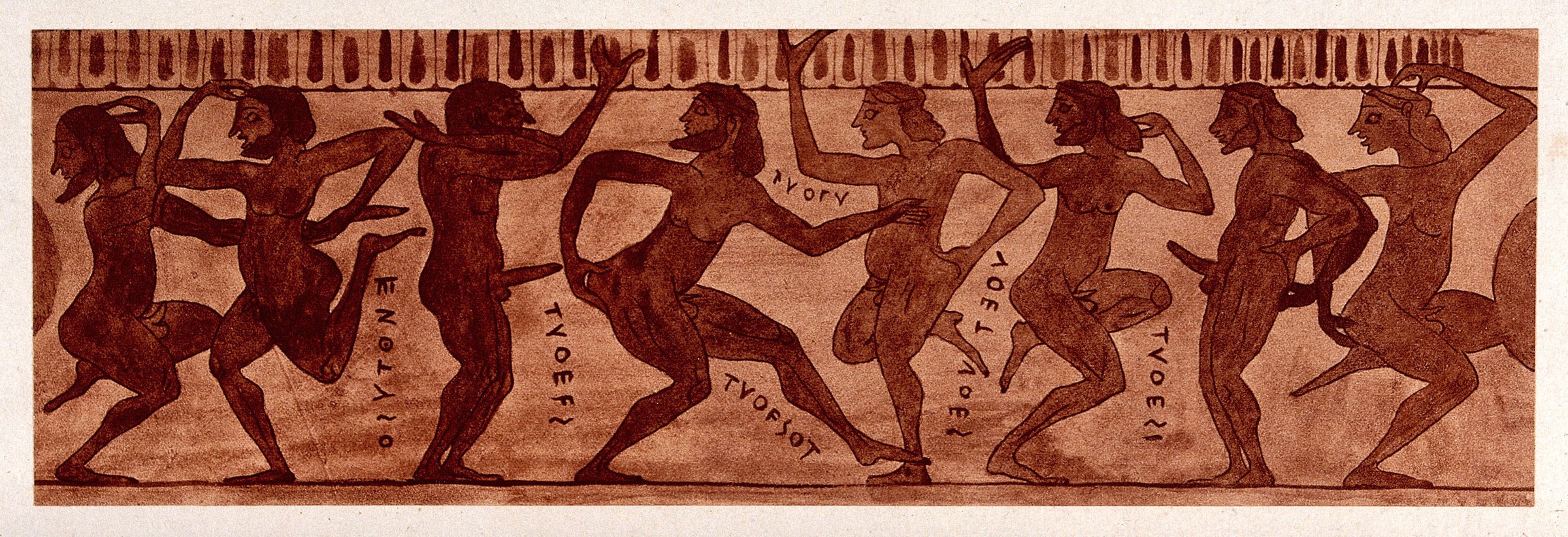
A frieze depicting dancing figures of men. Process print, 1921.
Unknown artist
- Source:
- Wellcome Collection
- Rights:
- Public domain — free to use, share and adapt.
- Recorded as:
- Public Domain Mark
This frieze records an intermediate moment in the history of movement documentation: too schematic and frontal for theatrical dance, too ordered and repeated for pure athletics, and predating most formalized systems of movement notation. It shows how print culture in the early twentieth century served to study, analyze, and standardize the moving body—a concern central to modern dance, Olympic athletics, and industrial time-motion study alike.
What you are looking at
A horizontal frieze of eight male figures rendered in reddish-brown silhouette against a lighter ground, arranged in a continuous processional composition. The figures are nude or near-nude, moving from left to right in dynamic poses that suggest vigorous leaping and jumping. Each figure is caught mid-action with limbs extended—arms raised, legs splayed or bent in suspension. The ground line is marked by a decorative geometric border at top and bottom. Between several figures are inscribed labels in small capitals: "IVORY" appears above the central figures, and "TYBFOV" (or similar abbreviated text) labels other sections. The style is consistent with classical frieze conventions but the labeling is cryptic and suggests this may be a diagram, study, or annotated document rather than a standalone artwork.
The dancing
The dancers are shown in successive snapshots of a jumping or leaping action. Each figure displays high extension through the legs and torso, with arms either raised overhead or extended outward for balance. The postures suggest rapid, energetic elevation off the ground—typical of acrobatic or gymnastic display rather than balletic control. There is no partnering or formation; each figure is isolated in its own trajectory. The weight appears distributed through balls of the feet, with knees bent and torsos arched, creating a sense of airborne movement frozen in sequence. The musculature is suggested through simple contour and tonal variation rather than anatomical detail.
The dance depicted
This appears to depict acrobatic or athletic jumping rather than a formalized dance tradition. The sequence and energy recall ancient Greek or Roman athletic imagery, though the cryptic inscriptions complicate that reading. The figures may represent a gymnastic or acrobatic routine photographed or illustrated as a study of human movement in flight. Without clearer context for the labels or date of the work, it is difficult to assign this to a named dance tradition. The repetitive pose and sequential presentation suggest either a pedagogical study of jumping technique or a record of an acrobatic display. The formal conventions recall movement notation or photographic motion study rather than traditional dance documentation.
How it was made
The catalogue record identifies this as a process print from 1921, suggesting photomechanical reproduction rather than hand-drawn artisanal printmaking. The silhouette effect and uniform brown tonality are characteristic of rotogravure or similar photo-based printing methods that were used in early twentieth-century publishing for educational and scientific illustration. The technique allowed rapid production of consistent copies and suited the documentary intent of what appears to be a movement study or instructional diagram. The precision of line and regularity of the composition suggest this was printed rather than drawn.
About this work
This is a frieze-format study of eight male figures executing a jumping or flying movement, presented as a continuous sequence in silhouette. The work is printed in brown on tan paper using early twentieth-century photo-mechanical reproduction, a process suited to educational and scientific illustration. Whether representing ancient athletic tradition, contemporary acrobatics, or experimental movement documentation remains unclear from the image alone. The work belongs in a dance gallery as evidence of how artists and publishers documented and analyzed human movement in the years immediately after the emergence of motion photography—a period when dance, athletics, gymnastics, and biomechanical study were not yet fully separated disciplines.
How to look at it
Trace the progression of each figure from left to right and observe how the artist has frozen a repeating moment—takeoff or apex of a jump—across the sequence. The inscriptions, though illegible without context, indicate this was intended as a labeled or classified document, not a decorative frieze. Notice the absence of facial features or individual personality; the emphasis is on the pure geometry and physics of the airborne body. This is movement reduced to its essential lines, as if the body itself were a notation system.
The period
The 1921 date places this work in the early modernist period, when photography had just made possible the scientific analysis of movement and when the Bauhaus and other avant-garde schools were experimenting with abstraction, geometry, and human motion as subjects of art and design. This was also the era when Rudolf Laban was developing his notation system for dance movement (Labanotation), and when artists and choreographers were newly interested in isolating and analyzing the component parts of human movement. The frieze format and silhouette technique reference both classical art history and the simplified, geometric language of modernist design.
Where it lives
The work is held in the Wellcome Collection, a repository of medical, scientific, and social history materials. Its presence there suggests it may have been used for educational, therapeutic, or scientific documentation of human movement rather than created for fine art circulation.
Dance in this work
Questions about this work
What do the inscriptions say?
The visible labels include 'IVORY' and 'TYBFOV' or similar abbreviations, but their meaning is not clear from the image alone. They may refer to movement categories, anatomical regions, or notational stages. Consulting the Wellcome Collection's records or related documents would be necessary to decode them.
Is this based on ancient Greek art?
The frieze format and silhouette style evoke classical Greek pottery and sculpture, but the dated 1921 and process-print technique are distinctly modern. The artist may have been deliberately quoting classical conventions to give authority to a contemporary movement study.
Could this be a dance notation system?
Possibly. The sequential, diagrammatic approach resembles early attempts at movement notation, though it predates Labanotation (1928) and is less schematic. It may represent a hybrid between artistic documentation and functional analysis.
More dance artwork





