49 works in this view — arrow keys or swipe to move between them.
Dance in Art
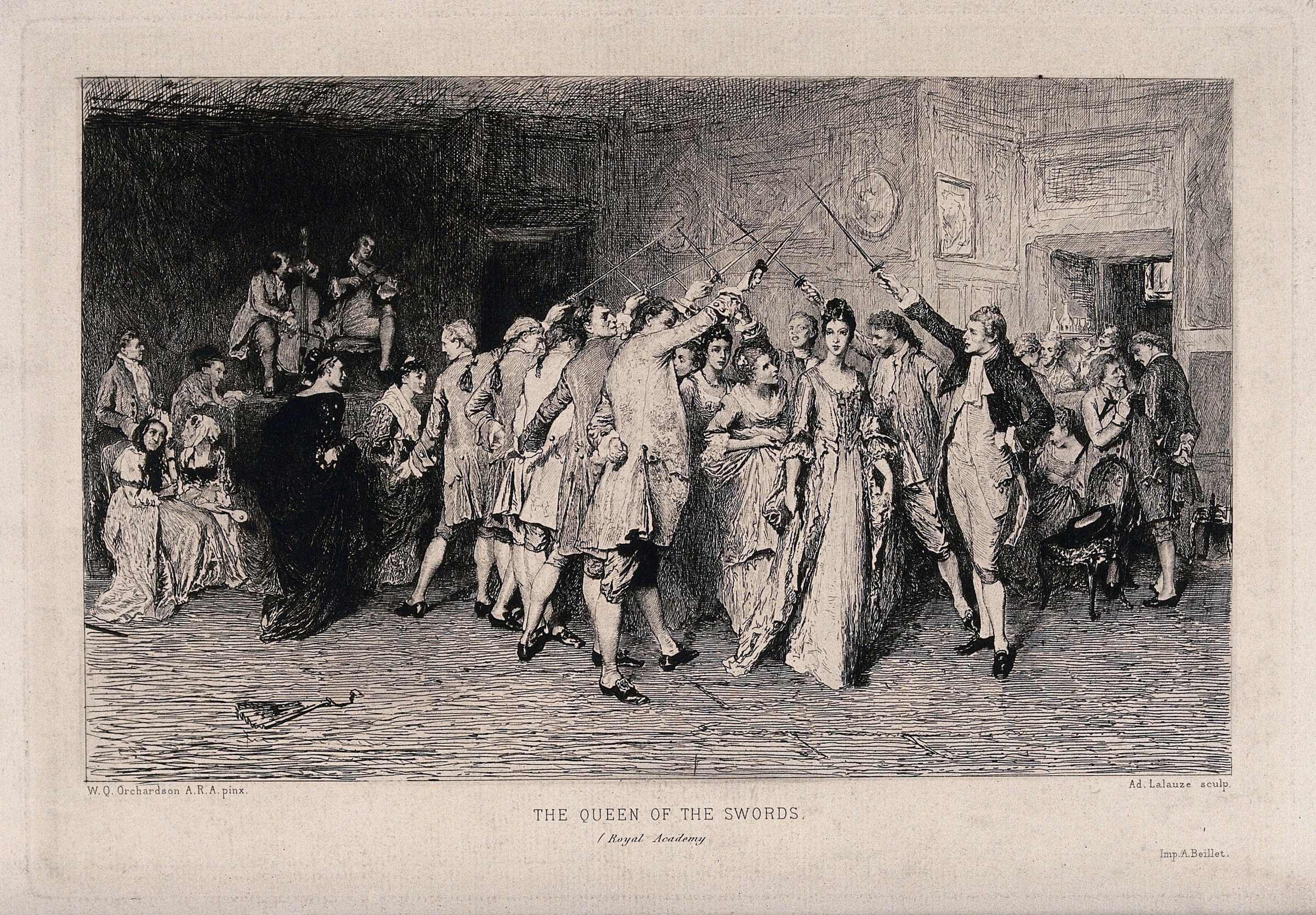
A line of young women are dancing under an arch created by the swords of their male dancing partners. Etching by Ad. Lalauze after W.Q. Orchardson.
Unknown artist
- Source:
- Wellcome Collection
- Rights:
- Public domain — free to use, share and adapt.
- Recorded as:
- Public Domain Mark
The work documents a specific courtly dance figure and the conventions of formal ballroom display in the Georgian or Regency era, showing how dance functioned as structured visual entertainment rather than individual expression. It is rare visual evidence of how 'sword dances' or weapon-based courtly figures were staged and framed, and it demonstrates the marriage of martial symbolism with elegant social performance in aristocratic culture.
What you are looking at
A formal indoor gathering in what appears to be an 18th-century salon or ballroom, its walls lined with classical architectural details—panels, a clock, and doorways visible in the background. A large group of fashionably dressed figures, perhaps twenty or more, crowds the floor in an animated scene. In the center, a line of young women in light, flowing gowns stand with arms raised while men in breeches and jackets hold swords aloft, forming an arch of crossed blades above the women's heads. The composition suggests a moment of choreographed display rather than everyday movement—this is clearly a structured entertainment or dance figure being performed for the assembled company. Several onlookers sit or stand at the margins, watching the action. The etching technique renders the crowd in varying degrees of detail, with the deepest blacks marking the shadowed left side of the room and the figures in the arch of swords catching the most light.
The dancing
The dancing women stand upright with arms extended upward, their bodies arranged in a loose vertical line as they pass beneath the sword arch. The men hold their swords aloft in a synchronized, geometric arrangement—each blade angled to interlock with its neighbors, creating a regular pattern overhead. The women's posture is formal and frontal; there is no evidence of turned-out legs, pointed feet, or the flexed extensions that would characterize ballet. The men's stance is planted and static, focused on holding the frame of swords rather than executing footwork. This is a group formation emphasizing visual geometry and courtly display over individual virtuosity.
The dance depicted
This appears to depict a formal court dance or cotillion figure, likely from the 18th century based on the dress and interior setting. The 'Queen of the Swords' (as the title names it) is a structured courtly entertainment in which couples or lines of dancers move through architectural frames created by male dancers' weapons—a theatrical conceit that merged martial and courtly symbolism. The women process or dance through the arch while the men maintain a static, supporting role. This type of figure appears in formal ballroom culture of the Regency and late-Georgian periods, though the exact choreography is not fully recoverable from the image alone. The emphasis is on spectacle, order, and the visual pleasure of symmetric formation rather than technical display.
How it was made
This is an etching—a print made by incising lines into a metal plate and using those lines to hold ink. The catalogue attributes the design to W.Q. Orchardson (a painter) and credits Ad. Lalauze as the etcher (the craftsman who translated the painting to the plate). Etching allows for fine linear detail and the creation of deep blacks through cross-hatching, both of which are evident here: the dark mass of the shadowed left side, the intricate rendering of fabric folds, and the careful delineation of individual figures within the crowd. As a reproductive print—made after a painting—this would have been more widely circulated and affordable than the original, reaching middle-class viewers interested in contemporary or historical social scenes. The Wellcome Collection's holding suggests it may have been catalogued for its social or antiquarian interest rather than as a primary art object.
About this work
This etching depicts a formal court dance or ballroom figure titled 'The Queen of the Swords,' in which a line of women dance beneath an arch created by crossed swords held by male partners. The work is a print after a painting by W.Q. Orchardson, etched by Ad. Lalauze, and belongs to the tradition of 18th- and early 19th-century social and theatrical documentation. It captures a moment of choreographed courtly display—likely a cotillion or similar formal figure—that emphasizes geometric composition, symmetry, and the visual spectacle of court dance rather than virtuosic movement. The etching medium allowed this scene to reach a broad audience interested in historical manners, court culture, and the aesthetics of social performance.
How to look at it
Observe the geometric precision of the crossed swords and the neat vertical line of women passing beneath them—the artist has chosen a moment of formal stillness or ordered movement rather than dynamic action, emphasizing the visual frame and composition over individual gesture. Note the contrast between the animated crowd of onlookers on the margins and the controlled, almost processional quality of the central figures. The etching's fine lines and cross-hatching create depth, pulling your eye from the shadowed left side through to the lit arch of swords and the figures beneath. Look at the women's upright posture and extended arms—this is not the flexed, turned-out movement of ballet, but the formal carriage of court dance, where presentation and spatial geometry matter more than technical virtuosity.
The artist
W.Q. Orchardson (William Quiller Orchardson, 1832–1910) was a Scottish painter specializing in historical and social narrative scenes, often depicting moments of high drama or formal social ceremony. Ad. Lalauze was a 19th-century French etcher known for reproductive prints after paintings, particularly those depicting historical or social subjects. Lalauze's role was to translate Orchardson's composition into the etching medium, a common division of labor in print production of this period.
The period
This etching belongs to the 19th-century antiquarian revival of interest in historical court culture and manners. The mid-to-late 19th century saw renewed fascination with Georgian and Regency society, expressed through literature, painting, and historical reconstruction. Orchardson and similar painters of the era often depicted 18th-century social scenes—balls, courtships, theatrical moments—as a way of exploring historical elegance and social hierarchy. In dance history specifically, this period saw the codification and documentation of ballroom forms (quadrilles, cotillions, waltzes) and growing nostalgia for earlier, more formal court dances. The 'sword dance' as a motif carries both historical and romantic associations, evoking chivalric tradition and military pageantry merged with courtly sophistication.
Where it lives
This print is held by the Wellcome Collection, a library and museum focused on the history of medicine, science, and the human experience. Its presence in the Wellcome suggests it was catalogued for its social, historical, or antiquarian interest rather than for its technical or artistic significance as a print. The work is an etching made from a painting, a common form of reproductive print in the 19th century designed for broad distribution.
Dance in this work
Questions about this work
What is 'the Queen of the Swords' and was it a real dance?
The title likely refers to a formal courtly figure or cotillion in which a female dancer or 'queen' was featured, and male dancers or partners created an arch of crossed swords for her to move through. Such figures existed in 18th-century court dance and formal ballroom culture, combining military and courtly symbolism. However, the exact historical provenance of this specific figure is not clear from the image alone; it may be a historical reconstruction, a theatrical invention, or a figure documented by Orchardson from a historical source.
Why did court dancers use swords in formal dances?
Swords and other weapons featured in court dances as symbols of martial nobility, courtly honor, and the refinement of military virtue. By including weapons in formal dances, courts demonstrated that martial prowess could be aestheticized and brought under control through elegant movement and geometric precision. It was a way of merging chivalric tradition with social sophistication.
How do we know this is an etching and not a painting?
The catalogue credits Ad. Lalauze as the etcher, and the image shows the characteristic linear quality, cross-hatching, and fine detail of an etched print. Etching creates images through incised lines on a metal plate; you can see this in the way the lines build shadow and texture, particularly in the dark areas on the left side of the composition.
What does the formal line and pose of the women tell us about court dance?
The upright carriage, extended arms, and processional arrangement indicate that formal court dance prioritized presentation, spatial order, and visual symmetry over the flexible, turned-out technique that would later define ballet. Court dancers moved with dignity and formal decorum, arranging themselves in geometric patterns for visual effect rather than executing virtuosic steps or poses.
More dance artwork





