49 works in this view — arrow keys or swipe to move between them.
Dance in Art
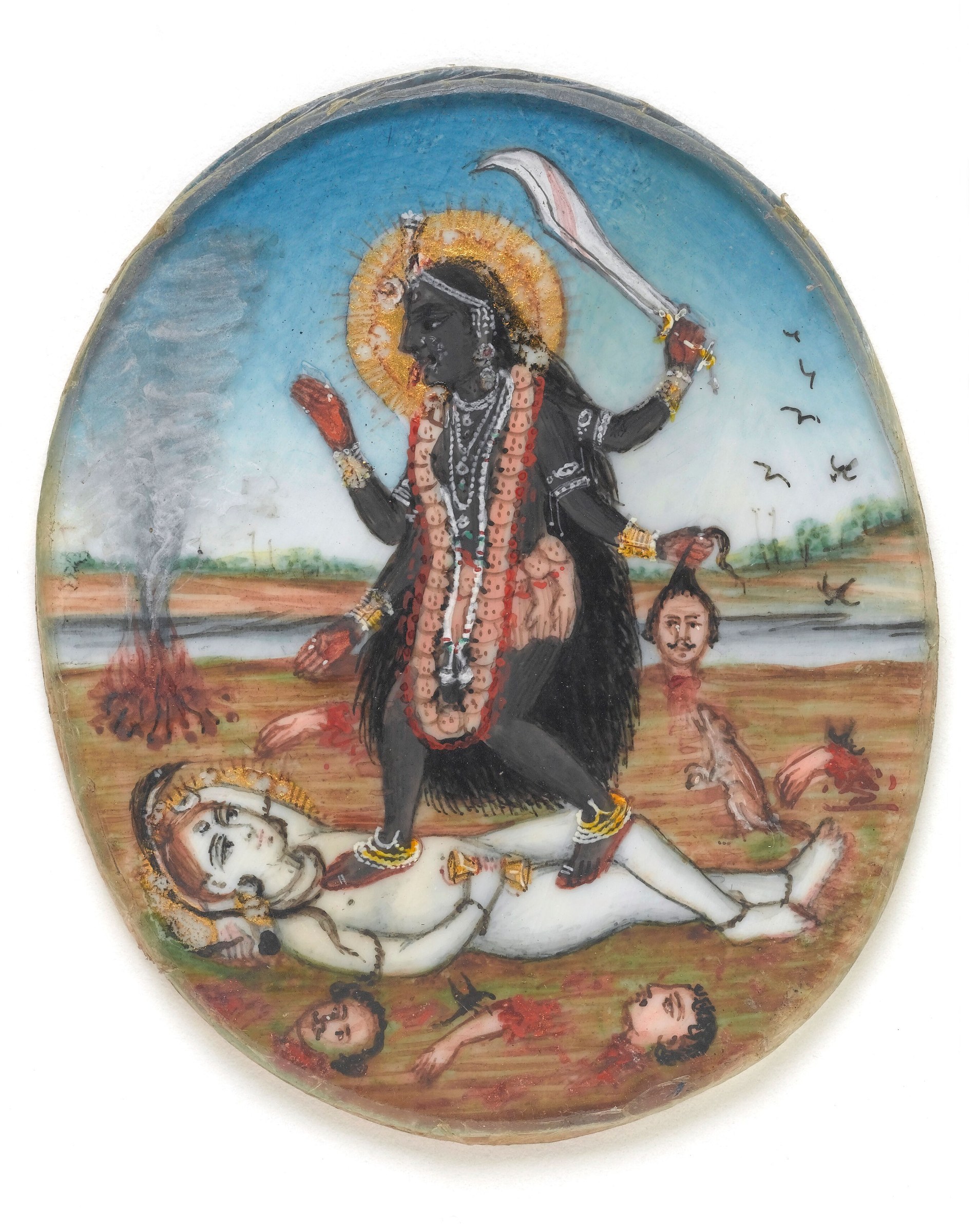
Goddess Kali dancing on Shiva. Gouache painting by an Indian artist.
Unknown artist
- Source:
- Wellcome Collection
- Rights:
- Public domain — free to use, share and adapt.
- Recorded as:
- Public Domain Mark
The image documents a foundational concept linking divinity to movement in Hindu thought: that Kali's cosmic dance (tandava) generates and destroys worlds. For dance historians, it reveals how South Asian visual culture understood the body as a vehicle for sacred power—not merely as technical virtuosity but as metaphysical action. The work also illustrates the miniature painting tradition's capacity to visualize complex theological concepts through bodily gesture and composition.
What you are looking at
A dark-skinned figure with a golden halo stands centrally in a landscape of water and earth, wearing a black garment with an ornate red necklace of severed heads and a billowing white scarf or sword held aloft. Below the figure lies a pale corpse in a recumbent position, adorned with golden ornaments. Surrounding this central group are smaller figures—some appear to be severed heads on the ground, others are live attendants positioned at the edges of the composition. A river or body of water occupies the middle distance with birds in flight above. In the far background, a funeral pyre or fire rises from the earth. The entire scene is painted in gouache on an oval format, with the bright blue sky and sandy earth rendered in warm and cool tones typical of Indian miniature painting.
The dancing
The central figure stands with a dynamic, wide-legged stance and one arm raised high overhead in a gesture of triumph or power, holding the curved sword or scarf. The other arm hangs at the side. The body is portrayed with strong verticality and an assertive, commanding posture. The recumbent figure below is entirely passive, lying prone with limbs extended. The smaller attendant figures are distributed around the composition in observational or submissive poses. The composition emphasizes domination and extreme contrast between the upright, active central figure and the prone victim.
The dance depicted
This appears to depict the Hindu deity Kali in a moment of fierce, ecstatic dance or divine action rather than a conventional dance performance. Kali's iconography—the dark skin, golden halo (tilaka or crown), the garland of severed heads, and the curved sword or scimitar—is consistent with her role as a wrathful, destructive manifestation of divine power in Hindu theology. The figure's stance suggests violent movement or a warrior's stance rather than a choreographed dance form. If this is intended to represent Kali dancing, it would be a sacred-ceremonial or mythological interpretation rather than a codified dance style, and it appears to depict her in a moment of transcendent, destructive action associated with her role in the cosmic cycle rather than human performance.
How it was made
This is gouache on paper in an oval format, consistent with Indian miniature painting traditions. Gouache allows for bright, opaque color and fine detail, evident here in the intricate rendering of ornaments, the necklace of heads, and the facial features. The technique supports both the jewel-like brightness of the colors and the narrative clarity required for religious or mythological illustration. The oval framing and miniature scale suggest this was intended for intimate viewing—possibly an album leaf or part of a series—and indicates production within an Indian court or scholarly context where such religious and mythological imagery was actively commissioned.
About this work
This gouache miniature represents the Hindu deity Kali in a visionary or ecstatic moment, likely from an Indian religious or mythological text tradition. The image conflates iconographic representation with dynamic bodily action, positioning Kali's destructive power as a form of cosmic dance. The work belongs in a dance gallery not because it depicts a human dance technique, but because it visualizes a sacred, divine movement central to Hindu philosophical and theological understanding. The figure's violent stance and commanding gesture position the body as the instrument through which transcendent, destructive force manifests in the world—a concept deeply embedded in both Hindu liturgical practice and philosophical understandings of rhythm, time, and cosmic order.
How to look at it
Attend to the relationship between the two primary figures: the upright, dynamic deity above and the prone, passive figure below. The composition visualizes hierarchy, power, and transformation. Notice how the artist uses the golden halo to locate divinity in the body itself, and how the gesture of the raised arm—holding the curved blade—reads as both weapon and dance movement. The scarf or sword billowing behind the figure suggests motion frozen mid-moment, a technique common in miniature painting to suggest eternal or perpetual action rather than a single instant.
The artist
The artist is not recorded. The style, materials, and iconography are consistent with Indian miniature painting traditions of the 16th–18th centuries, likely produced in a court workshop or scholarly atelier in North or Central India. The level of detail, the use of gouache, and the narrative clarity suggest professional, trained production rather than folk or peripheral work.
The period
This work emerges from a long tradition of Hindu visual theology in which divine beings are understood through their characteristic movements and poses (asana, mudra, tandava). The painting tradition itself flourished in Mughal and post-Mughal courts, where Hindu mythological and religious subjects were actively commissioned alongside Persian and Islamic themes. The image dates from a period in which the body—whether of god or dancer—was increasingly understood as a legible text encoding metaphysical truths.
Where it lives
The work is held in the Wellcome Collection, which houses historical images of medicine, health, and science, but also holds examples of religious and cultural iconography from global traditions. This gouache miniature is catalogued within that broader collection context.
Dance in this work
Questions about this work
Is Kali actually a dancer?
In Hindu theology, Kali's cosmic dance (tandava) is metaphorical—a way of describing the eternal cycle of creation and destruction. She is not historically associated with a specific human dance form. However, her dynamic, fierce power is consistently expressed through movement and gesture in visual and performing arts, and later traditions did develop performance vocabularies influenced by her iconography.
Why is Kali depicted with severed heads?
The severed heads and skirt of severed arms are part of Kali's iconography as a destroyer of ego and ignorance. In Hindu philosophy, these images represent the annihilation of the self and liberation from illusion (maya). They are not meant to be literal or horrifying in a conventional sense, but rather symbolic of transcendence.
What is the figure beneath Kali?
The recumbent figure is traditionally understood to be Shiva, Kali's consort, lying beneath her in a state of absorption or meditation. In some interpretations, Kali is depicted dancing on Shiva as a metaphor for the feminine power (Shakti) activating the masculine principle (Shiva). The title of the work confirms this reading.
What dance tradition does this painting belong to?
This is not a depiction of a codified dance technique, but rather a visualization of sacred or cosmic movement in Hindu theology. If approached as a dance subject, it would fall under sacred-ceremonial practices and the philosophical traditions that inform contemporary Indian classical dance forms like Bharatanatyam, which do draw on mythological narratives of deities in motion.
More dance artwork





