49 works in this view — arrow keys or swipe to move between them.
Dance in Art
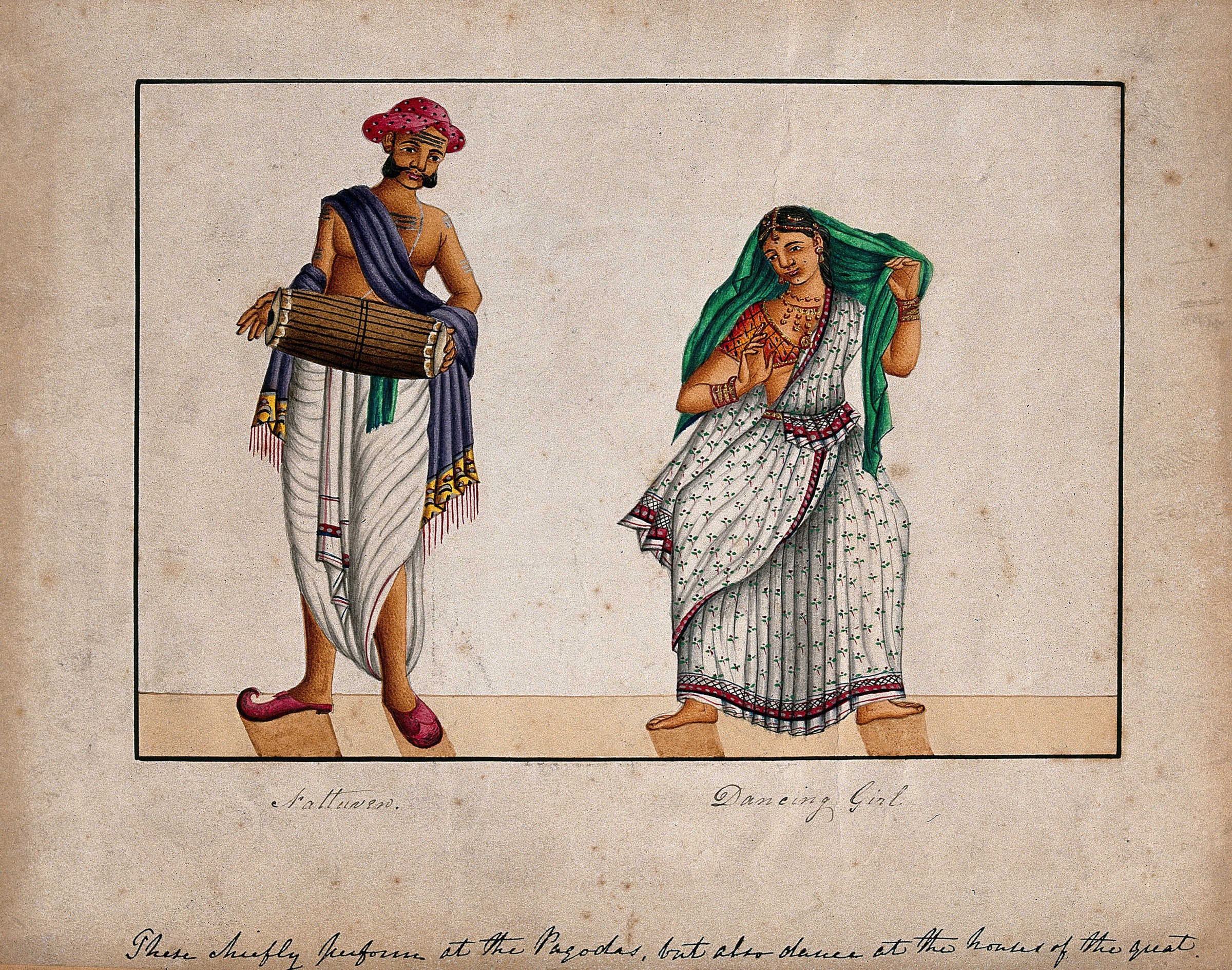
A dancing girl and musician. Gouache painting by an Indian painter.
Unknown artist
- Source:
- Wellcome Collection
- Rights:
- Public domain — free to use, share and adapt.
- Recorded as:
- Public Domain Mark
This image is among the earliest visual records of South Asian classical dance outside Sanskrit texts and temple sculpture. It provides evidence of costume, ornamentation, and posture as they existed in lived practice, and it documents the social context of temple performance at a moment before major transformations in colonial attitudes toward devadāsī dancers.
What you are looking at
Two figures stand against a plain, cream-colored ground in what appears to be a hand-colored gouache or watercolor. On the left, a bearded man wearing a burgundy cap and draped in a dark blue shawl holds a large cylindrical drum or barrel-shaped percussion instrument, striped horizontally and bound with rope or cords at intervals. His lower garment is white with dark stripes and a fringed green edge. On the right, a young woman in a pose of active movement wears a short pleated white skirt decorated with embroidered or printed patterns, a rust-colored upper garment, and bracelets on her arms. She holds a green fabric—perhaps a dupatta or shawl—above her head with one arm extended upward and back, her body angled in a characteristic dancing posture. She wears what appears to be ankle bells or similar ornaments. The inscription beneath reads "Mullanen" (left) and "Dancing Girl" (right), with a further note stating "These briefly perform at the Pagodas, both also dances at the temples of the great."
The dancing
The musician stands relatively still and frontal, his weight evenly distributed, presenting the instrument as the focus. The dancer's body is animated and asymmetrical: her weight appears shifted, one arm raised to shoulder height holding the green dupatta, the other at her side, her torso turned and her hips angled to suggest mid-movement or a held position within a dance sequence. Her head is inclined and turned toward the raised arm. The relative proportions and anatomical structure suggest the artist had direct observation of or familiarity with the movements.
The dance depicted
This image depicts a South Asian temple dancer, most likely from 18th-century India, performing in a religious or ritual context. The inscription's reference to performance at pagodas and temples, combined with the costume elements—the pleated skirt, upper garment, bracelets, ankle ornaments, and the use of a draped fabric (dupatta)—strongly suggests a form of classical or devotional dance associated with temple worship. The posture and arm extension are consistent with classical South Asian dance vocabularies such as Bharatanatyam, Kathak, or Kathakali, though the costume does not precisely match any single tradition. The musician with the drum (possibly a mridangam or similar percussion) indicates this is a performance with live accompaniment.
How it was made
This is a hand-colored gouache or watercolor painting, recognizable by the flat color application, soft edges, and slight translucency of the pigments against a textured paper or vellum ground. The technique allows for fine linear detail—visible in the striping of the drum, the pleats of the skirt, and the jewelry—while maintaining the decorative, illustrative character typical of Indian manuscript traditions or European ethnographic illustration of the period. The hand-coloring and gouache medium suggest this was either an Indian painter working in a Mughal or Indo-European hybrid tradition, or a European artist recording Indian subjects with the aid of Indian pigments and possibly Indian artistic conventions.
About this work
This gouache painting documents a temple dancer and her percussion musician, identified by inscription as performers in early modern South Asia. The work is a record of religious and social practice: temple dancers, often associated with ritual service and sexual availability, occupied a contested social position, and visual documentation of their practice was generated for both indigenous and European audiences in the colonial and pre-colonial periods. The style—hand-colored gouache with careful attention to textile detail and ornamentation—is consistent with the ethnographic documentation practices of the 18th and early 19th centuries, when European curiosity about Indian customs drove demand for such images.
The work belongs to a significant body of imagery depicting devadāsī (temple servant/dancer), nāch girls, and other professional dancers of South Asia. Such images circulated in albums, natural history collections, and as standalone sheets, serving as both artistic records and ethnographic evidence. This painting is valuable precisely because it captures the dancer in an active pose—not as a static figure—and pairs her with the musician, showing dance as a collaborative practice rooted in musical accompaniment.
How to look at it
Observe the dancer's asymmetrical posture: one arm raised with the fabric, the body angled, suggesting the moment within a turning or weight-shifting movement rather than a static tableau. Note the musician's stable, frontal stance in contrast. The artist has chosen to show the dancer at a dynamic instant, her lifted arm and angled hips conveying motion rather than rest. The careful rendering of the pleated skirt and its geometric pattern shows the artist's attention to the visual specificity of South Asian dress and textile work. The pairing of musician and dancer indicates that the artist understood dance as an ensemble practice dependent on percussion.
The period
This work dates to a period—likely late 18th or early 19th century—when European interest in Indian ethnography was rising, but before the colonial consolidation that would later pathologize temple dancers. The painting reflects a moment of documentary interest rather than moral judgment. In South Asia, the traditions of classical dance were at this time primarily sustained by hereditary communities of performers attached to temples, courts, and traveling performance groups. The pose and costume suggest continuity with classical forms codified in texts like the Nāṭya Śāstra and performed in court and temple settings for centuries.
Where it lives
The source is listed as Wellcome (the Wellcome Library, London), a major repository of ethnographic, medical, and travel-related imagery. Such works often entered Wellcome as part of larger collections of natural history, travel accounts, or colonial documentation. The object type is not specified in the record, but the hand-coloring and gouache medium indicate it was a finished work, likely loose or part of an album.
Dance in this work
Questions about this work
What kind of dance is this?
The costume, posture, and context suggest a classical or devotional South Asian dance tradition, most likely Bharatanatyam, Kathak, or a regional variant. The pleated skirt, upper garment, arm ornaments, and the use of a draped fabric are consistent with 18th-century temple dance practice. However, the inscription and artistic documentation style do not allow attribution to a single modern classical tradition.
Who was the dancer and musician?
The inscription does not name them individually. The label "Dancing Girl" and "Mullanen" (possibly a title or descriptor) suggest this may be a type figure—a representative example of a category of performer—rather than a portrait of a specific, named individual. This was common in ethnographic illustration of the period.
Why was this image made?
The work was likely created as ethnographic documentation for a European audience curious about Indian customs, or as part of a larger album of Indian types and practices. The careful attention to costume detail and the inscription in English suggest it was made for circulation among English-literate collectors and scholars.
What is the green fabric the dancer is holding?
This is likely a dupatta or orhni, a draped scarf or shawl used in South Asian dance as an extension of the body and an expressive element. Its use appears in classical forms and in devotional and social dances. In this image, the dancer uses it to frame and extend her upper body and arm.
More dance artwork





