49 works in this view — arrow keys or swipe to move between them.
Dance in Art
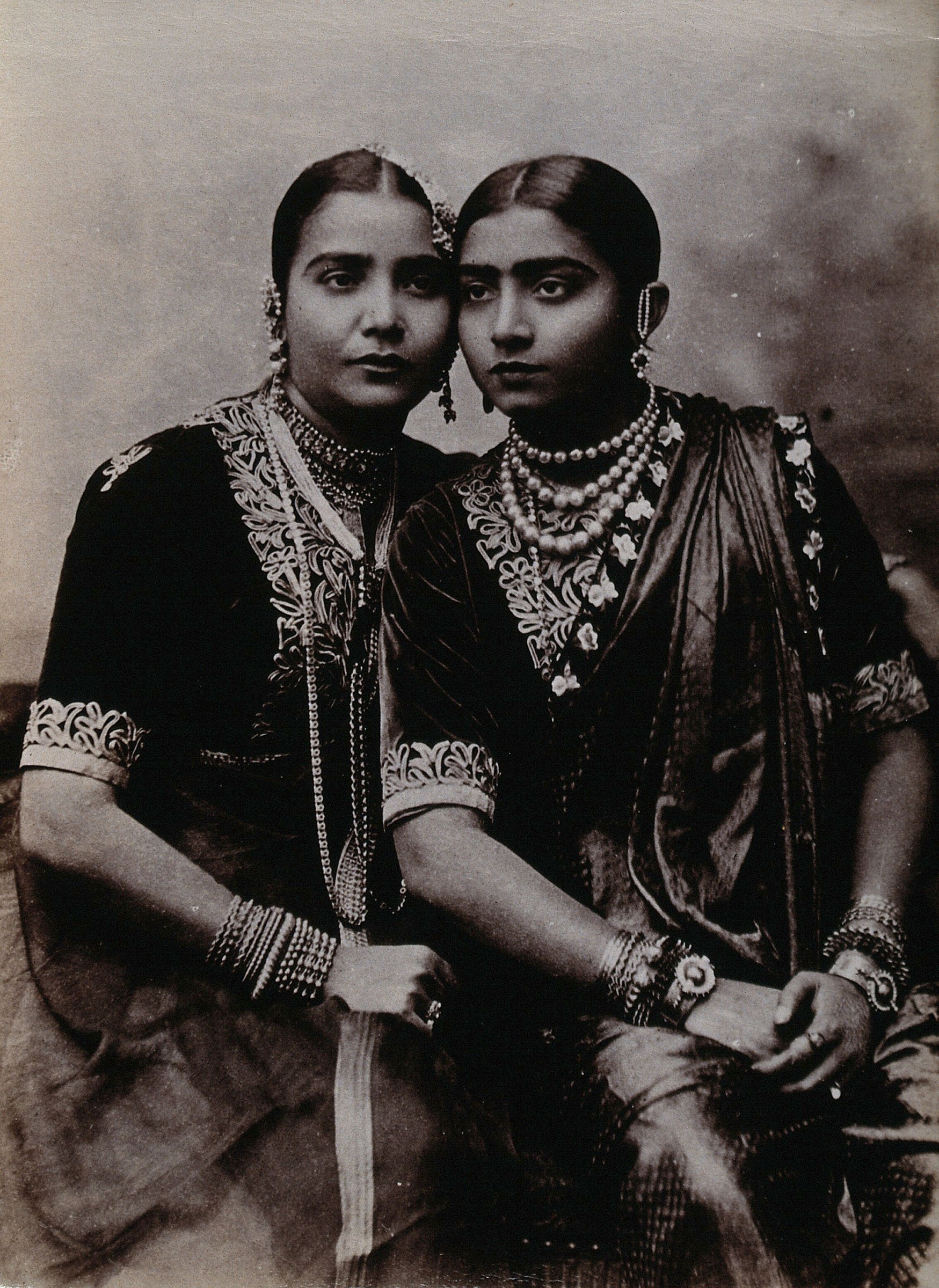
Two nautch dancing girls, in a studio setting. Photograph, ca.1900.
Unknown artist
- Source:
- Wellcome Collection
- Rights:
- Public domain — free to use, share and adapt.
- Recorded as:
- Public Domain Mark
Nautch dancers occupied a complex and often stigmatized position in colonial India, yet this formal studio portrait asserts their dignity and professional status. The photograph is one of few visual records of early twentieth-century nautch dancers and their costume, and it captures a moment when studio photography itself was becoming a tool for performers to control their own image and circulation.
What you are looking at
Two women in matching ornate dark garments stand close together in a studio setting against a neutral backdrop, posed for a formal portrait photograph. Both wear richly embroidered short-sleeved kaftans or tunics with intricate white floral or geometric embroidery on the chest and sleeves, paired with draped skirts. Each wears multiple strands of pearls at the neck and chandelier-style pearl earrings; the woman on the right additionally wears a long pearl necklace extending below the waist. Their dark hair is parted in the center and pulled back smoothly. They stand at a slight angle toward the camera, their bodies nearly touching, with composed, frontal expressions. The photograph is a sepia or silver-toned print characteristic of early twentieth-century studio portraiture.
The dancing
Both figures stand in a relaxed, symmetrical pose with arms at their sides, weight distributed evenly. There is no visible dance movement or gestural language captured in this moment. Their proximity and matching attire suggest they are a paired unit or ensemble, but the photograph freezes them in a static presentation pose rather than an active dance moment.
The dance depicted
The title identifies these as 'nautch dancing girls'—a term referring to professional female dancers in colonial-era India, particularly those who performed in court, temple, or entertainment contexts. The ornate dress and jewelry are consistent with performance costume of that period and region. However, this photograph captures them in a studio portrait session, not in performance. It documents their identities and their formal presentation as dancers rather than capturing them in the act of dance. The image thus serves as documentary evidence of nautch dancers' appearance and status rather than as a record of actual movement or technique.
How it was made
This is a photograph, likely gelatin silver or platinum print, dating to approximately 1900. The studio setting—neutral backdrop, controlled lighting, formal pose—and the photographic process indicate this was a professional commission, a portrait made for documentation or display. The technical qualities of early twentieth-century photography allow fine detail in the embroidered textiles and jewelry, but the static pose and composition are those of portraiture, not action photography. The clarity and tonal range suggest this was made by a skilled studio photographer, possibly in India or within a European colonial photography studio serving the Indian market.
About this work
This is a studio portrait of two professional nautch dancers from early twentieth-century India, documented in their performance dress. The photograph is not a record of dance movement but rather a formal identification and presentation of two named performers. It belongs in a dance gallery because it documents the appearance, status, and material culture of an important historical tradition of female performers whose own voices and artistic achievements remain largely absent from written histories. The image tells us how these dancers presented themselves to the camera and to viewers—jeweled, skilled enough to command a professional portrait, and presented as a unit or partnership. The photograph sits at the intersection of colonial documentation, performance history, and the visual culture of South Asian dance.
How to look at it
Read this photograph not for action but for presence and presentation. Notice the symmetry and coordination of dress—identical embroidered garments, matching jewelry, synchronized styling—which suggests these dancers understood themselves as a team or ensemble. The direct, composed gaze and the formal pose are characteristic of early twentieth-century portraiture conventions across South Asia and Europe. The photograph records not a dance but the dancers' claim to professional identity and worth through costume, ornamentation, and the status of being photographed in a studio. The fine detail visible in the embroidery, the quality of the jewelry, and the controlled setting all communicate the performers' economic means and professional status.
The artist
The photographer is not recorded. The work originated from the Wellcome Collection, a historical archive focused on medicine, science, and social history, suggesting it may have been part of colonial-era documentation efforts or have entered the collection as part of broader ethnographic or historical acquisition rather than artistic patronage.
The period
This photograph dates to a period of transition in both Indian dance and photographic practice. By 1900, studio photography had become established across colonial India and was used by performers and clients alike to create portable images for circulation and documentation. Simultaneously, nautch dancers were subject to increasing scrutiny and moral judgment by colonial administrators and Indian reformers; professional dance was often characterized as morally suspect. The formality and dignity of this portrait—the expensive jewelry, the professional setting, the careful composition—pushes back against that stigmatization. Photographically, this falls in the era of the studio portrait as the standard format for recording identity and status.
Where it lives
This photograph is held in the Wellcome Collection, a history-of-medicine and natural history archive in London. It entered the collection as part of broader historical and ethnographic documentation, not as fine art.
Dance in this work
Questions about this work
What is a nautch dancer?
Nautch (from Hindi 'nach', to dance) was a term used in colonial India for professional female dancers who performed in courts, temples, and for private patrons. These performers were skilled in classical and popular dance traditions, but the term was often used pejoratively by colonial administrators. Nautch dancers occupied a complex social position: respected for their artistry and often economically independent, but also subject to moral censure from both colonial and Indian reformist authorities.
Why is this photograph in a dance collection if it doesn't show dancing?
This photograph documents dancers as historical subjects. It records their appearance, costume, jewelry, and professional presentation at a specific moment in history. For traditions like nautch that left few written records and whose practitioners had limited control over their representation, a photograph made by the dancers themselves (or on their commission) is valuable historical evidence. It shows how these performers wanted to be seen.
How do we know these are dancers?
The title given with the photograph identifies them as 'nautch dancing girls.' The ornate embroidered dress, multiple strands of pearls, and chandelier earrings are consistent with performance costume and jewelry worn by professional dancers of that period and region. The formal studio portrait format and professional quality suggest this was a commissioned photograph made to establish their identity and status.
Can you tell what kind of dance they performed from this image?
Not specifically. The photograph is a portrait, not a record of movement. The costume and jewelry are consistent with several Indian dance traditions of that era, but without documentation of their specific training, repertory, or technique, we cannot determine which tradition(s) they practiced.
More dance artwork





