49 works in this view — arrow keys or swipe to move between them.
Dance in Art
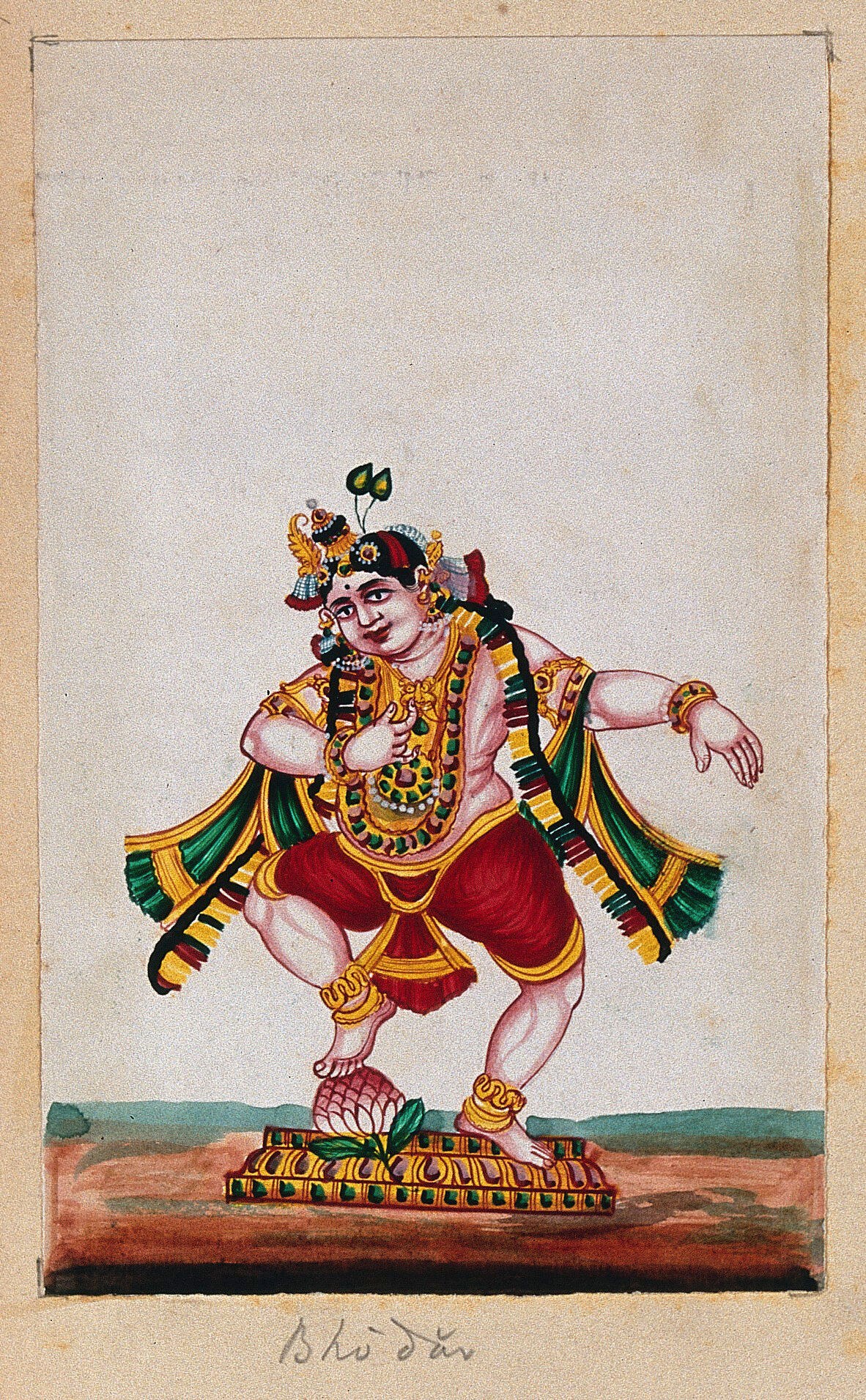
Lord Krishna dancing on a lotus. Gouache painting by an Indian artist.
Unknown artist
- Source:
- Wellcome Collection
- Rights:
- Public domain — free to use, share and adapt.
- Recorded as:
- Public Domain Mark
This image documents how a divine dancing figure was imagined and represented in Indian visual culture, offering insight into the aesthetic principles—grace, joy, abundant ornamentation, and physical presence—that inform South Asian classical dance traditions. It represents a moment when religious devotion and performance arts were visually inseparable.
What you are looking at
A portly figure in ornate costume stands in a dynamic pose on a stylized lotus flower, emerging from earth rendered in warm brown and green. The figure is shown in profile-frontal view, weight on one leg in a pronounced contrapposto stance, the opposite leg extended with knee bent. The costume is rich and elaborate: a jeweled crown with peacock feathers and ornamental crescent above; multiple strands of beaded necklaces and a broad circular breastplate in gold; a short gathered skirt in deep red with gold borders; and gold bangles at wrists and ankles. The figure's round belly is prominently displayed, unclothed, with a hint of amusement in the stylized facial expression. The upper body is draped with a flowing cape or shawl in green and gold with striped tassels. The pose suggests movement—not static display but a moment of joyful, weightless action. The composition is frontal and iconic, filling the page with warm ochre ground and pale cream sky, framed in a simple ruled border.
The dancing
A single figure occupies the composition, shown in a stance that combines grounded weight distribution with upward lift through the torso and extended limbs. The dancer's weight is on the right leg (viewer's left) with the left leg extended in a bent knee position, suggesting a step or hop in progress. Both arms are raised and extended—one reaching upward, one outward and downward—in gestures of exuberance and play rather than formal alignment. The pose is three-dimensional and suggests movement through space, the body neither rigidly vertical nor in a controlled line but curved and organic.
The dance depicted
This is a representation of Krishna, the Hindu deity, depicted in a posture of divine play (leela). While Krishna appears in numerous sacred and performative traditions, the image does not depict a specific named dance form but rather a devotional or mythological visualization—a rendering of the god as a dancer. The costume and iconography point to Krishna worship traditions, and the figure's joyful, playful movement echoes the rasa (emotional aesthetic) of divine joy celebrated in South Asian performance traditions, particularly Kathakali and other classical Hindu temple dance forms, though this appears to be a devotional visual representation rather than a record of performance practice.
How it was made
This is a gouache painting on paper, as stated in the record. The work employs bright, carefully applied mineral pigments with fine detailing: the intricate jewelry, feather work, and drapery are rendered with precision using fine brushwork. Gouache's opaque quality allowed the artist to build rich, saturated colors and to layer details such as the gold patterns over the darker fabrics. The technique suggests skilled training in miniature painting, likely within an Indian artistic tradition (possibly Rajasthani, Mughal, or other regional schools). This format—a single devotional figure on a page—was characteristic of popular religious illustration and print production in India from the 18th century onward.
About this work
This is a gouache painting of Krishna as a dancing figure, a devotional image representing the Hindu god in a pose of divine joy and play. The work combines iconographic precision—the peacock crown, jewelry, and ritual attributes—with a genuine sense of movement and spatial action. The figure is rendered in the style of Indian miniature painting, suggesting circulation as a popular religious image, likely from the 18th or 19th century, though the exact date and artist remain unrecorded.
The work is valuable for dancers and historians as a visual document of how Krishna was imagined as a moving, joyful figure within Hindu devotional culture. It shows not static iconography but a theology of divine play (leela) expressed through the body—a conception that deeply influenced South Asian classical dance and continues to inform how dancers embody Krishna in contemporary Bharatanatyam, Kathakali, and other traditions.
How to look at it
Notice the artist's choice to capture a moment of suspended action—the figure is neither standing at rest nor fully committed to a single direction, but caught in a joyful, spiraling movement. The lifted chest, extended limbs, and playful facial expression communicate delight rather than reverence or formality. Observe how the elaborate costume details (the specific arrangement of jewelry, the peacock crown, the tasseled shawl) do not constrain the body but enhance its sense of motion—the drapery swirls around the figure as though caught by the movement itself. This is a theological principle rendered physical: Krishna as a being of overflow, abundance, and play.
The period
The style, medium, and iconographic precision suggest this work was created during the period of Indian miniature painting production, likely the 18th or 19th century, when devotional prints and paintings of Krishna were circulating widely. The image reflects a long tradition of depicting Krishna in Hindu theology and performance—as the divine cowherd and lover celebrated in the Bhagavata Purana, a figure whose life and exploits, particularly his playful interactions (leela) and romantic encounters (as in the Gita Govinda), became central subjects for visual artists and, by extension, for classical dancers. The work exists at the intersection of religious practice, royal patronage, and popular print culture.
Where it lives
The work is held in the Wellcome Collection, a major institution in London dedicated to the history of medicine and related cultural practices. Its presence there reflects the Wellcome's broad acquisition policy during a period of active collecting from India and other regions.
Dance in this work
Questions about this work
Why is Krishna depicted as a dancer?
In Hindu theology, particularly in devotional traditions, Krishna is celebrated as a divine dancer and musician. His play (leela) is understood as a form of cosmic joy and abundance. Depicting him in a posture of dance and movement was a way to express his divine nature and his accessibility to human devotion. Dance itself became a mode of religious expression, and many Indian classical dance forms are performed stories of Krishna's life and exploits.
What tradition of painting is this?
This work appears to be created in the tradition of Indian miniature painting, a highly skilled technique that was practiced across various Indian regions (particularly in courts and religious centers) from medieval times through the colonial period. These paintings were often devotional in purpose and circulated as popular religious images among both elite and broader audiences.
How does this image relate to classical Indian dance today?
Contemporary classical dancers in Bharatanatyam, Kathakali, Kuchipudi, and other traditions regularly perform stories of Krishna, and the aesthetic principles visible in this image—the ornamentation, the joy, the sense of divine play—inform how dancers embody the deity. The image documents a continuity between devotional visual art and performance tradition.
More dance artwork





