49 works in this view — arrow keys or swipe to move between them.
Dance in Art
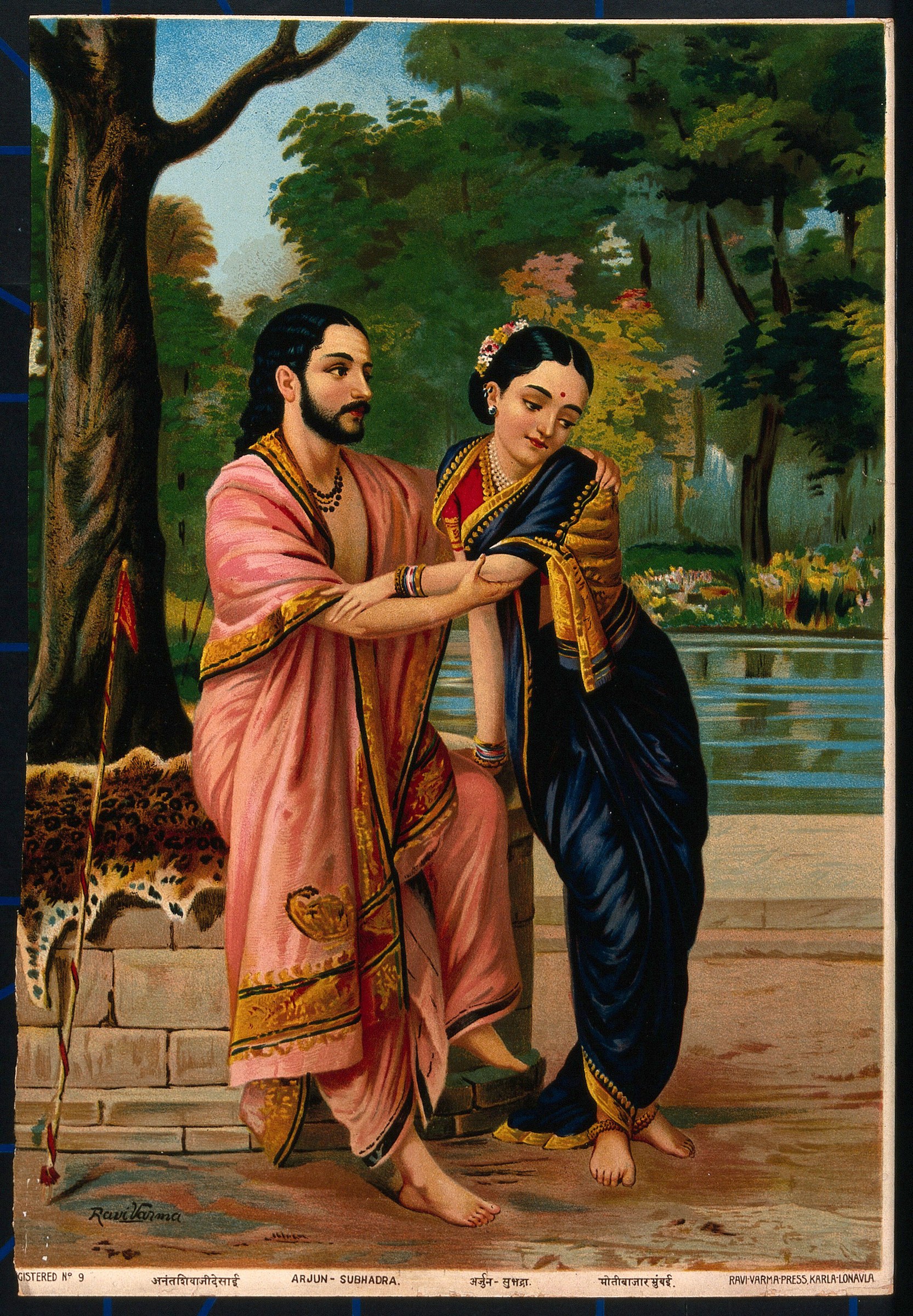
Arjuna in disguise a dancing teacher wooing Subhadra. Chromolithograph by R. Varma.
Unknown artist
- Source:
- Wellcome Collection
- Rights:
- Public domain — free to use, share and adapt.
- Recorded as:
- Public Domain Mark
This work documents the literary and theatrical contexts in which South Asian classical dance was embedded—specifically, the Mahabharata tradition and the figure of the dance-teacher as mediator and lover in narrative. Chromolithographs like this one were the primary vehicles through which classical narratives reached mass audiences in the late nineteenth century, shaping how ordinary people understood dance, courtship, and classical propriety. The work is also an example of Ravi Varma's practice, one of the most influential visual artists in creating a modern 'Indian classical' aesthetic.
What you are looking at
Two figures in classical South Asian dress stand in a garden beside a river. The man, at left, wears a rose-pink dhoti and upper garment trimmed in gold brocade, with a beaded necklace and bracelets; his dark hair and beard are styled in the manner of classical portraiture. The woman, at right, wears a deep indigo sari with gold borders and a red blouse, her dark hair adorned with flowers, her posture modest and turned slightly away. Between them stands a large tree, its pale trunk prominent in the foreground. The garden behind them is lush with flowering shrubs and tall trees in varied greens and golds, while a still river or pool reflects the sky in pale blue in the middle distance. The light is clear and frontal, rendering the figures and foliage in jewel-like colours typical of chromolithography. This appears to be a narrative moment—the man's gesture is courteous and persuasive, the woman's demeanor receptive but reserved.
The dancing
The man leans slightly toward the woman with his right arm extended in an open, invitational gesture; his weight is forward and his posture is upright and dignified. The woman stands with her left arm held modestly at her side, her right arm relaxed, her body angled away but her gaze lowered toward the man in a gesture of attention or modest consideration. Both figures are barefoot. The composition places them close but not in contact, with the tree framing the space between them—a common device in narrative portraiture to suggest both intimacy and propriety.
The dance depicted
The catalogue identifies this as 'Arjuna in disguise a dancing teacher wooing Subhadra'—a scene from the Mahabharata. In the narrative, the warrior Arjuna, disguised as a wandering music and dance teacher named Brihannala, encounters Princess Subhadra and courts her. What is depicted here is not active dance but the theatrical or devotional mode of approach that frames the encounter: the man's gesture suggests instruction, persuasion, or the opening of a courtship ritual rather than performance. The work documents a literary and dramatic tradition of South Asian classical theatre in which dance instruction and courtship were closely intertwined, both involving refined gesture and verbal art. No specific classical dance style is directly performed in this frozen moment, but the work is rooted in the Mahabharata tradition that generated multiple dance and theatrical forms across South Asia.
How it was made
This is a chromolithograph, a colour printing process that allowed mass production of images from separate stone plates inked in different colours. The technique enabled vibrant, jewel-like hues and fine detail in costume and setting, visible here in the precise rendering of gold brocade borders, the modulation of the garden foliage, and the subtle gradations of the river. The signature 'Ravi Varma' is visible lower left. Chromolithographs of this type were produced in large numbers in late 19th and early 20th-century India and circulated widely as affordable art, making scenes of classical literature and mythology accessible to urban middle-class audiences. The technique's capacity for flatness and saturated colour suited the jewel-box aesthetic of classical narrative art.
About this work
This is a chromolithograph depicting a scene from the Mahabharata: Arjuna, disguised as the music and dance teacher Brihannala, approaching Princess Subhadra in a garden. The work represents a narrative moment rather than active dance performance, but it documents the cultural association between dance instruction and courtship in classical South Asian drama and literature. Produced as a mass-market print, it belongs to the nineteenth-century tradition of mythological chromolithography that brought classical narratives to new urban audiences across India. For dance historians, it is valuable as evidence of how South Asian classical dance and drama were understood and depicted in popular visual culture, and how the figure of the dance teacher functioned in narrative and social imagination.
How to look at it
Attend to the stillness of the pose and what it conveys: this is not a moment of active dance but of narrative approach and persuasion, yet the artist has used the language of refined gesture—the open arm, the modest downcast gaze—that belonged to classical dance vocabulary. Notice the framing by the tree, which separates the figures while keeping them in dialogue, and the garden setting, which signals classical courtly refinement. The chromolithographic process renders the figures in brilliant, almost enamelled colour, creating a sense of precious artifice suited to the mythological subject. The barefoot stance of both figures is deliberate: it signals both the classical world of the narrative and the Indian context, in contrast to European shoes.
The artist
Ravi Varma (1848–1906) was a Kerala-born painter and printmaker who became one of the most celebrated artists of nineteenth-century India. He trained in European academic realism and spent much of his career depicting scenes from Hindu mythology and classical literature in a style that blended European technique with Indian subject matter and aesthetics. In 1894, he established the Ravi Varma Press in Lonavala to produce chromolithographic prints of his own and other works, making high-quality colour reproductions of paintings affordable to the Indian middle class. His work was enormously influential in establishing a modern visual language for 'Indian classical' culture and in making mythology accessible beyond courtly and temple contexts.
The period
This print dates from the era of Indian cultural nationalism and the emergence of the urban middle class in late nineteenth-century India. Chromolithographic prints of mythological subjects were part of a deliberate project to preserve and disseminate classical Indian culture in the face of colonial rule and rapid social change. At the same time, classical South Asian dance forms—particularly Bharatanatyam—were undergoing revival and codification by Indian scholars and practitioners, often through appeal to ancient textual sources like the Mahabharata and the Natya Shastra. The print reflects this moment: it presents classical narrative as a source of refined aesthetic and social value, suitable for display in modern homes. The Mahabharata itself was a major subject of this cultural project, reprinted, illustrated, and circulated widely during this period.
Where it lives
The work comes from the Wellcome Collection, a London-based archive of medical and cultural history. It is catalogued as a chromolithograph, and the signature 'Ravi Varma' visible in the lower left identifies it as a product of the Ravi Varma Press or a contemporary publisher working in his style. Chromolithographs from this period often lack precise production details, but they are typically dated to the 1890s–1910s based on printing technique and subject-matter circulation.
Dance in this work
Questions about this work
Who was Brihannala, and why is Arjuna disguised as a dance teacher?
In the Mahabharata, after the Pandavas' defeat in a rigged dice game, they are exiled for thirteen years and must spend the thirteenth year in hiding. Arjuna disguises himself as Brihannala, a eunuch dance and music teacher, and takes a position in the court of King Virata. In this role, he encounters the king's daughter Subhadra and the two fall in love. The disguise allows Arjuna to move in court spaces and to approach Subhadra through the culturally legitimate medium of dance and music instruction.
Is this a depiction of actual dance, or just a narrative scene?
This image captures a narrative moment rather than a dance performance. However, it documents the literary and cultural association between dance instruction and courtship in classical South Asia. The open gesture and refined posture of the figures reflect the vocabulary of classical gesture and movement that was part of both dance and courtly behaviour. The work is valuable for showing how dance was understood to function socially and narratively, not just as performance.
What is a chromolithograph, and why was this medium important?
A chromolithograph is a colour print made by transferring an image onto separate lithographic stones, one for each colour, and printing them in sequence. The process allowed high-quality colour images to be produced cheaply and in large quantities. In late nineteenth-century India, chromolithographs like this one made classical art and mythology available to urban middle-class audiences who could not afford original paintings or who did not have access to temple or courtly contexts where such images were traditionally displayed.
Why is Ravi Varma significant in Indian art history?
Ravi Varma was one of the most influential artists in modern India. He blended European academic painting technique with Indian mythological and literary subjects, and his establishment of the Ravi Varma Press in 1894 democratized access to high-quality colour reproductions of classical imagery. His work was central to the creation of a modern 'Indian classical' aesthetic that shaped how the Indian middle class understood and valued their own cultural heritage during the colonial period.
More dance artwork





