49 works in this view — arrow keys or swipe to move between them.
Dance in Art
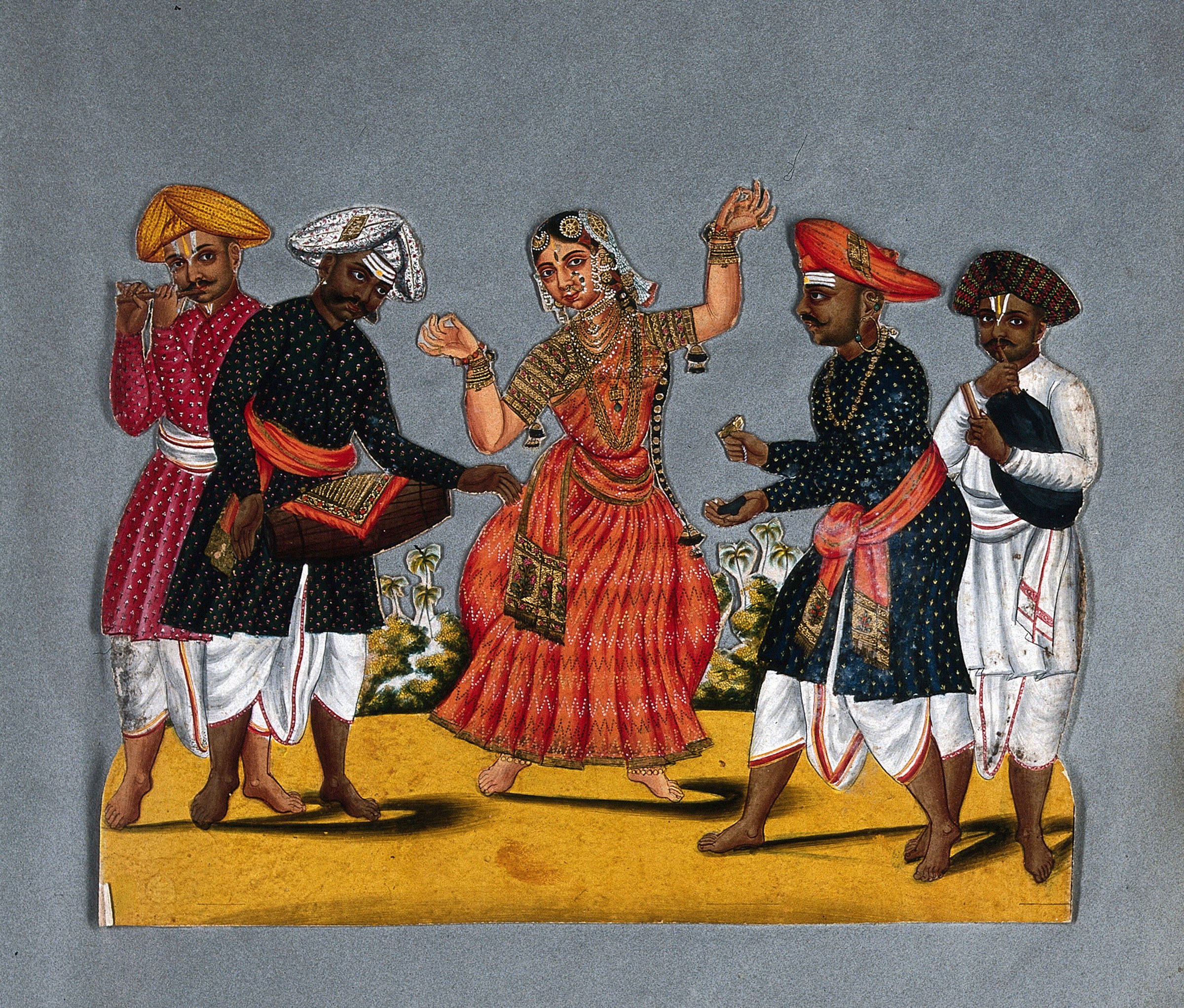
A dancing woman with four male musicians of south India. Gouache painting.
Unknown artist
- Source:
- Wellcome Collection
- Rights:
- Public domain — free to use, share and adapt.
- Recorded as:
- Public Domain Mark
The painting preserves visual evidence of how classical Indian solo dance was performed, costumed, and situated within aristocratic social space before the colonial period—information not always accessible through written sources. It demonstrates that solo female dance performance in formal court contexts was an established and valued practice, and shows the integral role of live instrumental accompaniment to the dancer's movement.
What you are looking at
A woman in elaborate classical Indian dress performs in the center of the composition, surrounded by four male musicians in court attire. The central dancer wears a richly patterned silk sari in deep red-orange with gold embroidery, heavy gold jewelry including bangles and a necklace, and her hair is arranged with ornaments; her body is caught mid-movement, with one arm raised in a gestural pose and her torso twisted dynamically. She stands barefoot on a golden-yellow ground. The four men flanking her wear dark blue or black tunics densely patterned with small flowers or stars, paired with white dhoti-like lower garments; three wear wrapped turbans in gold, orange, or patterned cloth, while the rightmost wears a dark fan-shaped headdress. The men hold various instruments—one appears to hold a stringed instrument, others are in gesture suggestive of musical accompaniment. The background is a soft gray-blue, creating strong contrast with the golden stage beneath. The work is a gouache painting on paper, executed in the Mughal or Indo-Persian miniature tradition, with meticulous attention to textile pattern, jewelry detail, and the precise rendering of fabric folds.
The dancing
The dancer's weight is shifted, her body in a spiral contrapposto with one hip dropped and the opposite shoulder lifted; her raised arm extends upward in what appears to be a classical Indian arm position (likely a hasta or mudra gesture), while her other hand is held at mid-torso. Her gaze is directed outward, suggesting performance toward an unseen audience rather than engagement with the musicians. The four men stand in relaxed attending postures around her, their bodies oriented toward the dancer; they are not partnered with her but rather form a performative ensemble. All figures stand firmly on the ground with no suggestion of elevation or aerial movement.
The dance depicted
This depicts a solo female dancer of South India, most likely performing Bharatanatyam or a closely related classical form such as Kuchipudi, accompanied by live musicians. The sari draping, jewelry, and the formal court setting—evident from the musicians' dress and the composition's hierarchical arrangement—suggest this is a performance context within a royal or noble household, possibly 17th–18th century. The dancer's arm position and the formal solo-with-ensemble structure are consistent with classical Indian solo dance forms. The painting documents not only the dance itself but the social and musical context in which it occurred: solo female performance in an aristocratic setting with dedicated instrumentalists.
How it was made
Gouache on paper, executed in the tradition of Mughal or Indo-Persian court painting. The technique allows for rich, opaque color layering and fine linear detail—evident in the intricate floral and geometric patterning of the textiles, the precision of the jewelry rendering, and the careful articulation of facial features and costume. Gouache's opacity enabled the artist to build luminous color without the transparency of watercolor, and its quick-drying properties suited the miniature format. This work belongs to the documented tradition of Indo-Islamic court painting, which circulated among aristocratic and merchant patrons across South Asia; its presence in the Wellcome collection suggests it was later acquired as an ethnographic or historical document of Indian performance practice.
About this work
This is a gouache painting documenting a classical Indian solo dance performance in a court or aristocratic setting. A woman in formal Bharatanatyam-style dress performs in a dynamically posed moment while four male musicians in court costume accompany her, establishing both the visual splendor of the occasion and the collaborative musical-choreographic tradition that underlay classical Indian dance. The work is a primary document of South Indian performance culture, rendered in the miniature tradition of Indo-Persian painting.
How to look at it
Attend to the dancer's torso and arm position: the spiral twist of her body and the raised gesture of her arm are the core of classical Indian dance vocabulary, distinct from European balletic or social dance forms. Note the asymmetry and counterbalance—the raised arm and lifted shoulder opposed by the dropped hip—which creates the characteristic S-curve silhouette of classical Indian solo dance. Observe how the four musicians are arranged in a frame around her but do not interact with her directly; this is hierarchical solo performance, not partnership or social exchange. The sumptuous detail of the textile patterns and jewelry underscores the formal, high-status context of the performance.
The period
The style and format situate this work within the broader Indo-Islamic miniature painting tradition, which flourished from the 16th through 18th centuries across the courts of the Mughal empire and regional South Indian kingdoms. During this period, classical Indian dance forms including Bharatanatyam and Kuchipudi were highly developed performance arts, patronized by royal and noble households. The musician-and-dancer ensemble shown here reflects the organized, hierarchical structure of court performance. The Wellcome collection's acquisition of this work reflects 19th- and early 20th-century European collecting practices, when material objects from colonized regions—including artistic documents of performance—were gathered as ethnographic specimens.
Where it lives
The work is held in the Wellcome Collection, a major holding of historical, ethnographic, and scientific materials assembled in the early 20th century. It arrived as part of the documented interest in non-Western performance practices and material cultures during the period of European imperial expansion.
Dance in this work
Questions about this work
What dance form is being performed here?
The dancer's posture, costume, jewelry, and the formal musical accompaniment suggest this is Bharatanatyam or a closely related classical South Indian form such as Kuchipudi. The elaborate sari, gold ornaments, and the specific arm gesture are consistent with these traditions, though the painting does not inscribe a name. The formal court setting indicates this was a valued, high-status performance art.
Was solo female dance performance common in South India?
Yes, by at least the 17th–18th centuries (the likely date of this work), solo female dance was an established court art form, patronized by royal and noble households. Dancers performed for aristocratic audiences, often as part of formal entertainment. This painting is evidence of that practice, showing the institutional framework—musicians, formal dress, court setting—that supported such performances.
Why did the Wellcome Collection acquire this painting?
Henry Wellcome (1853–1936) assembled his collection as a record of human medicine, science, and culture across time and geography. Objects from colonial territories, including artistic and ethnographic materials, were gathered as historical documents. This painting would have been valued as a record of Indian performance practice and court life, fitting Wellcome's broader mission to document human cultural achievement.
More dance artwork





