49 works in this view — arrow keys or swipe to move between them.
Dance in Art
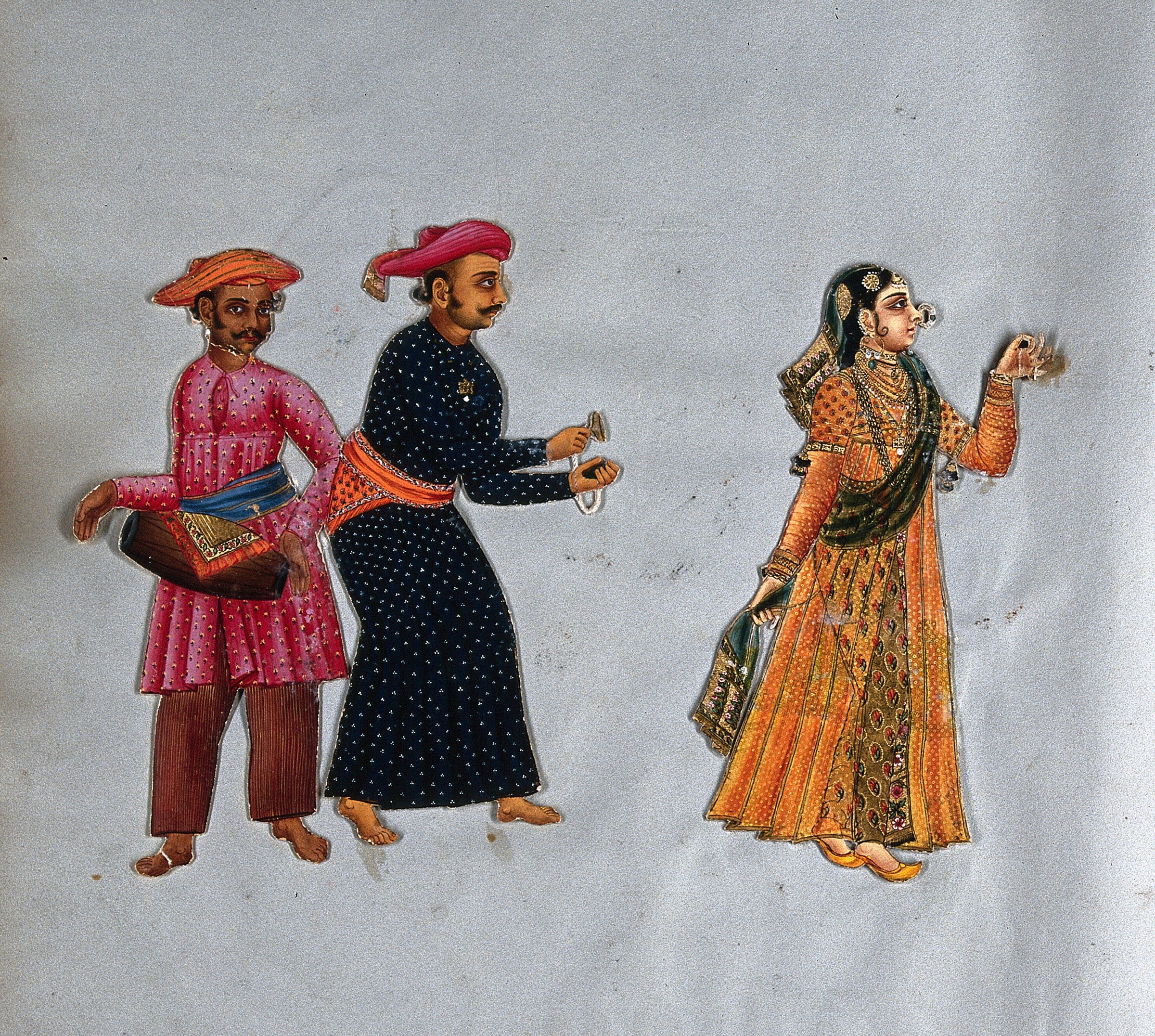
A Muslim dancing woman with two male musicians of south India. Gouache painting.
Unknown artist
- Source:
- Wellcome Collection
- Rights:
- Public domain — free to use, share and adapt.
- Recorded as:
- Public Domain Mark
This image preserves a rare visual record of Muslim women's dance and musical patronage in the Indo-Islamic courts at a period when such scenes were seldom documented by European artists. It shows that courtly dance in South India involved both performance and formal presentation, and that women of rank participated in highly codified musical and movement traditions. For dance historians, it demonstrates the visual conventions used in Indo-Islamic painting to convey status, musical training, and courtly refinement through dress, posture, and gesture.
What you are looking at
A gouache painting depicting four figures in richly colored dress against a pale background. On the left, two men face right: one wears a pink tunic with striped leggings and an orange turban; the second, slightly behind and taller, wears a dark navy tunic with small white dots and a crimson turban with trailing fabric. Both stand barefoot. To the right, a woman in an orange-gold dress with deep green accents and gold embroidery stands in profile, her head covered with an ornate dark headdress decorated with gold leaf or metalwork. Her right hand is raised and gestured outward in a graceful position; her left hand rests near her body. The figures occupy shallow picture space with no landscape or interior setting suggested. The painting style—with its precise outlines, flat color fields, and decorative detail—is consistent with Indo-Islamic manuscript or album painting traditions of the 17th or 18th century.
The dancing
The woman's posture is notably upright and frontal, her upper body lifted and composed. Her raised right hand, fingers extended, suggests a controlled, refined gesture rather than vigorous movement. The two men beside her appear to be attendants or musicians: their positioning places them as subsidiary figures relative to the woman, who commands the visual center despite standing apart from them. No physical contact occurs between any of the figures. The woman's weight appears centered and balanced; there is no suggestion of dynamic weight shift or traveling movement.
The dance depicted
The costume, headdress, and gestural vocabulary suggest a courtly or noble Indian Muslim woman, possibly from the Mughal or Deccan sultanate period. The raised hand and composed posture are consistent with classical Indian dance vocabularies such as Kathak or court dance traditions associated with Indo-Islamic courts, where hand gestures (mudra) and subtle body positioning conveyed meaning and rank. However, the image does not show active, weight-bearing movement characteristic of performance dance. This may depict a moment of formal presentation, a posed tableau, or a style of courtly movement—deliberate and restrained—rather than narrative or athletic dance. The presence of two male figures suggests musicians or attendants, which would be typical of a court music and dance setting.
How it was made
This is a gouache painting on paper, recognizable by its opaque, matte finish and the precision of line work. The technique allows for bright, saturated color and crisp edges, which the artist has exploited in the ornamental detail of the headdress and the geometric patterning of the garments. Gouache on paper was the standard medium for Indo-Islamic court albums and manuscripts from the 16th century onward, particularly in Mughal and regional sultanate courts. This format was typically bound into albums for viewing by patrons and their inner circle, which shaped both the scale (intimate) and the subject matter (court life, portraiture, and ceremonial scenes).
About this work
This gouache depicts a moment of courtly encounter or presentation in an Indo-Islamic court setting, likely from the 17th or 18th century. The woman's formal posture, ornate dress, and controlled gesture suggest refinement and status rather than exuberant performance. The presence of two attendants or musicians situates her within a musical and dance tradition, yet the image captures a pose of composed stillness rather than dynamic motion—a style consistent with courtly dance traditions of South India and the Deccan sultanates, where movement was measured and meaning was conveyed through gesture, costume, and spatial arrangement. The work belongs to a genre of court album paintings that documented courtly life and the visual culture of patronage.
How to look at it
Attend to the woman's posture and hand position rather than expecting dynamic movement; the stillness itself is the moment the artist chose to capture, and it conveys courtly composure and training. Notice the extreme care taken with ornament—the headdress, the gold embroidery, the precise patterning of cloth—which signals rank and the context of elite consumption. The spatial arrangement, with the woman slightly apart and elevated in status relative to the two men, follows a convention of Indo-Islamic painting for depicting hierarchical relationships at court. The bright, flat color and crisp outlines are typical of Mughal and Deccan painting traditions and would have been viewed in an album format, up close and in intimate settings.
The period
In the 16th–18th centuries, Indo-Islamic courts—particularly in the Mughal empire and regional sultanates of the Deccan—supported elaborate musical and dance traditions. These courts employed both male and female musicians and dancers, and female performers of high status were often depicted in court albums and manuscripts. South Indian courts, including those of the Deccan sultanates (Bijapur, Golconda), supported traditions of courtly dance that blended Sanskrit classical forms with Persian courtly aesthetics. During this period, gouache album paintings became a primary means of documenting court life, and such scenes of musical and dance performance reflected the visual culture of elite patronage. European travelers and missionaries to India in the 17th–18th centuries also documented such performances, though with different artistic conventions and often with moral disapprobation.
Where it lives
The work is held by the Wellcome Collection, a major repository of medical, scientific, and cultural historical materials gathered by the collector Henry Wellcome in the late 19th and early 20th centuries. The Wellcome Collection includes extensive South Asian and Indo-Islamic manuscripts, paintings, and prints acquired from dealers and auctions. No accession number, catalogue date, or detailed provenance is recorded in the available metadata.
Dance in this work
Questions about this work
Is this a depiction of actual dance or a formal posed portrait?
It is likely both. The woman's posture and hand gesture suggest courtly training in music and movement, but the composition—with all figures still and frontally arranged—depicts a moment of formal presentation or tableau rather than active performance. In Indo-Islamic court traditions, such poses were themselves part of courtly performance and musical presentation, distinct from vigorous or narrative dance. The image preserves the visual culture of this restrained, gestural tradition.
What was the social status of the woman depicted?
Her ornate headdress, rich embroidered dress, and central position in the composition indicate high rank or status. She may have been a musician, dancer, or patronized performer associated with a royal or noble court. The presence of two male attendants or musicians reinforces her elevated position. In Indo-Islamic courts, women performers of high training and rank occupied distinct social roles and were often the subjects of court portraiture.
Where and when was this painted?
The style and costume suggest a South Indian or Deccan sultanate court of the 17th or 18th century. The gouache technique and compositional conventions are consistent with Mughal and Deccan court album painting. No artist signature or date is recorded, and the work's earlier provenance is unknown.
What musical or dance tradition is depicted?
The woman's trained posture and gestural vocabulary suggest a courtly dance tradition of South India or the Deccan, possibly related to classical forms such as Kathak or to Persian-influenced court dance. The precise identity of the tradition cannot be established from the image alone, but the formality and restraint are characteristic of elite Indo-Islamic courtly practices rather than folk or performative public dance.
More dance artwork





