49 works in this view — arrow keys or swipe to move between them.
Dance in Art
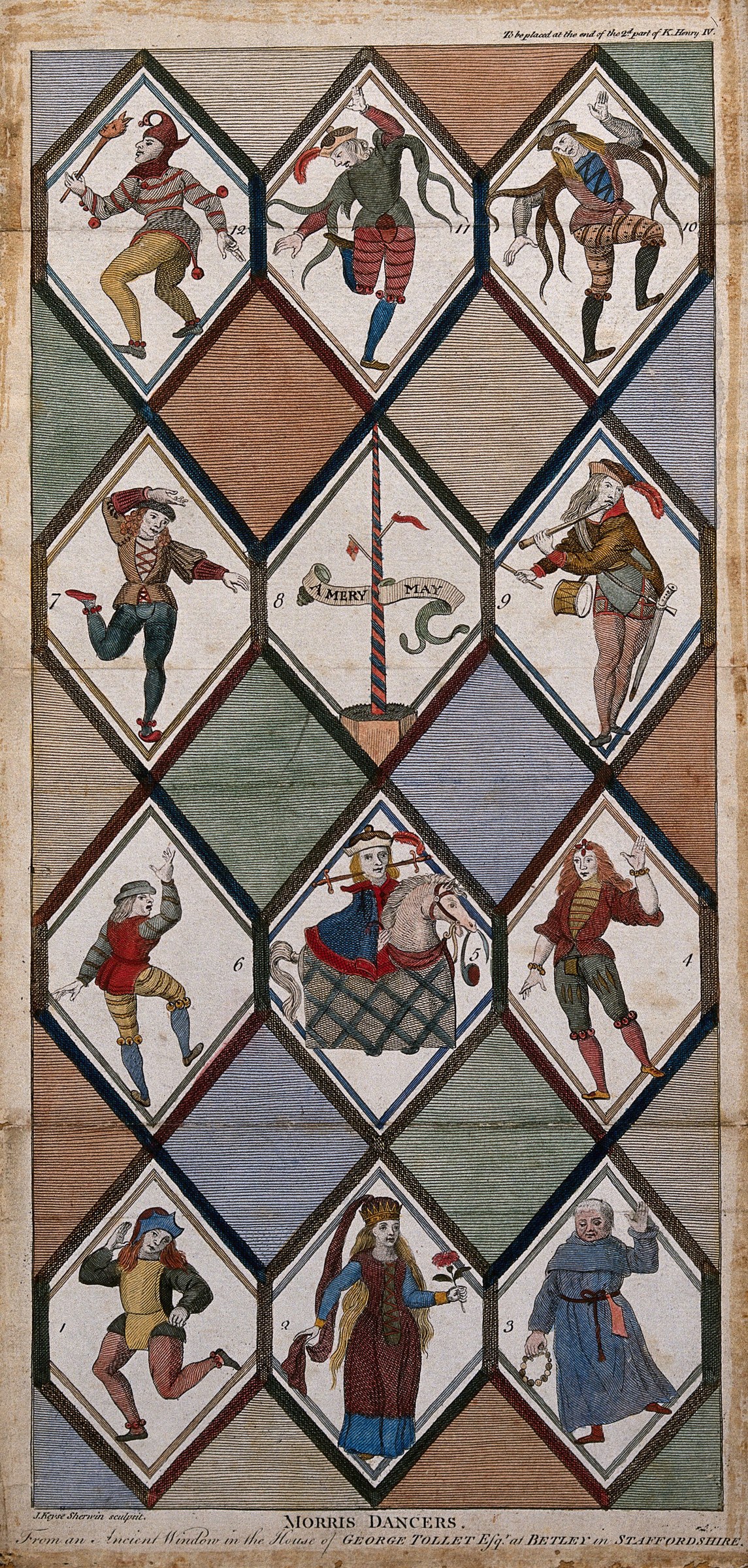
Men and women dancing and playing music. Coloured engraving by J. Keyse Sherwin.
Unknown artist
- Source:
- Wellcome Collection
- Rights:
- Public domain — free to use, share and adapt.
- Recorded as:
- Public Domain Mark
Morris dancing is one of the few English folk dance traditions with visual documentation spanning several centuries; this engraving is an invaluable record of how the dance was understood, represented, and consumed in the 18th century. The comparison between these theatrical, elevated poses and the grounded, rhythmic footwork of surviving morris traditions reveals how folk forms are transformed and distorted when mediated through print and commercial spectacle. For historians of dance notation and dance image-making, the work also demonstrates the conventions of how movement was frozen and codified in the absence of notation systems or photography.
What you are looking at
A grid of nine diamond-shaped frames arranged in three rows of three, each containing a single figure in elaborate costume against a plain background. The frames are separated by a striped cross-hatch pattern in brown and tan tones, and a central banner reading "MERRY MAY" with a Maypole illustration anchors the composition. The figures wear clothing from around the 16th-17th century: hose, doublets, farthingales, and feathered hats in red, green, blue, and gold. Each figure is captured mid-gesture or mid-step—some with arms raised and legs bent as if leaping or dancing, others in exuberant twisted poses. The overall effect suggests a carnival or festival celebration, with the variety of costumes and the energy of the individual poses conveying mirth and movement. The hand-coloring of the engraving creates a lively, decorative quality typical of printed broadside material.
The dancing
Each figure occupies its own frame in isolation, allowing close study of individual body positions. The dancers display varied stances: some stand with weight shifted to one leg and the other raised, arms held aloft or extended outward in gestures of joy; others twist at the torso with exaggerated spinal curves, suggesting the flexible, playful physicality expected of performers. The postures are highly stylised and theatrical rather than naturalistically grounded—no two dancers hold their bodies the same way. The variety of poses and the absence of partnering or formation suggests these may be individual character dances or solo turns rather than a coordinated ensemble movement.
The dance depicted
The title 'Morris Dancers' and the label 'MERRY MAY' identify this as documentation of morris dancing, the English folk tradition performed around May celebrations. However, the figures shown here do not display the characteristic low-to-ground, heavily stamping footwork of authentic morris dance. Instead, the poses are lifted, pirouetting, and acrobatic—more consistent with the comic or grotesque character dances that accompanied festival celebrations, or with the theatrical burlesque of professional performers mimicking folk forms. The variety and individualism of the poses suggest these are stock character types rather than a unified tradition, and the medium (printed engraving for circulation) implies these are recognisable comic performers rather than documentation of actual village practice.
How it was made
This is a hand-coloured engraving, as stated in the catalogue record and confirmed by the fine parallel lines (hatching) visible in the background and the artist credit 'J. Keyse Sherwin' noted below the image. The engraving technique allowed for sharp, clear definition of costume detail and gesture, and the hand-colouring (in blue, red, green, and ochre) was applied after printing to increase visual appeal and commercial value. The format and style are consistent with 18th-century broadside prints—small, portable, decorative, and suitable for framing in a domestic interior or for sale as a cheap print. The archival note 'From an Ancient Window in the House of George Tollet Esq at Betley in Staffordshire' suggests the image may derive from a stained glass window or architectural detail, though the engraving itself is a later reproductive print.
About this work
This is a hand-coloured engraving by J. Keyse Sherwin documenting or commemorating Morris Dancers and associated May celebrations in England. The nine figures shown are rendered in individual frames in elaborate period costume, each frozen in a moment of exuberant movement. Rather than a naturalistic record of a folk tradition, the work functions as a entertainment print—a display of character types and theatrical poses designed to amuse and to circulate knowledge of festive customs among a broad domestic audience. The work sits at the intersection of folk practice, theatrical spectacle, and commercial print culture, capturing both the real historical tradition of May celebrations and the way those traditions were already being stylised and reimagined for urban audiences in the 18th century.
How to look at it
The viewer should note the variety and individuality of the poses within the rigid grid format: each dancer is allowed a distinct personality and physical vocabulary, suggesting these are stock character types (the fool, the acrobat, the prancer) rather than iterations of a single technique. Pay attention to the elevation and rotation of the figures—the bent knees, raised heels, and twisted torsos—and compare this to historical photographs of actual morris dancers, which show a much lower, more grounded, rhythmic aesthetic. The use of individual frames in isolation also affects interpretation: by separating the dancers, the engraving denies us any sense of formation, coordination, or ensemble timing, focusing instead on costume, character, and individual virtuosity. The banner with the Maypole at the centre establishes the thematic link to May celebrations, but the figures around it are performers rather than participants in folk ritual.
The artist
J. Keyse Sherwin (fl. 1770s–1790s) was a London engraver known for reproductive prints, antiquarian subjects, and popular entertainment imagery. He worked in the tradition of commercial print-making that supplied the growing consumer market for decorative and educational engravings in the late 18th century. Sherwin often drew on historical sources, local antiquities, and folk traditions, presenting them in an accessible, coloured format for domestic circulation. His work typically served both documentary and entertainment purposes, and his use of distinctive costume and character types reflects the period's fascination with regional customs and 'Englishness'.
The period
The engraving dates to the late 18th century, a period of intense interest in English folk traditions, rural customs, and antiquarian subjects among urban, educated audiences. The rise of hand-coloured prints and broadside publication made such imagery widely available to middle-class households. Morris dancing itself had ancient roots but was already becoming a subject of nostalgic interest and theatrical reinterpretation by this period, as urbanisation and industrialisation seemed to threaten traditional rural practices. The association with May celebrations and fertility rites added romantic appeal, and May Day itself was undergoing a shift from folk ritual to fashionable social occasion in some contexts.
Where it lives
The catalogue record notes the source as the Wellcome Collection, and includes the archival note 'From an Ancient Window in the House of George Tollet Esq at Betley in Staffordshire', suggesting the engraving was preserved as a record of local or family history. The holding institution is not specified in the catalogue record provided.
Dance in this work
Questions about this work
Is this a real record of how morris dancers actually moved?
Partly, but with significant theatrical distortion. The costumes and the mention of May celebrations are authentic to the english folk tradition, but the elevated, acrobatic poses shown here are exaggerated and theatrical. Actual morris dancing relies on low stances, rhythmic footwork, and often coordination in lines or circles—none of which is evident here. This engraving shows how the tradition was interpreted and performed for urban audiences, not how village performers danced it.
What was J. Keyse Sherwin?
An 18th-century London engraver who specialised in reproductive prints, antiquarian subjects, and popular imagery. He worked in the commercial print trade, supplying affordable, hand-coloured engravings to middle-class households. His practice was typical of late 18th-century entrepreneurial print-making, which combined documentation, entertainment, and profit.
Why are the dancers shown in separate frames?
The diamond-frame format serves several purposes: it allows clear display of individual costumes and character types, it echoes the aesthetic of heraldic or antiquarian prints, and it emphasises character and costume over ensemble movement or formation. This compositional choice tells us that the print is primarily interested in recognisable character types and visual novelty rather than in choreographic detail or social dance practice.
What is the Maypole at the centre?
The Maypole is the symbolic centre of May Day celebrations, around which ribbons are woven and traditional dances performed. Its inclusion in this print's title and composition anchors the morris dancers to the broader May celebration tradition, though the individual poses shown do not appear to be from an actual Maypole dance.
More dance artwork





