49 works in this view — arrow keys or swipe to move between them.
Dance in Art
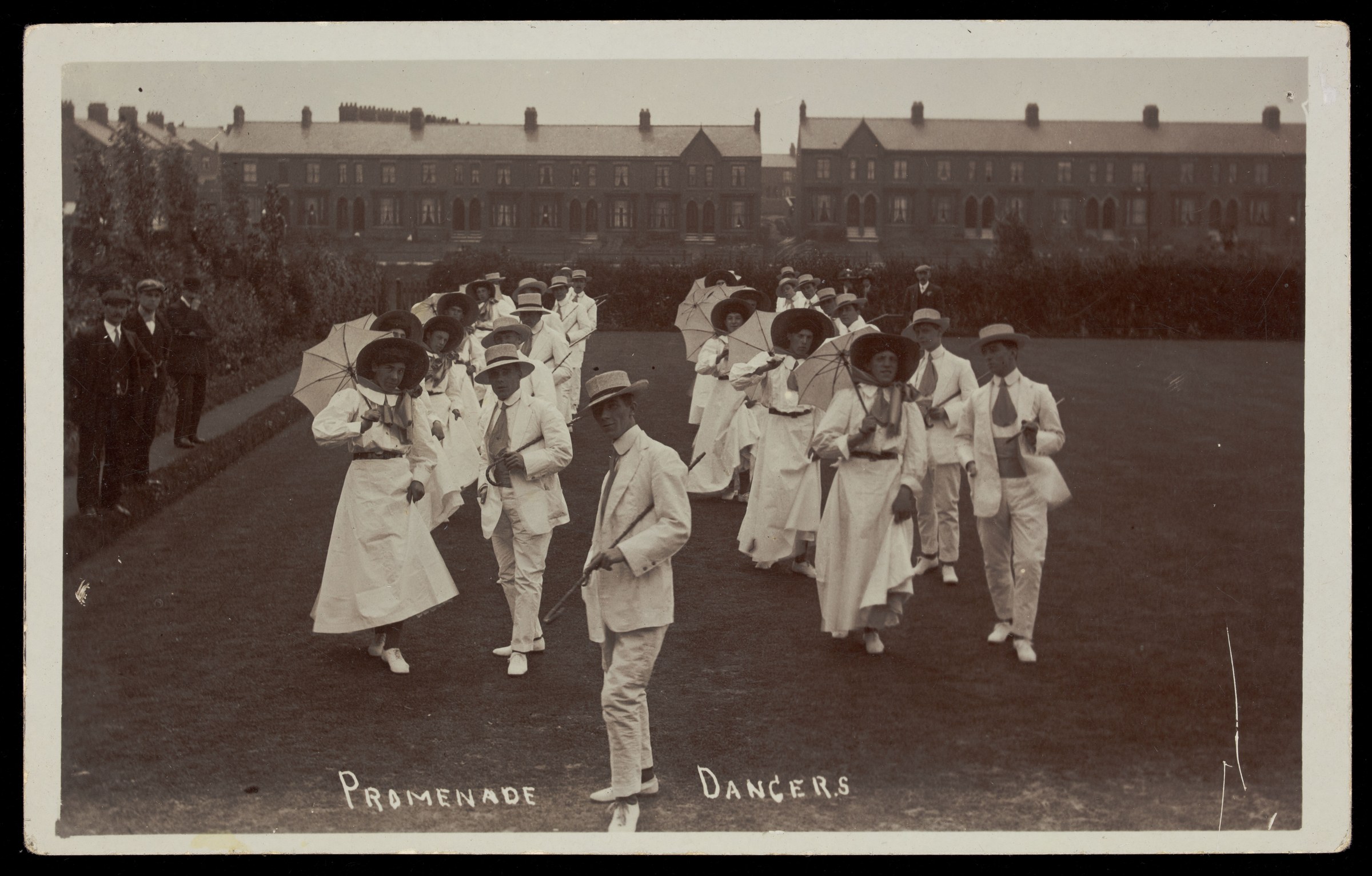
A group of men, some in drag, dancing the Promenade on a lawn.
Unknown artist
- Source:
- Wellcome Collection
- Rights:
- Rights reserved by the holding institution — do not reuse without permission. Source record ↗
- Recorded as:
- In copyright
This image documents the promenade not as an elite ballroom display but as social theater, performed outdoors and in fancy dress by what appear to be amateur performers or institutional residents. It reveals how fundamental ballroom movements circulated beyond the dancehall into public entertainment, garden parties, and institutional life. The cross-dressing element suggests the promenade was flexible enough to accommodate playful performance and social commentary, not simply a vehicle for displaying correct technique.
What you are looking at
A photograph captures a group of approximately twenty people arranged in two loose clusters on a manicured lawn, dressed uniformly in white or cream linen suits and holding parasols against bright sunlight. The figures are positioned as if mid-promenade, moving informally across the grass with a relaxed, social bearing. In the background, a substantial Victorian-era brick building with tall chimneys dominates the composition—institutional in character, with regularly spaced windows and a formal roofline. The photograph's sepia tone and the quality of the light suggest a leisurely summer afternoon, possibly at a school, hospital, or country estate. Several onlookers in dark formal dress stand at the left edge, observing the scene.
The dancing
The dancers move in a social formation rather than a tight ensemble line, distributed across the space with varying distances between them. Many hold parasols overhead or at angles, which occupy the arms and determine posture; the parasols suggest protection from sun rather than structural support for the dance. The bodies are upright and relaxed, the gait appears unhurried, and the overall frame is one of social promenade rather than technical choreography. The dress—identical white suits, straw hats or boater hats, some with feminine jackets—indicates this is fancy-dress or costume performance, not authentic period attire.
The dance depicted
This is a promenade—a basic social walking formation in couples or groups, fundamental to ballroom, quadrille, and regency-era contra dancing. The title explicitly identifies it as 'Promenade Dancers.' The white costume and the casual, outdoor summer-fete setting suggest this is a theatrical or social entertainment, possibly part of a garden party, charity event, or institutional celebration. The presence of cross-dressing (men in feminine dress among the group) indicates this is either a comedy sketch, a masquerade, or an amateur theatrical performance rather than a formal dance competition. The promenade itself is among the easiest and most universal of ballroom movements—a simple walk in hold—and requires no special skill; its presence here emphasizes the social and entertainment value over technical instruction.
How it was made
This is a gelatin silver bromide photograph, likely taken with a fixed-focus or simple box camera in natural daylight. The sepia or cream toning suggests it has aged or been treated in printing. The composition is documentary in approach: a distant wide shot that captures the full group and their setting, prioritizing information over artistic composition. The depth of field is shallow; figures in the background blur slightly. This type of photograph was common in institutional and social archives of the Edwardian era, used to document garden parties, theatrical performances, and social events. The Wellcome Collection acquisition suggests this may have been associated with a hospital, school, or public health institution, and the photograph may have been used for publicity, record-keeping, or internal documentation.
About this work
This photograph documents a promenade dance performed outdoors on a lawn, likely part of a fancy-dress entertainment or garden party at a substantial institutional building, probably in Britain in the early 20th century. The performers—approximately twenty people in costume white suits and hats—move in a loose social formation, many holding parasols. The promenade is one of the foundational social dances of the ballroom tradition, a simple coupled or grouped walk performed with upright posture and formal bearing; it appears throughout regency quadrilles, waltzes, and later ballroom sequences. The photograph shows how the dance was adapted for casual public entertainment and how costume and setting could transform a basic social movement into theatrical spectacle.
How to look at it
Note the uniform white costume and the parasols, which impose a visual order and constraint on the movement; the parasols particularly affect the arm carriage and prevent the closed holds typical of ballroom dancing. Observe the spacing and formation—this is loose and social, not military or balletic in precision. The participants' evident pleasure and informality, despite the formal costume, suggests the promenade was valued as a social gesture and a marker of civility, not as a technical challenge. The photograph freezes a moment of processional movement, capturing the dancers mid-stride on the lawn.
The period
The photograph dates to the Edwardian era or early 20th century, when the ballroom tradition was established but still novel in its social forms. The promenade was a standard opening or closing figure in the quadrille and was retained in the waltz and other ballroom dances. Outdoor garden parties and fancy-dress entertainment were popular among the middle and upper classes; the presence of an institutional building suggests this may have been a school, hospital, or charitable organization using such events for fundraising or morale-building. Cross-dressing in theatrical and social contexts was common in Edwardian entertainment, though usually coded as comedy or pantomime.
Where it lives
The photograph is held by the Wellcome Collection, a major archive of medical, social, and cultural history. Its presence in the collection suggests it may have been associated with a hospital, school of nursing, public health institution, or sanatorium; such institutions often used garden parties and theatrical entertainments as therapeutic or social events. The photograph is a gelatin silver print, a common format for documentary and institutional photography of the period.
Dance in this work
Questions about this work
What exactly is a promenade in dance?
A promenade is a basic ballroom figure in which dancers walk forward in hold, typically in couples or small groups, with upright posture and a simple step. It is used to open or close dances, to move between figures, and in the waltz and quickstep as a fundamental movement. Unlike more complex figures, the promenade requires no special technique; its purpose is social and processional rather than virtuosic.
Why are some of the dancers in women's clothing if they are men?
This appears to be a fancy-dress or costume entertainment, where cross-dressing was a common comedic or theatrical device in Edwardian society. The identical white suits and the outdoor garden setting suggest this was a playful, amateur performance rather than a serious ballroom competition. Cross-dressing in this context was typically presented as amusing or whimsical rather than transgressive.
What institution or event does this photograph document?
The record does not specify. The presence of a large Victorian institutional building and the photograph's holding by the Wellcome Collection (focused on medical and social history) suggest it may have been taken at a hospital, sanatorium, school, nursing college, or similar establishment. The garden party may have been a therapeutic activity, a fundraiser, or a social event for residents or staff.
More dance artwork





