49 works in this view — arrow keys or swipe to move between them.
Dance in Art
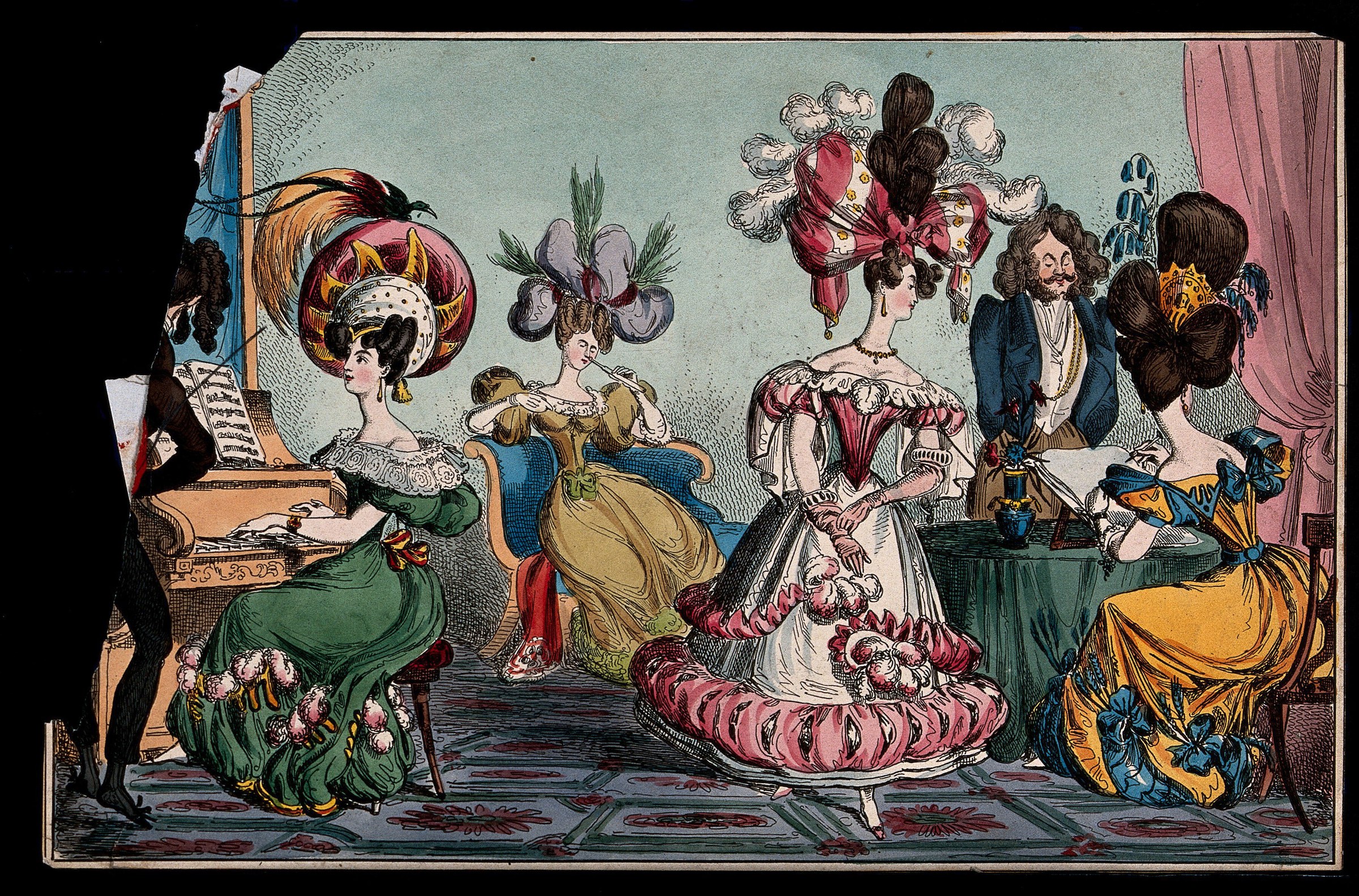
Women wearing enormous headwear amusing themselves by playing music, dancing and drawing. Coloured etching.
Unknown artist
- Source:
- Wellcome Collection
- Rights:
- Public domain — free to use, share and adapt.
- Recorded as:
- Public Domain Mark
The print reveals the precarious status of dance in early 19th-century polite society—present as an aspiration, a costume showcase, and a background activity, but not the central action. The enormous, impractical headdresses and elaborate skirts shown here raise questions about what movement was actually possible or intended. The work documents the feminized, domestic performance space of drawing-room entertainment and shows how dance existed within a broader spectrum of artistic and social display.
What you are looking at
A fashionable interior scene of social entertainment, likely early 19th century, showing five women and two male musicians in elegant dress. The composition centers on a woman in an elaborate white gown with pink bows and ribbons, whose voluminous skirt takes up much of the lower canvas. To her left sit two women at a desk or table—one in green, one in tan and blue—attending to drawing or writing. Behind them stand three additional figures, including a woman with an enormous headdress of ostrich feathers and ribbons in pink and white. Two male musicians occupy the right side: one plays a stringed instrument while another holds sheet music or a document. The setting is a formal parlor with pink curtains, decorative molding, and a patterned floor. The etching is hand-colored with bright, saturated hues—greens, blues, pinks, and golds—and shows the characteristic line work of satirical print of the period.
The dancing
The principal figure in white stands in an upright, static pose with arms at her sides, presenting her costume rather than moving through space. The seated figures bend forward over their work in postures of concentration. The standing women maintain erect posture befitting fashionable deportment. None of the figures is captured mid-step or in a recognizable dance frame; even those standing are positioned for display rather than movement. The male musicians are engaged in performance, not social dancing partnership.
The dance depicted
While the title invokes dancing, the image depicts a music and drawing party—a social gathering for genteel entertainment—rather than active dance. The woman in white may be posed to perform or prepare to dance, but she is frozen in presentation, not caught in movement. No partner, hold, or footwork is visible. The scene represents the context in which dance occurred in fashionable society rather than depicting dance itself. The entertainment is multiple and simultaneous: music-making, artistic drawing, and social interaction, with dance as a potential but not executed activity.
How it was made
This is a hand-colored etching, evident from the fine parallel line work (hatching and cross-hatching) creating shadow and form, the characteristic plate marks and ink variations of the etching process, and the hand-applied watercolor or ink wash added afterward. The technique allowed for mass reproduction with individual coloring, typical of satirical or fashionable prints intended for a broad middle-class audience. The bright, slightly garish colors suggest amateur or rapid hand-coloring typical of commercial print production of the 1810s–1830s.
About this work
This is a satirical or documentary etching of fashionable women's society in the early 19th century, focusing on an elaborate costume display and the multiple entertainments—music, drawing, conversation, and presumed dancing—that occupied genteel social life. The work captures a moment of stillness and presentation rather than active performance, making it a document of fashion, interior design, and social custom as much as of dance practice. It belongs in a dance archive because it records the social contexts and partnerships in which dance occurred, the dress worn for dance, and the ambitions of women's physical display and artistic participation in the era.
How to look at it
Notice first the costume: the woman in white is not posed for movement but for viewing. Her skirt's volume and the headdresses of the other figures are exaggerated to the point of visual comedy—this is satirical commentary on fashion excess. Observe where the actual action is: at the desk, where two women focus intently on drawing. The musicians are engaged, but the woman who might dance is a static display object. Look at the floor: no one is positioned to move across it. This is a print about the contradiction between the aspirations of fashionable entertainment and the constraints of the dress that embodied those aspirations.
The period
The etching dates to the early 19th century, an era of intense fashion innovation and satire in European print culture. Women's dress became increasingly ornate, with exaggerated sleeves, high waistlines, and elaborate headdresses that reached their visual extremes in the 1820s–1830s. During the same period, dance in fashionable society remained dominated by country dances, cotillions, and quadrilles—group dances requiring minimal physical contact and maximum opportunity for display. The Regency and early Georgian eras saw a flood of satirical prints mocking women's fashion excess, and this work fits that tradition. Drawing, music, and needlework were celebrated as accomplishments for women of the leisured classes, placing dance in a context of multiple genteel arts.
Where it lives
Held by the Wellcome Collection, a repository focused on the social and cultural history of medicine and science; this print may have been collected for its documentation of historical dress, social life, or feminine accomplishment. The Wellcome source suggests the print was significant enough to be preserved in a major institutional collection, though its original context of publication and intended audience remain unrecorded.
Dance in this work
Questions about this work
What are those huge headdresses made of?
Ostrich feathers, silk ribbons, and artificial flowers mounted on a foundation, likely buckram or wire. They were expensive, fragile, and genuinely difficult to wear; the exaggeration in this print satirizes the impracticality of fashionable dress. They would have made active movement—especially turning or bending—hazardous.
Is anyone actually dancing?
No. The woman in white is posed in presentation, not captured in movement. The title promises dancing, but the image shows the social context in which dance *could* occur—music, company, interior space, and costume. This gap between promise and action may itself be the satire.
Why are two women drawing in a dancing scene?
Because this is not primarily a dance scene; it is a record of genteel women's entertainments. Drawing, music, conversation, and dance were all part of the same social gathering. The print documents the plural accomplishments expected of fashionable women.
Could someone actually dance in a skirt like that?
With difficulty. The skirt is shown at its widest and most impractical. Country dances and quadrilles of the period required movement but not high kicks or close partnering; the dress limited range but was not entirely prohibitive. The exaggeration here suggests satire on fashion excess rather than documentation of actual wear.
More dance artwork





