49 works in this view — arrow keys or swipe to move between them.
Dance in Art
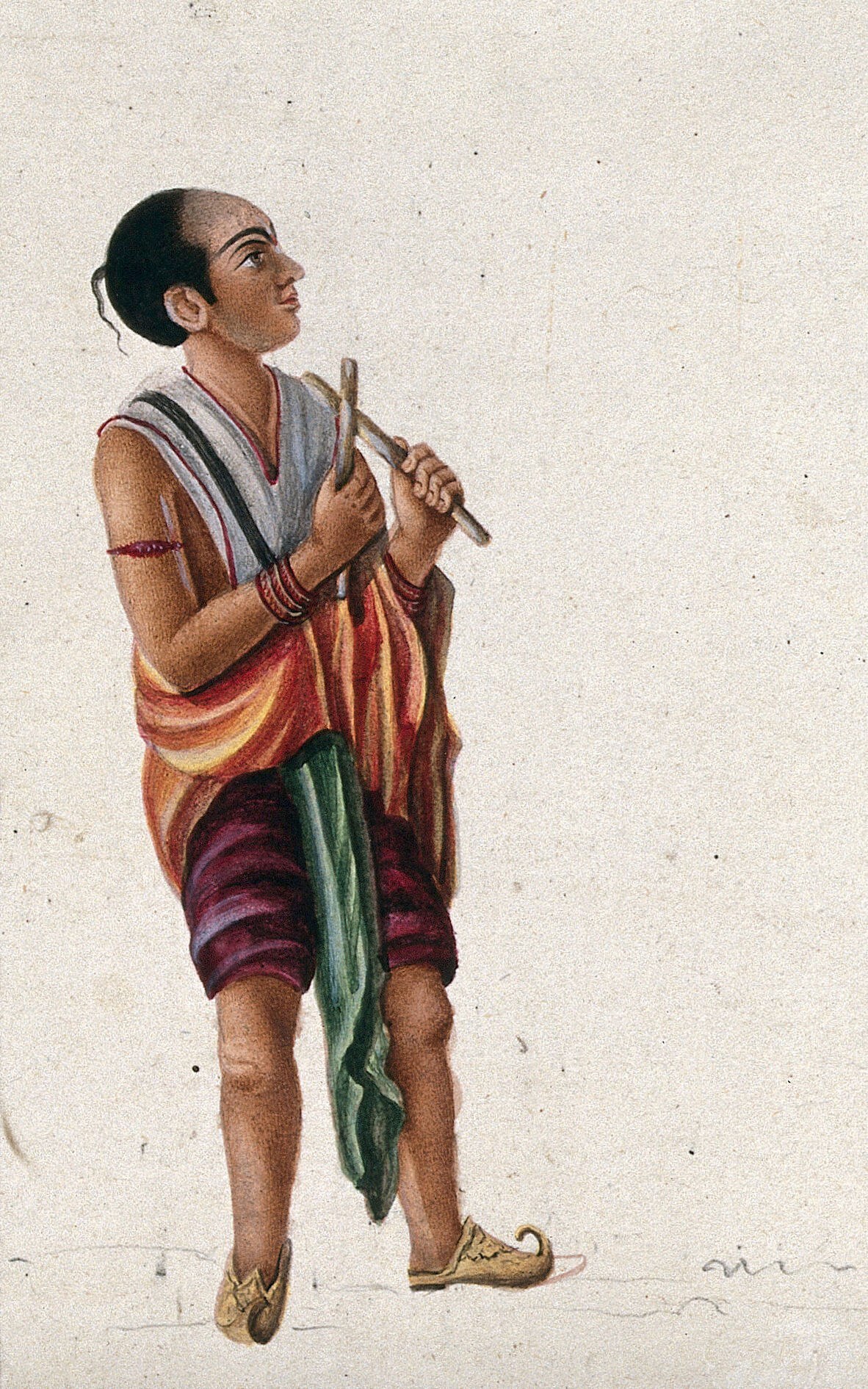
Two musicians playing with a kolu; pair of sticks beaten together in folk dances. Gouache painting by an Indian artist.
Unknown artist
- Source:
- Wellcome Collection
- Rights:
- Public domain — free to use, share and adapt.
- Recorded as:
- Public Domain Mark
This painting is one of the few surviving visual records of kolu practice in South Asian folk tradition, documenting both the instrument itself and the posture and dress of performers. For dancers and historians, it provides concrete evidence of how the sticks were held, the body position maintained during performance, and the social context suggested by dress and ornamentation. The work also exemplifies the practice of South Asian courtly artists in recording vernacular traditions, a documentation method that preserved knowledge of folk practices that might otherwise have been lost.
What you are looking at
A single male figure stands in profile against a pale background, gazing upward with a contemplative expression. He wears a sleeveless blue-grey upper garment draped across one shoulder, leaving the torso partially exposed, and deep red-purple pleated lower garment or skirt reaching to mid-thigh. His left wrist and arm bear stacked red-brown bangles or bracelets. He holds a wooden stick or staff horizontally across his body with both hands, roughly at chest height. A green cloth drapes from his right side. His feet are bare and appear to rest on the ground in a neutral stance. The figure's dark hair is pulled back, and his facial features and body type suggest South Asian origin. The painting style uses translucent gouache with fine detail, typical of 19th-century Indian miniature or courtly manuscript illustration.
The dancing
A single male dancer stands in a posture of repose or pause rather than active motion. His weight is evenly distributed and his stance is upright but not rigid. Both arms hold the wooden stick (kolu) in a balanced, horizontal position at mid-torso, suggesting either a moment of readiness or the conclusion of a striking action. The body posture is frontal in profile, with the gaze directed upward in a moment of inward focus rather than outward performance.
The dance depicted
This appears to document a male dancer performing or holding the kolu (paired wooden sticks beaten together in folk dances), as the catalogue notes. The kolu is associated with various folk traditions across South Asia, particularly in celebratory and martial contexts. The upward gaze and contemplative bearing suggest this may capture either a moment of preparation before striking the sticks together, or a pause between sequences. The bare feet, minimal dress, and simple stance indicate a vernacular rather than courtly tradition. Without additional context, the specific regional or ritual context cannot be determined with certainty, though the iconography points to popular celebration or festive gathering.
How it was made
This is a gouache painting on paper, a medium well-suited to the luminous color gradations visible in the fabric folds and skin tones. Gouache allowed the artist to work with opaque pigments applied in thin layers, visible here in the subtle shading of the garments and the refined detail of the jewelry and facial features. The technique and composition suggest this work belongs to the South Asian tradition of courtly or documentary painting, possibly from the 18th or 19th century, created for a patron or collector interested in ethnographic or costume documentation. The careful attention to textile patterns and ornament is characteristic of manuscript or album painting traditions rather than easel painting for exhibition.
About this work
This gouache painting documents a South Asian folk dancer or musician holding the kolu, paired wooden sticks struck together as percussion in festive and ritual contexts. The work captures a single figure in a moment of poised readiness, dressed in vernacular clothing and minimal ornament, with the gaze and posture suggesting either spiritual focus or the pause between dance movements. The painting exemplifies 19th-century South Asian courtly or documentary practice, recording the dress, gesture, and instruments of lived folk tradition for a patron's collection.
The work is significant as ethnographic documentation of South Asian dance practice at a period when such traditions were being recorded by artists working for colonial or regional courts. The attention to textile detail, ornament, and the specific iconography of the kolu makes this a valuable visual record of how these instruments were held and used in performance. The solitary figure and upward gaze distinguish this from celebratory group scenes, instead suggesting either a ritual or preparatory moment within performance practice.
How to look at it
Attend first to the posture of the figure and the precise position of the kolu sticks across the body—this captures the ready position before striking or the pause within a rhythmic sequence. The upward gaze is not directed toward an audience but inward or heavenward, suggesting ritual or spiritual dimension to the performance. The rendering of fabric and ornament, particularly the pleating of the lower garment and the stacked bangles, shows the artist understood both the material culture and the body beneath it. The artist chose a moment of stillness within what would have been active, percussive movement—a choice that emphasizes the dignity and focus of the performer.
The period
This work likely dates to the 18th or 19th century, a period when South Asian courtly and regional patrons commissioned artists to document local customs, dress, and performance traditions. The gouache technique and compositional style are consistent with Mughal or post-Mughal painting practices, particularly the tradition of costume and character studies created for royal albums or collections. The work reflects both aesthetic interest in vernacular subjects and the documentary impulse that characterized colonial-era collecting of ethnographic imagery.
Where it lives
The work is held in the Wellcome Collection, a research institution housing historical materials on medicine, science, and cultural practice. The Wellcome has significant holdings of South Asian courtly and documentary painting from the colonial period, acquired as part of broader collections of ethnographic and scientific imagery.
Dance in this work
Questions about this work
What is a kolu and when is it used?
The kolu refers to a pair of wooden sticks, typically held horizontally and struck together to create percussion. The sticks appear in various South Asian folk and celebratory traditions, particularly in festival contexts and ritual performances. The specific regional attribution and ritual function cannot be determined from this image alone, but the careful documentation suggests the tradition was active and recognized in the period when this painting was made.
Why is the figure looking upward?
The upward gaze could indicate several possibilities: a moment of spiritual focus or prayer within a ritual performance, the conclusion of a sequence where the dancer looks skyward, or simply the artist's choice to convey dignity and inward focus rather than outward showmanship. Without additional context, the precise meaning remains open to interpretation.
How can we date this painting?
The style, technique, and composition are consistent with South Asian courtly painting of the 18th or 19th century. The paper, pigments, and brushwork suggest this period, though without scientific analysis or documentary evidence of date or signature, the precise date remains uncertain. The work's presence in the Wellcome Collection may provide additional institutional documentation.
More dance artwork





