49 works in this view — arrow keys or swipe to move between them.
Dance in Art
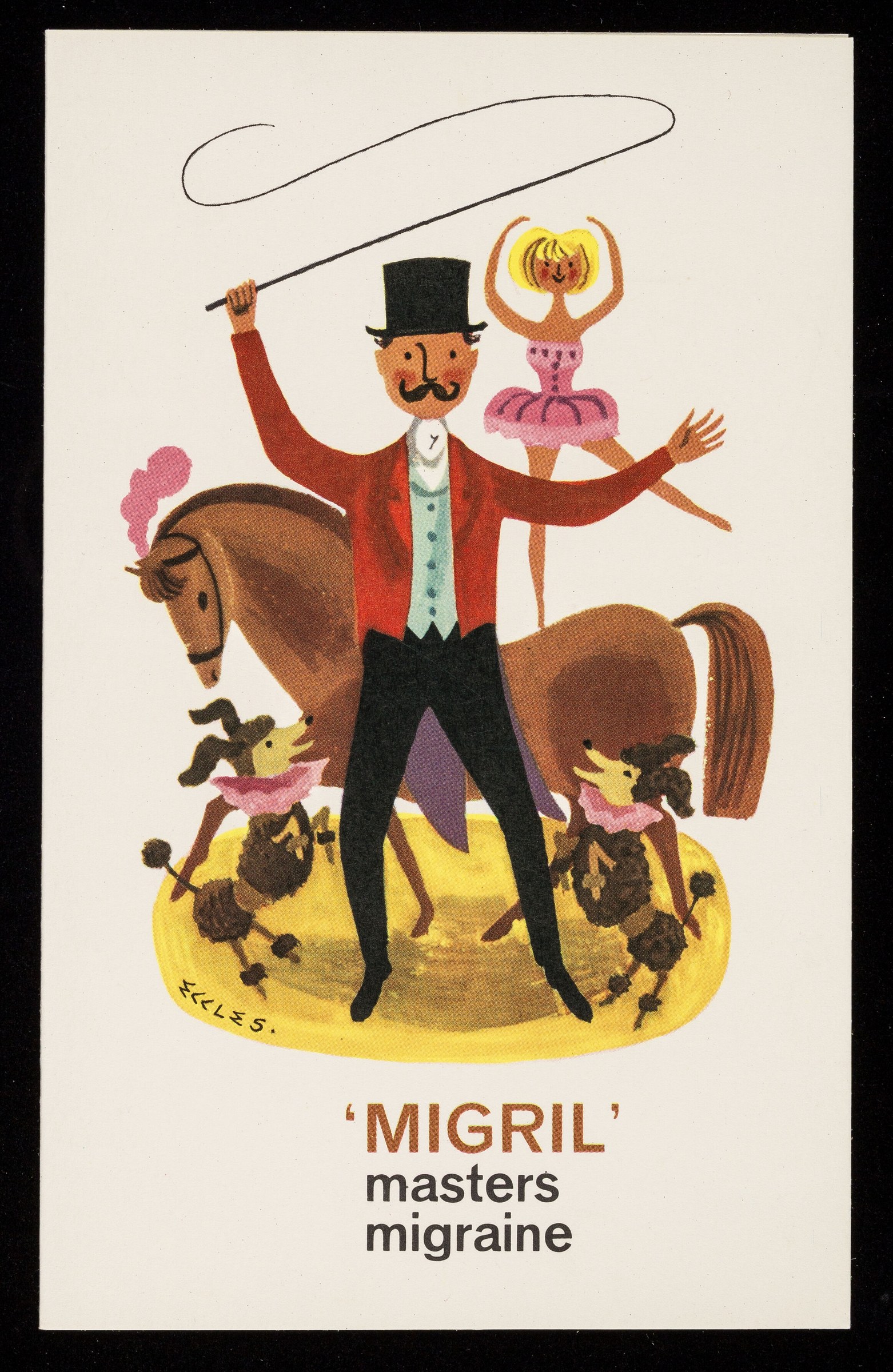
'Migril' masters migraine : it is difficult or any migraine patient to enjoy the circus, the theatre, the concert, or indeed any social occasion - when burdened with fears of a migraine attack...
Unknown artist
- Source:
- Wellcome Collection
- Rights:
- Rights reserved by the holding institution — do not reuse without permission. Source record ↗
- Recorded as:
- In copyright
Circus ballet is a largely undocumented historical practice, overshadowed by both circus history (which emphasizes acrobatics and animals) and dance history (which centers concert and theatrical ballet). This advertisement preserves visual evidence that balletically trained dancers performed in circus rings, and that their technical skill was considered a significant draw. It also documents the cultural logic that connected dance, health, and consumption in early-20th-century marketing.
What you are looking at
A ringmaster in formal circus attire stands at the center of a yellow circular arena, holding a long whip aloft in one hand. He wears a red coat with black lapels, a white shirt with green buttons, black trousers, and a black top hat; his face is rendered in warm orange tones with an emphatic black mustache. To his right, a blonde woman in a pink tutu and pink bodice stands with her arms raised overhead in a balletic pose, her body arched backward. To his left and below, two small figures in brown clothing (possibly clowns or acrobats) gesture upward. Behind the ringmaster, a brown horse with a pink plume in its mane completes the classical circus ensemble. The entire composition sits within a shallow yellow ground against a cream background, with the whip's curved handle extending upward into the margin of the page.
The dancing
The woman at right demonstrates a classic balletic fifth or arabesque-like position, with both arms raised in an open, celebratory frame and her torso lifted—characteristic of trained theatrical dance of the late 19th and early 20th centuries. Her body weight is centered, her posture erect. The ringmaster's stance is commanding but static, weight planted, one arm extended in a gesture of presentation or control. The smaller figures below are gestural and comic rather than balletic, their poses emphasizing surprise or delight.
The dance depicted
The blonde woman most likely represents a circus performer executing a classical ballet phrase—possibly a variation or display number of the kind that formed the entertainment spectacle within circus rings during the late 19th and early 20th centuries. Circus ballet was a distinct genre, performed by trained dancers who combined balletic technique with the novelty and risk of performance in the round, often in proximity to animals and acrobats. The context here is explicitly commercial: this is the merchandise of a patent medicine (Migril), and the circus serves as a symbol of excitement and spectacle from which the viewer—understood to be a migraine sufferer—is isolated by their condition.
How it was made
This is a color lithograph, evidenced by the flat color planes, the deliberate contours, and the characteristic soft halftone rendering of figures against a uniform background. The technique allows rapid commercial reproduction and bright, durable color; the style and finish suggest a consumer product advertisement or packaging illustration rather than fine art. The hand-drawn quality and the artist's monogram (visible as 'KCLES' in the lower left) indicate production by a commercial lithographic house, likely European, in the early 20th century.
About this work
This is a pharmaceutical advertisement using circus spectacle as a visual metaphor for the social and recreational pleasures from which migraine sufferers feel excluded. The image pairs a trained ballet dancer in classical pose with the ringmaster, animals, and clowns that made up the circus bill—the ultimate symbol of public entertainment and joy in the popular imagination of its era. The work is neither fine art nor documentary dance imagery, but it captures a real performance context (circus ballet) and preserves evidence of how early-20th-century commercial culture understood and deployed dance as a symbol of health, vitality, and the capacity to participate in leisure. The emotional logic of the advertisement—that Migril will restore your ability to enjoy such spectacles—rests on the viewer recognizing the dancer's pose as aspirational and its associated pleasure as worth reclaiming.
How to look at it
Attend first to the dancer's pose: it is not a static or neutral position, but a lifted, open, celebratory one—the visual language of accomplishment and joy. Note how the lithographer has used the soft orange and pink tones to render her as the focal point despite her smaller size relative to the ringmaster. The whip and the other circus figures (horse, clowns) create a dense composition of spectacle around her, but her balletic form and upright bearing distinguish her visually and grammatically—she is the aspirational figure, the emblem of what the drug promises to restore. The work demonstrates how advertising harnessed the cultural prestige of trained dance to sell a product.
The artist
The work is signed 'KCLES,' likely a monogram for a commercial illustrator or lithographic atelier active in the early 20th century. The style is characteristic of Art Nouveau-inflected commercial design: simplified forms, bold outlines, flattened color, and a decorative rather than naturalistic sensibility. No further biographical information on the artist is currently recorded.
The period
Circus ballet flourished in Europe and North America from the mid-19th century through the early decades of the 20th, reaching a peak of popularity before the First World War. The Cirque Medrano in Paris, the Circus Knie in Switzerland, and Barnum & Bailey in the United States all featured ballet dancers as part of their regular bills. Simultaneously, patent medicine advertising was at its height, with manufacturers of unproven remedies using increasingly sophisticated graphic design to build brand recognition and emotional appeal. The combination of circus and pharmaceutical marketing reflects both the popularity of the circus as an entertainment form and the commercial appetite for novel advertising strategies that associated products with happiness, vitality, and social inclusion.
Where it lives
The work is held by the Wellcome Collection, a London-based archive of medical history and material culture. It is catalogued as advertising material or commercial ephemera related to pharmaceutical products, and likely dates to the first or second decade of the 20th century.
Dance in this work
Questions about this work
Did circus performers really do ballet?
Yes. From the mid-19th century onward, European and American circuses regularly featured ballet dancers or dancers trained in ballet technique as part of their programs. These performers occupied an ambiguous position: they brought theatrical prestige to the circus, but their work in the circus ring was often considered a step down from concert or opera ballet. Some performers moved between contexts; others specialized in circus performance.
Why is a circus scene used to advertise medicine?
The advertisement uses the circus as a symbol of joy, spectacle, and social participation—all things the viewer is supposedly denied by migraines. The implicit message is that Migril restores your capacity to enjoy entertainment and public life. This is typical of early-20th-century marketing, which sold products by associating them with emotional and social aspirations rather than by claims of medical efficacy.
What does the woman's pose tell us about circus ballet?
Her fifth-position or arabesque-like pose, with lifted torso and raised arms, shows that circus dancers performed in the vocabulary of classical ballet rather than inventing a separate style. However, the circus context meant they performed in the round, often alongside acrobats and animals, and their acts were typically shorter, more dramatic variations rather than full-length ballets.
Is this work by a known artist?
The work is signed with a monogram 'KCLES,' likely representing a commercial lithographic studio or illustrator rather than an individual artist. No further biographical information has been established. The style is consistent with early-20th-century advertising illustration, but the artist's identity remains unconfirmed.
More dance artwork





