49 works in this view — arrow keys or swipe to move between them.
Dance in Art
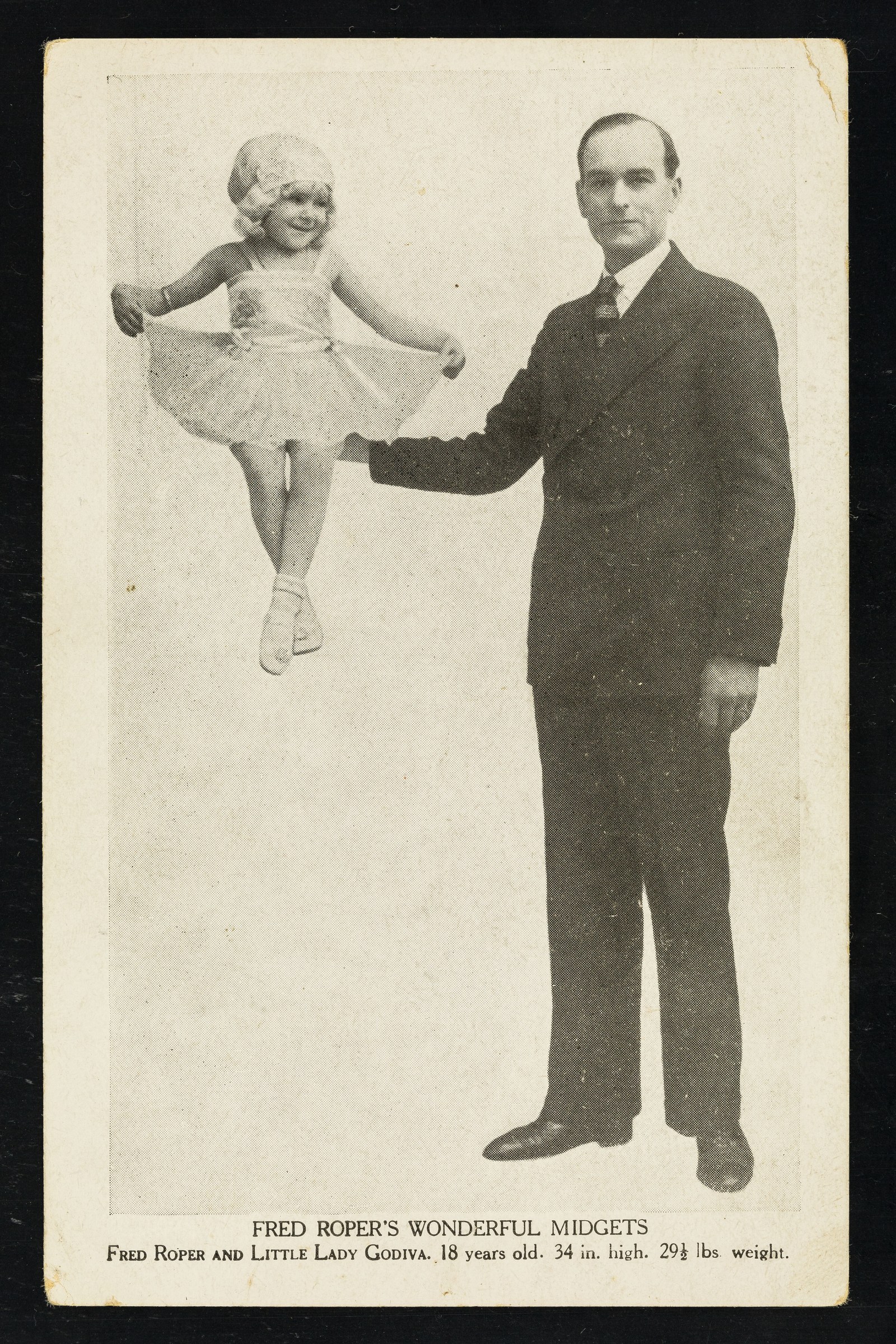
Fred Roper's wonderful midgets : Fred Roper and Little Lady Godiva : 18 years old, 34 in. high, 29 1/2 lbs weight.
Unknown artist
- Source:
- Wellcome Collection
- Rights:
- Rights reserved by the holding institution — do not reuse without permission. Source record ↗
- Recorded as:
- In copyright
This image documents a forgotten category of early-20th-century performance: the music hall act combining acrobatics, novelty appeal, and the exhibition of human difference. For dance historians, it illustrates partner acrobatics and adagio performance outside the theatrical ballet tradition, showing how such techniques were deployed in popular entertainment. For historians of disability and spectacle, it is a primary document of how children with dwarfism were marketed and displayed as curiosities in commercial performance.
What you are looking at
A black-and-white photograph showing a tall, formally dressed man in a dark three-piece suit standing beside a small child, whom he holds aloft at arm's length. The child, identified as Little Lady Godiva, wears a light-colored dress with puffed sleeves and a bonnet, and appears to be in mid-dance or performance pose—legs extended, arms outstretched in a dynamic gesture. The man gazes downward with a composed expression while supporting the child's weight. The photograph is set against a plain, neutral background typical of early-20th-century studio portraiture. The composition emphasizes the stark contrast in scale between the adult performer and the child, making the child's small stature—29½ lbs at 34 inches tall—visually explicit.
The dancing
The child is held horizontally, roughly at the man's chest height, with legs extended and arms spread wide. Her posture suggests a held or suspended moment within a performance phrase. The man's stance is grounded and stable, his body upright and still, functioning as a human stage or support system. There is no physical contact between their bodies beyond his supporting grip; the child appears weightless and elevated, performing for the camera while the man remains formally static. The asymmetry of movement—child airborne and animated, adult stationary and composed—is the visual core.
The dance depicted
This appears to document music hall or vaudeville performance rather than a recognizable dance style. The image records a novelty act: Roper, likely a music hall performer or acrobat, presenting a child performer billed as a 'wonderful midget' (using period terminology now recognized as offensive). The holding pose resembles partner acrobatics or adagio work, where one performer supports another in a stationary or lifted hold. The child's extended limbs and theatrical posture suggest she performed tricks, holds, or miniature dance phrases while supported. Without additional documentation, the specific choreography cannot be determined, but the format aligns with early-20th-century circus, vaudeville, and music hall entertainment combining acrobatics, spectacle, and the exhibition of human curiosities.
How it was made
This is a gelatin silver print, a standard photographic medium of the early 20th century. The image was likely printed from a negative taken in a professional studio; the even lighting, plain backdrop, and sharp focus are consistent with commercial portraiture of the period. The photograph functioned as promotional material or documentation of a public performance act—a common use of studio photography in the entertainment industry. The clarity and professional finish suggest it was made for circulation among theaters, booking agents, and audiences, not as a fine-art object.
About this work
This is a studio photograph documenting a vaudeville or music hall novelty act from the early 20th century. It records Fred Roper, a performer, holding a child performer identified by her stage name 'Little Lady Godiva.' The image captures a suspended moment within what was likely an acrobatic or partner-based performance act marketed around the child's unusual small stature. The photograph is an artifact of early-20th-century entertainment culture, when such acts were common attractions in commercial theaters and circuses. It reveals both the theatrical practices of the period and the historical normalization of displaying people with physical differences as entertainment spectacles.
How to look at it
Attend to the photograph's central visual logic: the man is the infrastructure, the child the spectacle. Notice how the child's extended posture creates a geometric shape—limbs and torso stretched into space—while the man's body remains vertical and stable, absorbed into the act's architecture. The photographer has caught the moment of suspension or hold, not of transition or descent. This freezing of a supported position is typical of acrobatic photography, where the dramatic moment is the most extreme or impossible-looking extension of the human form.
The artist
The photographer is unnamed in the record. Fred Roper is identified only as a performer; no additional biographical information is recorded. The act was apparently significant enough to warrant professional studio documentation, suggesting Roper was an established music hall or vaudeville performer, but details of his career, performance venues, or biographical dates are not available.
The period
Early-20th-century music hall and vaudeville entertainment commonly featured novelty acts, acrobatics, and performers marketed around human difference or unusualness. Such acts occupied a space between circus, theater, and variety entertainment. Professional acrobatics and partner work—adagio and related techniques—were developed and refined in this commercial entertainment sector rather than in formal dance institutions. The photograph dates to an era before strict regulation or ethical concern around the exhibition of people with disabilities; such acts were standard commercial attractions.
Where it lives
The image is held in the Wellcome Collection, a medical history archive. Its presence there—rather than in a performing arts collection—reflects the historical classification of such acts under curiosity, medical interest, or human abnormality rather than under entertainment or dance.
Dance in this work
Questions about this work
Was Little Lady Godiva a professional dancer?
The available evidence suggests she was a vaudeville performer trained in acrobatics and partner work, not a trained dancer in the ballet or theatrical sense. She performed within the music hall tradition of novelty and acrobatic entertainment. The specific content of her act—whether it included dance phrases, tricks, or purely acrobatic poses—cannot be determined from this image alone.
Why is this photograph in a medical archive?
The Wellcome Collection documents the history of medicine and human difference. In the early 20th century, people with dwarfism or short stature were often classified and studied as medical or anthropological subjects, even when their primary role was as entertainers. The photograph's presence in the collection reflects this historical intersection of entertainment, spectacle, and medical interest.
What does 'midget' mean in this context?
The term was standard period nomenclature for performers of short stature, particularly in circus and vaudeville. It is now recognized as offensive. The term in the original caption reflects historical language and commercial branding practices, not current usage or respectful terminology.
More dance artwork





