49 works in this view — arrow keys or swipe to move between them.
Dance in Art
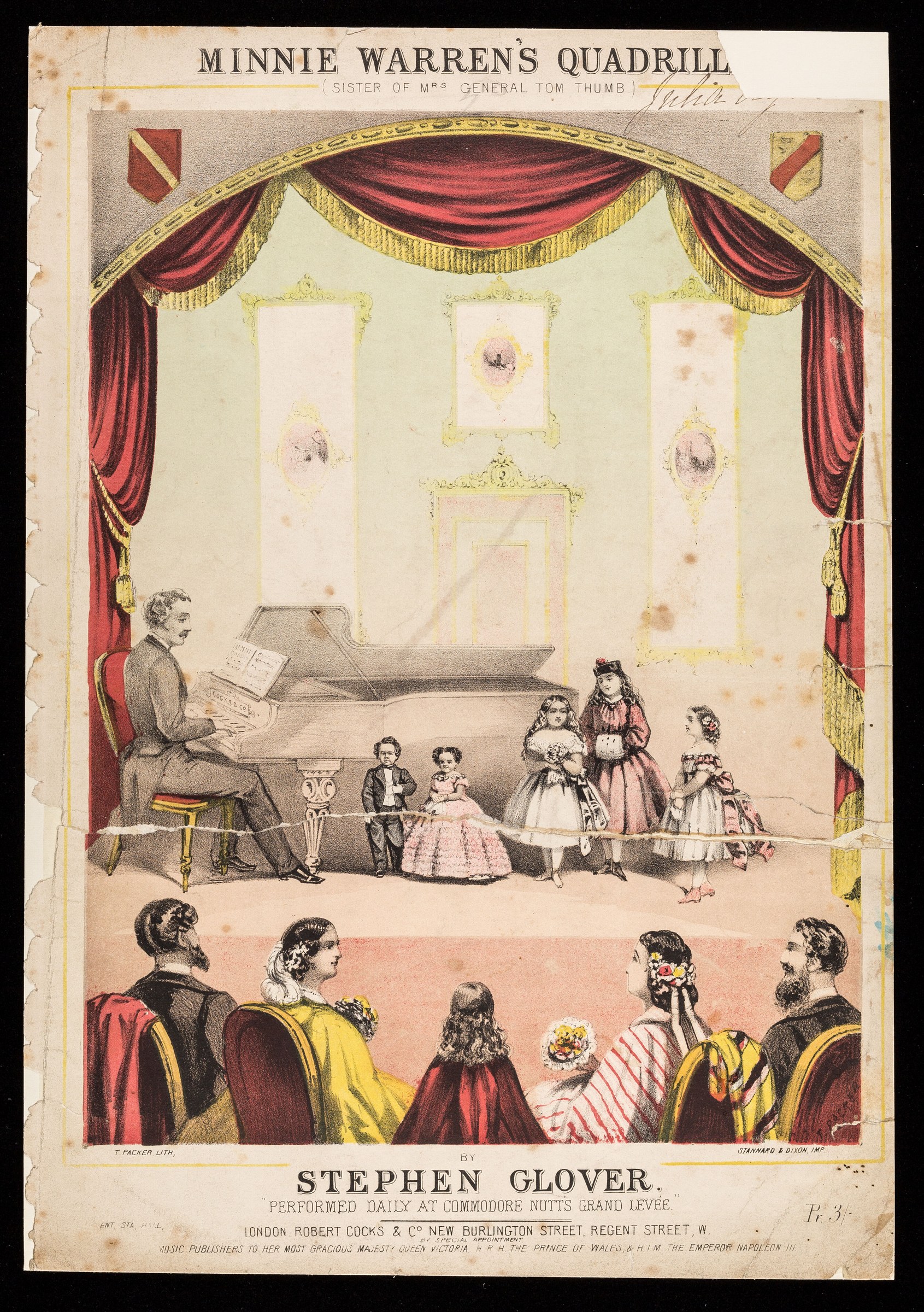
Minnie Warren's quadrille (sister of Mrs. Tom Thumb) / by Stephen Glover. Performed daily at Commodore Nutt's grand levée.
Unknown artist
- Source:
- Wellcome Collection
- Rights:
- Public domain — free to use, share and adapt.
- Recorded as:
- Public Domain Mark
This print documents an otherwise ephemeral moment in which a mainstream social dance was adapted for celebrity performance and commercial display, and in which dancers with dwarfism were presented as skilled performers of a demanding ensemble form. It reveals how the quadrille functioned as both democratic social practice and coded display of respectability and order, and how those meanings could be exploited through spectacle.
What you are looking at
A theatrical performance staged on an ornate proscenium stage with deep crimson velvet curtains and gilt swags. A pianist sits stage left, reading from sheet music. Center stage, five figures—children or young people of notably small stature—are arranged in a formal quadrille formation: two pairs facing each other with a soloist between them. The performer on the right wears an elaborate pink ball gown with white lace trim; her companions are in formal dress—dark suits and pink or patterned skirts. The floor is bare wood. Above hang three oval-framed portraits on the back wall, and gilt-edged rectangular panels flank them. The setting is unmistakably Victorian theatrical: gaslit, formal, and designed to present these performers as curiosities. Below the stage, an audience of formally dressed spectators in blacks, reds, and golds watches from the orchestra pit or front rows, their gaze directed upward at the performers.
The dancing
The five performing figures stand in the classic quadrille frame: two couples in side-by-side positions with weight centered, arms held at shoulder height in frame position, facing across the stage. The soloist (the girl in the pink gown, center-right) stands with upright posture and downturned gaze in the manner of formal social dancing. No visible footwork is caught mid-step; all figures are held in a posed, static moment of formation rather than captured mid-movement. The ensemble maintains the rigid vertical alignment and formal spacing required of quadrille choreography.
The dance depicted
This is a quadrille, the most fashionable social and theatrical dance of the 19th century, typically performed by four couples (16 people) in a square formation and divided into five figures with distinct choreographed sequences. Here, the standard formation is miniaturized: the performers are identified in the title as Minnie Warren and Commodore Nutt, members of P. T. Barnum's traveling museum show, performers with dwarfism who became international celebrities in the 1860s. The quadrille was a dance of precision, symmetry, and social hierarchy perfectly suited to theatrical display; its performance by these celebrated performers suggests both their acceptance into polite society and the commodification of their bodies as spectacular entertainment. The print advertises the piece as performed 'daily at Commodore Nutt's grand levée,' indicating a regular variety performance.
How it was made
This is a hand-colored lithograph, as indicated by the printer's mark ('LONDON ROBERT COCKS & Co NEW BURLINGTON STREET REGENT STREET, W.') and the characteristic soft tonal gradations and mechanical regularity of mid-Victorian theatrical prints. The coloring is applied in flat washes and simple modeling, with particular attention to the rich reds of the curtains and the pale cream of the architectural setting. Lithography allowed rapid, inexpensive reproduction and wide distribution, making this a popular souvenir or promotional print for Barnum's exhibitions. The technique's ability to capture both fine detail (the pianist's score, the gilt frames, facial features) and bold compositional areas (the curtains, the stage floor) made it ideal for theatrical publicity.
About this work
This is a promotional lithograph documenting a performance of the quadrille by celebrity performers Minnie Warren and Commodore Nutt during their London engagement with P. T. Barnum's museum exhibitions in the 1860s. It preserves both a social dance form—the quadrille, then at the height of its theatrical and ballroom popularity—and a moment of Victorian celebrity culture, in which human difference became spectacle. The image shows not the choreography itself but the formal presentation, positioning these performers as objects of curiosity within a highly theatrical and hierarchical frame: the stage, the audience, the formal dress, the orchestral accompaniment. It belongs in a dance archive because it documents how quadrille technique, formation, and social meaning were appropriated and modified for exhibition, and because it reveals the intersection of social dance and theatrical entertainment in Victorian culture.
How to look at it
Look first at the formation: the geometry of the quadrille is the entire point. The artist has chosen to show the 'salute' or opening figure in which dancers face across the square, upright and formally posed—not a moment of active stepping or turning, but the presentation of order and symmetry. The theatrical framing (the proscenium, the audience, the pianist) is as important as the dancers themselves: this is a dance being *displayed* rather than *experienced*. Notice the audience's gaze—turned upward, attentive, consuming these figures as a visual and musical spectacle. The hand-coloring emphasizes the theatrical artificiality: the vivid reds, the pristine gilt, the pale flesh tones all suggest a world of illusion and display rather than lived ballroom experience.
The artist
Stephen Glover was a prolific Victorian theatrical composer, conductor, and entertainer who created and arranged music for popular theatrical entertainments, pantomimes, and variety shows. He is credited on this lithograph for choreographing or arranging the quadrille performance. Glover was active in London's theatrical world and contributed regularly to both dramatic and musical entertainment; his association with Barnum's exhibitions indicates his willingness to work across the boundaries of 'legitimate' and popular entertainment.
The period
The 1860s were the height of the quadrille's popularity as both a ballroom dance and a theatrical showpiece. The dance had originated in Paris in the early 19th century as a court diversion, became the dominant social formation dance of the Victorian era, and was constantly adapted, simplified, and performed on stage. Simultaneously, P. T. Barnum's exhibitions—which ran in London in 1844–45 and again in the 1860s—were at their cultural peak, presenting 'curiosities' from around the world and capitalizing on Victorian fascination with human variation and exotic otherness. The same decade saw increasing professionalization and codification of ballroom dance technique in Britain, reflected in the precise formal positioning shown here.
Where it lives
The print is held in the Wellcome Collection, a holding that suggests it was acquired as a document of celebrity, exhibition history, or social curiosity rather than as a record of dance practice. The publisher was Robert Cocks of London, a major printer of theatrical and popular prints. The handwritten annotation at the top indicates earlier private ownership.
Dance in this work
Questions about this work
Who were Minnie Warren and Commodore Nutt?
Minnie Warren (Mercy Lavinia Warren Bump, 1842–1884) and Commodore Nutt (Edmund Sherwood, 1844–1881) were American performers with dwarfism who became international celebrities through P. T. Barnum's exhibitions and traveling shows. Both were skilled entertainers, not merely displayed as curiosities: they performed music, dance, and comedy, and Warren became famous for her elaborate wardrobe and social connections. Barnum marketed them as exotic attractions, but they were active professional performers who controlled aspects of their public image.
What is a quadrille and why was it performed on stage?
A quadrille is a square-formation social dance for four couples, divided into five choreographed 'figures' (movements), typically performed in ballrooms to orchestral music. It dominated Victorian social dancing and was considered refined, geometric, and respectable. Theatrical performers adapted it for stage, where its formal geometry and ensemble precision translated well to spectacle; audiences enjoyed seeing well-known dances performed by famous people, and the quadrille's clear formations were visually effective from a distance.
Why is this in a dance archive and not a history of celebrity or disability?
It documents the quadrille—a major social and theatrical dance form—at a specific historical moment, showing how it was adapted, performed, and presented. It also reveals the entanglement of dance history with performance history and exhibition culture: these dancers were not performing in a ballroom or at a dance academy, but in a commercial theatrical venue marketed as a 'levée.' Understanding how and why this dance was adapted for this context tells us something essential about Victorian dance culture and the economics of performance.
Is this a historically accurate representation of the quadrille?
The formation shown—the facing couples, the upright posture, the spacing—is consistent with quadrille technique of the period. However, this is a single frozen moment, not the full sequence of movement. The print captures the opening salute or a moment within one of the five figures, presented as a theatrical tableau rather than documenting the kinetic experience of the dance. For details of actual quadrille footwork and progression, one would need choreographic notation or a moving image.
More dance artwork





