49 works in this view — arrow keys or swipe to move between them.
Dance in Art
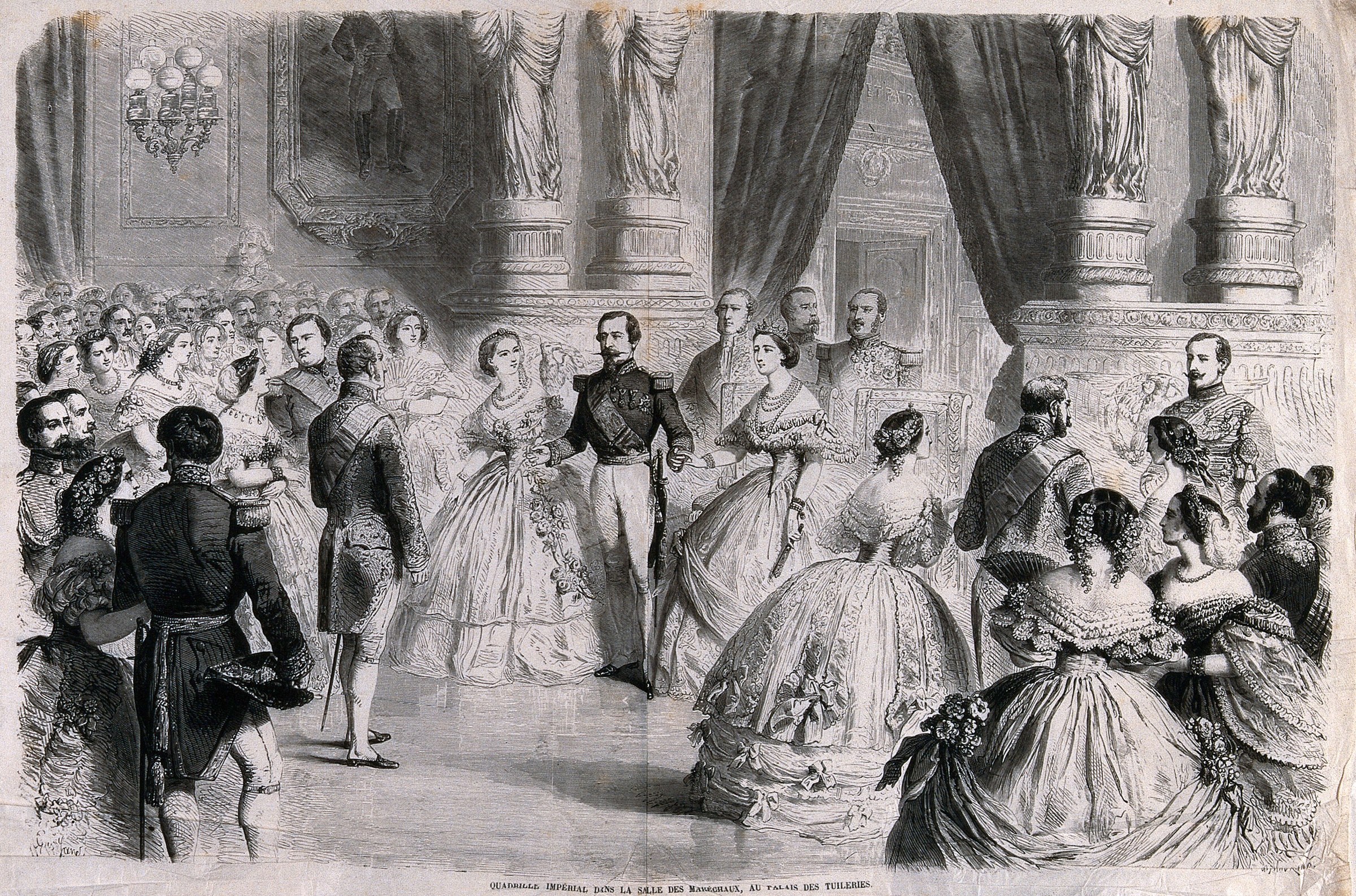
A ball in the Palais des Tuileries: the Emperor Napoleon III and the Empress Eugénie (?) take part in a quadrille. Wood engraving by Charles Maurand after Gustave Janet.
Unknown artist
- Source:
- Wellcome Collection
- Rights:
- Public domain — free to use, share and adapt.
- Recorded as:
- Public Domain Mark
The quadrille defined ballroom culture for a century, and this engraving is a rare contemporary image of it in action at the imperial court—the moment and place where the dance held its greatest prestige and formal codification. For historians and dancers, it is evidence of posture, spacing, dress, and the integration of dance into state ceremony. The engraving also demonstrates how mid-nineteenth-century print culture made court ritual visible to a broader public, transforming private imperial events into published spectacle.
What you are looking at
A formal imperial ball fills an ornate palace interior, identified in the caption as the Palais des Tuileries. The scene is crowded with aristocratic figures in full evening dress—men in military uniforms with decorations and women in elaborate ball gowns with full skirts. The setting features tall columns draped in heavy fabric, gilded architectural detail, and a coffered ceiling. In the center, a quadrille is underway: four couples arranged in a square formation, with the figures nearest the viewer captured in the moment of the dance. The composition creates depth by tapering the crowd toward the back wall. The wood engraving technique produces a fine, detailed black-and-white rendering with careful cross-hatching to suggest fabric, shadow, and the shimmer of evening dress. The overall impression is one of elaborate ceremony, formal control, and the grandeur of Second Empire court spectacle.
The dancing
The dancers in the quadrille are shown in closed hold, the men in upright military posture and the women with their bodies angled toward their partners, their full skirts spreading as they move. The nearest dancers are captured mid-figure, their legs and arms positioned to suggest forward progression and turning. The supporting cast of observers stands at the edges and background in profile or three-quarter view, many with fans or arms at rest, creating a clear hierarchy between active dancers and spectators. The poses are formal and controlled rather than exuberant; each body maintains the deportment expected of imperial court dress.
The dance depicted
This is a quadrille, the most prestigious ballroom dance of the European aristocracy in the mid-nineteenth century, danced here in the formal palace setting of the Second Empire court. The quadrille was a figure dance for four couples arranged in a square, with prescribed steps and formations that required coordination, memory, and rehearsal. The image shows the dance as practiced among the imperial elite—not a folk or theatrical version, but the highly codified court quadrille. The date is uncertain, but the costume and setting suggest the reign of Napoleon III (1852–1870). The engraving records both the dance form and the social ritual of the imperial ball.
How it was made
This is a wood engraving, a relief process in which an image is cut into the end-grain of a hardwood block and printed from the raised surface. The technique is identified in the caption credit to Charles Maurand, the engraver working after a design (likely a sketch or painting) by Gustave Janet. Wood engraving allowed for fine detail and was the standard medium for illustration in newspapers and journals of the period, making this work a mass-produced image likely published in a French illustrated periodical to document the imperial court. The technique's crispness and ability to hold fine lines made it ideal for rendering the elaborate detail of dress and architecture.
About this work
This is a documentary record of court dance practice in the Second Empire, captured as a wood engraving for public circulation. The quadrille was the defining social dance of nineteenth-century European aristocracy, and this image preserves both its form—the four-couple square arrangement, the closed hold, the formal deportment—and its context: an imperial ball in the Palais des Tuileries, surrounded by the ceremonial dress and architecture of state power. The work belongs in a dance gallery because it is both a historical document of how the quadrille was actually performed at the highest level of society, and an artifact of how that performance was communicated and celebrated through print culture.
How to look at it
Attend to the central four couples and the precision of their formation—the quadrille's structure is legible in the geometric square they occupy, even mid-movement. The engraver has chosen a moment that shows progression and turning rather than a static pose, preserving the sense of the dance as an unfolding figure. Notice the contrast between the dancers' upright, controlled bearing and the more relaxed postures of the spectators behind them; this distinction captures the ballroom as a space of observation and judgment. The architectural grandeur framing the scene is not merely decorative—it stakes the dance as an event of state, not merely social, significance.
The artist
Charles Maurand (1824–1904) was a French wood engraver specializing in the translation of paintings and drawings into illustrations for periodical publication. His practice was central to the mass production of visual reporting in nineteenth-century France. Gustave Janet, the designer of the original composition, is less well documented; the credit structure suggests Janet observed or sketched the scene and Maurand translated it into the engraving medium for print.
The period
The quadrille dominated European ballroom culture from the early nineteenth century through the Belle Époque. It was both a social ritual and a choreographic form that required instruction and rehearsal—a marker of education and rank. The Second Empire (1852–1870) was a period of state ceremonial spectacle, and the imperial ball was a key instrument of political display and dynastic legitimation. The rise of illustrated newspapers and journals in the 1850s–1860s meant that such events were increasingly captured, engraved, and circulated to a reading public, creating a new relationship between court life and public knowledge. The quadrille would decline in popularity after the 1880s as waltz, polka, and later dances took precedence.
Where it lives
The work is held by the Wellcome Collection, a repository of images relating to medicine, art, and society. Its presence there suggests the original publication was in a periodical or book in the Wellcome's historical holdings; the caption reference to the Palais des Tuileries and the imperial couple indicates the work was likely published in a French illustrated journal contemporary with the Second Empire or shortly after.
Dance in this work
Questions about this work
What is a quadrille and how was it danced?
A quadrille is a ballroom dance for four couples arranged in a square. Each couple occupies one side, and the dance unfolds through a series of prescribed figures—forward and back, turning, circling, and promenade. It was performed in closed hold (partners facing and touching), with a tempo typically moderate to brisk. The dance required rehearsal and was a marker of social accomplishment. By the mid-nineteenth century, it was the prestige dance of European court and aristocratic balls.
When and where was this ball held?
The caption identifies the location as the Palais des Tuileries (the royal palace in Paris) and indicates the presence of the Emperor and Empress, implying a Second Empire state ball (1852–1870). The exact date is not recorded in the catalogue. The style of dress and the technique of the engraving suggest the 1850s or 1860s, but without additional documentation, the precise date cannot be determined.
How was this image published and who saw it?
This was a wood engraving, a technique that allowed for mass reproduction in newspapers and illustrated periodicals. Such images were published in journals aimed at a literate, middle and upper-class readership interested in court events, fashion, and society news. The engraving made the imperial ball visible to people who would never attend such an event, transforming it from a private court occasion into public spectacle consumed through print.
What does the dress tell us about the period?
The women's gowns with massive full skirts (achieved through crinolines), off-shoulder necklines, and ornamental detail exemplify 1850s–1860s ball dress. The men wear military uniforms and evening coats with decorations—standard formal dress for imperial court occasions. The opulence of the fabrics and jewelry is rendered through the engraver's fine cross-hatching and can be read as an index of both wealth and the ceremonial importance of the event.
More dance artwork





