49 works in this view — arrow keys or swipe to move between them.
Dance in Art
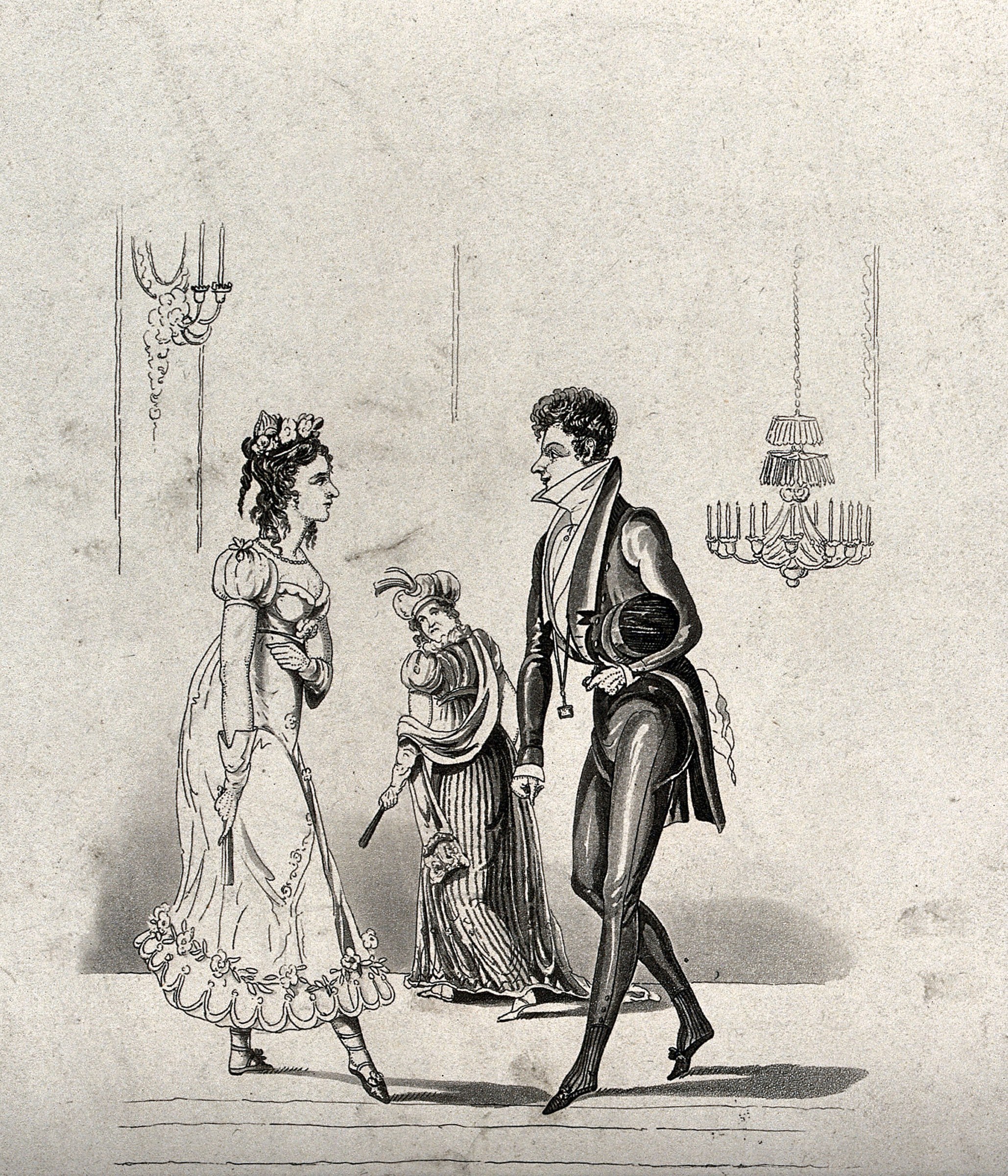
A young couple face one another during a dance watched with interest by another woman in the background. Etching and aquatint by G. Hunt after M. Egerton, 1825.
Unknown artist
- Source:
- Wellcome Collection
- Rights:
- Public domain — free to use, share and adapt.
- Recorded as:
- Public Domain Mark
This print preserves the visual codes of Regency ballroom etiquette at a moment when formal social dance was at the height of its cultural importance. It shows how artists of the period chose to represent dance—not through action or technique, but through the psychology of social encounter, revealing what contemporaries valued about ballroom dancing: its role in courtship, its requirement for self-control, and its embedding in precise codes of dress and behavior.
What you are looking at
An elegantly dressed couple occupy the center of a formal interior, poised in the moment of a dance. The woman, positioned on the left, wears a high-waisted white gown with voluminous puffed sleeves and an elaborate headdress adorned with feathers or plumes; her skirt is decorated with a scalloped hem and trails toward the ground. The man faces her in profile, dressed in dark tailcoat with a high collar, cravat, and white shirt front, holding what appears to be a top hat or similar accessory. Between them stands a younger figure, perhaps a child or adolescent, in a long striped or fluted gown, watching the pair with evident interest. The setting is a grand room with hanging candelabra visible in the background and tall vertical elements that suggest classical architectural detail—pilasters or doorways. The composition freezes an instant of courtly interaction: the couple are close but not yet in contact, their bodies angled toward one another in a moment of approach or invitation.
The dancing
The woman's posture is upright and formal, her body angled slightly toward the man while her gaze is directed downward in a gesture of modesty or anticipation. The man leans slightly forward, his profile dominant, suggesting he is initiating or leading the exchange. Neither figure is in a recognizable dance hold; instead they are captured in the social choreography of formal introduction or invitation to dance. The younger attendant's posture—standing apart but leaning in—suggests the roles of observer and participant that characterize ballroom protocol. The distance between the adults is significant: they have not yet joined hands or assumed a frame.
The dance depicted
This depicts the social preliminaries of a Regency-era ballroom dance, most likely a cotillion or quadrille—the formal dances of the early 19th-century drawing room. The image captures not the dance itself but the moment of invitation, a crucial part of ballroom etiquette. The clothing and interior setting are consistent with English Regency society (roughly 1811–1820), when such formal dances were central to courtship and social display. The presence of the attendant—possibly a chaperone or younger relative—reinforces the public, ritualized nature of the encounter. The artist has chosen to depict the psychological and social drama of the moment rather than the physical complexity of footwork, emphasizing the formality and self-consciousness of the interaction.
How it was made
This is an etching and aquatint, a printmaking technique that allowed for both linear detail and tonal shading. The catalogue records it as 'etching and aquatint by G. Hunt after M. Egerton, 1825'—meaning Hunt engraved a design after Egerton's original work. Aquatint enabled the artist to create the soft shadows on the woman's gown and the atmospheric depth of the interior, while etched lines define the figures' outlines and facial features with precision. As a print, this work was reproductive and circulative, made to be distributed among a broad middle- and upper-class audience interested in fashion, manners, and social satire. The relatively small scale and narrative focus suggest this may be a plate from a series on contemporary social life or dancing manuals of the period.
About this work
This 1825 engraving documents the visual culture and etiquette of English Regency ballroom dancing, capturing the moment before a dance begins—the social ritual of invitation and acceptance. It is neither a record of movement nor a celebration of virtuosity, but rather a study in courtship choreography, showing how dance functioned as a framework for regulated social interaction between the sexes. The work belongs to a tradition of satirical or documentary prints about fashionable life that flourished in the early 19th century, when the ballroom was a central arena for marriage-making and the display of status. For historians of dance, it offers evidence of how ballroom dancing was experienced, staged, and understood: not as an isolated physical practice but as an elaborate social performance embedded in dress, architecture, and gesture.
How to look at it
Attend to what the artist chose not to show: no feet, no footwork, no moment of actual dancing. Instead, look at the precise staging of the encounter—the woman's averted gaze, the man's lean, the positioning of the attendant. The composition emphasizes verticality and restraint; no one is in motion. Notice the luxury of the setting: the candelabra, the architectural detail, the quality of the textiles. These elements communicate that this is not a dance of pleasure or play, but a formal ritual embedded in wealth and social hierarchy. The print's technique—etching with aquatint—allows the artist to render the shimmer and weight of fabric, key to understanding how ballroom dress itself structured movement and deportment.
The artist
The print is credited as 'after M. Egerton' and engraved by G. Hunt. Without further documentation, the original painter or designer Egerton remains largely unknown from this record alone. The engraver Hunt was working in the reproductive tradition common to the period, translating original designs by artists into widely distributed prints. This division of labor—designer and engraver as separate craftspeople—was standard practice for prints intended for commercial distribution and a broad audience.
The period
The 1820s saw the height of Regency and early Georgian ballroom culture in England. The cotillion and quadrille, imported from France, had become the dominant social dances, replacing earlier country dances in fashionable circles. Dance was integral to the social season and the marriage market; mastery of ballroom etiquette was essential for respectability. In the visual arts, satirical and observational prints about fashionable life proliferated, often published in series and aimed at a readership amused by or critical of contemporary manners. Artists documented the follies, fashions, and rituals of society with sharp attention to costume and deportment. This etching sits within that tradition, combining documentary interest in dress and interior design with social commentary on the formality and emotional restraint required of participants in ballroom culture.
Where it lives
The work is recorded in the Wellcome Collection, a major holding of prints, photographs, and ephemera on the history of medicine and social life. Its presence in the Wellcome suggests it may have been collected for its documentary value as a record of 19th-century social custom and material culture rather than for its artistic merit alone.
Dance in this work
Questions about this work
Is this a real dance or a made-up scene?
The scene is a real moment from Regency ballroom life—the invitation to dance, part of the formal protocol of the ballroom. The couple have not yet begun dancing, and the image captures the social preliminaries that preceded the actual dance. The dress, setting, and etiquette are historically accurate to early 1820s England.
Who are the people in the print?
They are not identified individuals; the print represents types—a fashionable woman and man, and perhaps a younger chaperone or attendant. The work is a social document, not a portrait, made for a general audience interested in observing contemporary manners and fashion.
What dance are they about to do?
Most likely a cotillion or quadrille, the dominant ballroom dances of the Regency era. Both were formal, patterned dances performed in sets or lines, requiring precise etiquette and coordination. The image does not show the dance itself, only the moment before it begins.
Why is the woman looking away?
Modesty and restraint were essential to feminine deportment in Regency society. The averted gaze is part of the social performance required of respectable women in formal settings; it signals propriety and deference while the man takes the active role of initiating.
More dance artwork





