49 works in this view — arrow keys or swipe to move between them.
Dance in Art
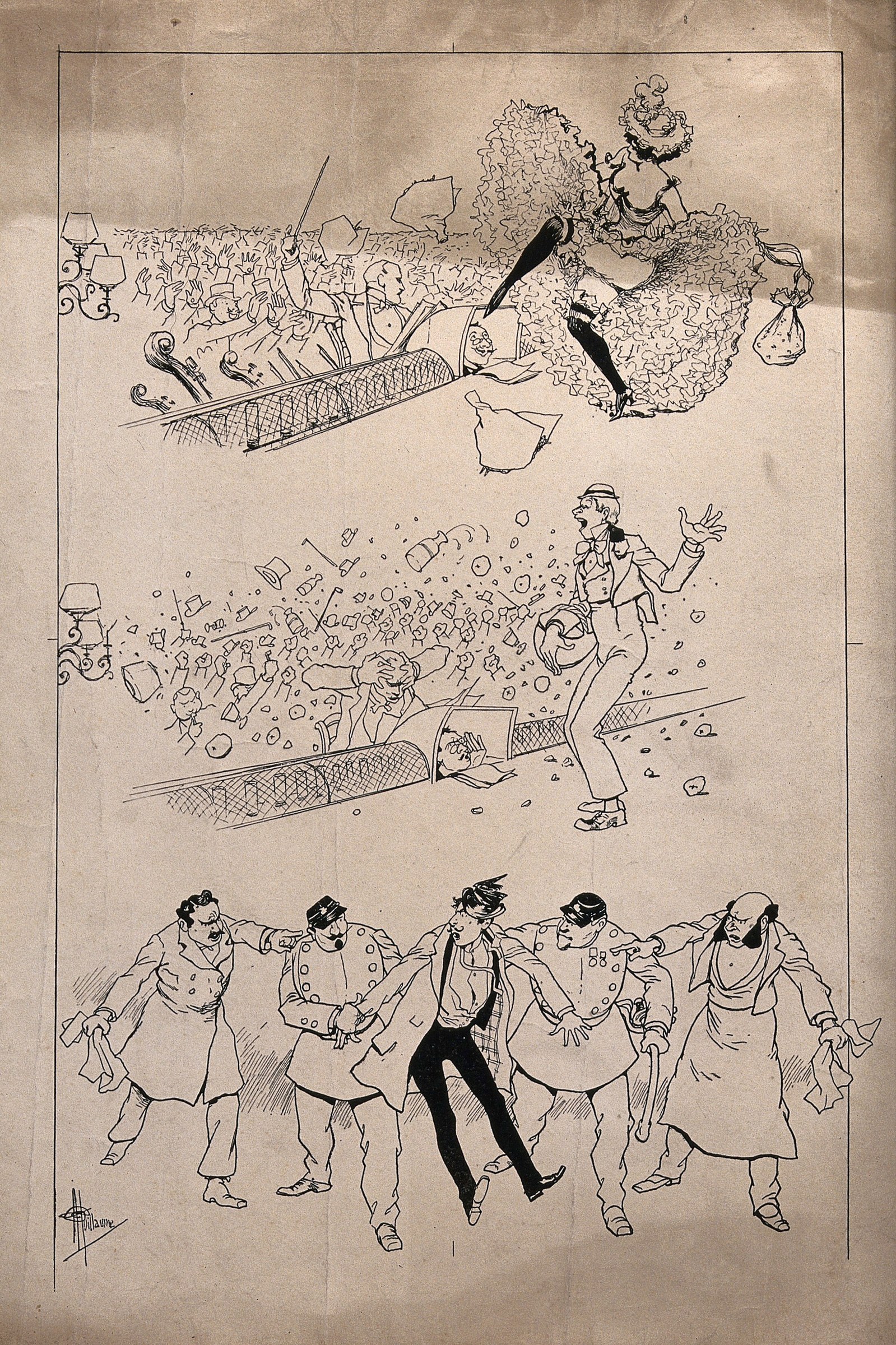
A prompter in a music hall enjoys watching a woman can-can dancer, tells an unpopular man entertainer to get off the stage, and is finally arrested at the request of two dissatisfied men. Process print after Albert Guillaume.
Unknown artist
- Source:
- Wellcome Collection
- Rights:
- Public domain — free to use, share and adapt.
- Recorded as:
- Public Domain Mark
The can-can is often remembered as a fixed spectacle, but this image shows it as a flashpoint for real social tension and taste in the music hall. Guillaume's satirical treatment reveals how the dance was contested—admired by some, rejected by others, threatening enough to provoke police intervention in this narrative. It is rare documentary evidence of how a dance form was actually discussed and debated in popular media.
What you are looking at
A three-panel satirical narrative in ink showing the chaos of a music hall performance. The top panel depicts a crowded stage thronged with dancers and musicians: a woman executes a high leg kick in a can-can pose while a male figure in formal dress (the prompter) watches approvingly from the side, gesticulating. The scene is dense with onlookers and performers rendered in lively, scratchy linework. The middle panel shows the same prompter, now animated and pointing forcefully offstage at an unpopular male entertainer amid a shower of objects—coins, bottles, hats—being thrown by a disapproving audience. The bottom panel shows five men in formal coats and hats, the central figure in black trousers among them, being escorted or arrested; they are linked arm-in-arm in a line, suggesting police or authorities have intervened. The entire composition is done in a light, journalistic sketch style with cross-hatching for texture, typical of early 20th-century comic illustration.
The dancing
The can-can dancer in the top panel shows the characteristic high leg extension and lifted torso of the dance, with her body arched backward in a dramatic pose. The prompter's gestures are exaggerated and emphatic—pointing, waving, his body twisted to address both the dancer and the audience. The male entertainer being ejected assumes a defensive or pleading posture amid the shower of missiles. The arrested figures in the final panel are drawn in a rigid, processional line, their formality contrasting sharply with the chaos above; the linkage of their arms suggests constraint rather than voluntary association.
The dance depicted
This is a can-can, identifiable by the high leg kick and the energetic, provocative style of the female dancer. The can-can was a popular music hall dance in late 19th and early 20th century Paris and London, performed in cabarets and theatres, often controversial for its apparent indecency. The image documents not the dance itself but the social friction it generated: the prompter's favour toward the can-can dancer, his rejection of a competing act, and the resulting arrest suggests a narrative about the competing attractions and social anxieties of the music hall. The dance is a vehicle for satire rather than instruction.
How it was made
This is a process print after a drawing by Albert Guillaume, a French caricaturist and illustrator. Process printing—combining halftone or line reproduction with hand-finishing—allowed comic narratives to circulate widely in newspapers and magazines. The original sketch technique is visible: bold ink lines, cross-hatching for shadow, rapid gestural marks that convey movement and emotion rather than anatomical precision. This technique was ideal for satirical narrative sequences, allowing the artist to compress incident, exaggeration, and humour into a small space with minimal tonal range.
About this work
This is a three-act satirical narrative sequence mocking the follies and factionalism of the music hall world. It follows a prompter's intervention in a performance: his enthusiasm for a can-can dancer, his violent rejection of a rival act, and his subsequent arrest—a darkly comic trajectory from taste to chaos. The work is a window into early 20th-century attitudes toward the can-can as both alluring and socially dangerous, and toward the music hall as a space of competing interests and public disorder. Guillaume's caricature style captures the absurdity of the scene through exaggerated gesture, crowded composition, and rapid visual pacing.
The work belongs in a dance gallery both as documentation of a specific dance genre and as evidence of how that dance was perceived and satirized in its own time. The can-can, though now associated with high-kicking spectacle, was often framed as transgressive or comic in early illustrations, and this image preserves that ambivalent cultural position.
How to look at it
Read the three panels as a continuous narrative sequence from top to bottom. Notice how the prompter's gesture and posture change across the scenes: from approval and engagement to authoritative rejection to passive restraint. The crowded top panel contrasts sharply with the ordered line of the final panel, suggesting the restoration of authority. Observe the can-can dancer's pose in isolation—a single moment of the high leg extension—suspended amid the crowd and noise. The work is less interested in how the dance is performed than in what its presence provokes: desire, dismissal, conflict, and law.
The artist
Albert Guillaume (1866–1942) was a French caricaturist, illustrator, and painter best known for satirical drawings published in newspapers and magazines, particularly *La Vie Parisienne*. His style was energetic and economical, built on rapid line and exaggeration of gesture to convey character and social critique. He specialized in scenes of modern urban life—theatre, café society, leisure, romance, and social embarrassment—and was widely reproduced in print media throughout the early 20th century. His work exemplifies the Belle Époque and post-Belle Époque illustrated press.
The period
The can-can became famous in the 1840s and 1850s as a transgressive dance associated with working-class and lower-middle-class leisure, performed in dance halls and music halls. By the 1880s and 1890s it had achieved international notoriety through images of the Moulin Rouge and similar venues, and had become a staple of music hall entertainment across Europe and North America. However, it remained controversial: it was attacked by moralists, censored in some jurisdictions, and often depicted as chaotic or absurd in popular illustration. The early 20th century saw the can-can become simultaneously more respectable and more comic—a trademarked spectacle of Paris that could be safely satirized. Guillaume's image fits this moment: the dance is present but almost incidental to the farce of social management and disorder surrounding it.
Where it lives
The work is held by the Wellcome Collection, a medical and social history archive in London. As a process print after an original by Albert Guillaume, it likely circulated as a magazine illustration or newspaper cartoon; its presence in Wellcome suggests it was collected as documentary evidence of social history, leisure culture, or attitudes toward the body in the early 20th century.
Dance in this work
Questions about this work
What is a can-can and why was it controversial?
The can-can is a high-energy, leg-kicking dance that originated in working-class dance halls in 1840s Paris. It became famous—and notorious—for its seemingly indecent exposure of the leg and the exuberant, undisciplined movement it encouraged. Moralists and censors attacked it as degrading, and it was banned or restricted in many places. By the early 20th century it had become a symbol of Parisian nightlife, but could still be presented as absurd or socially destabilizing, as in this cartoon.
Who was Albert Guillaume?
Guillaume (1866–1942) was a major French caricaturist and magazine illustrator specializing in satirical scenes of modern urban life. He worked for publications like *La Vie Parisienne* and was known for rapid, expressive line work and exaggerated gesture. His images of theatre, café society, and leisure defined how many people visualized the Belle Époque world.
Why is the prompter being arrested?
This is a satirical narrative, so the logic is comic rather than strictly realistic. The prompter's enthusiastic support for the can-can dancer and violent ejection of a rival act presumably disturb the peace or overstep his authority, leading to his arrest. The image uses exaggeration and absurdity to mock the chaos and competing interests of the music hall world.
What is a process print?
A process print is a reproductive technique that combines mechanical printing (halftone or line blocks) with hand-finishing. It allowed artists' drawings to be mass-produced in newspapers and magazines at lower cost than engraving or lithography. Process printing dominated illustrated journalism in the early 20th century and shaped how visual narratives reached wide audiences.
More dance artwork





