49 works in this view — arrow keys or swipe to move between them.
Dance in Art
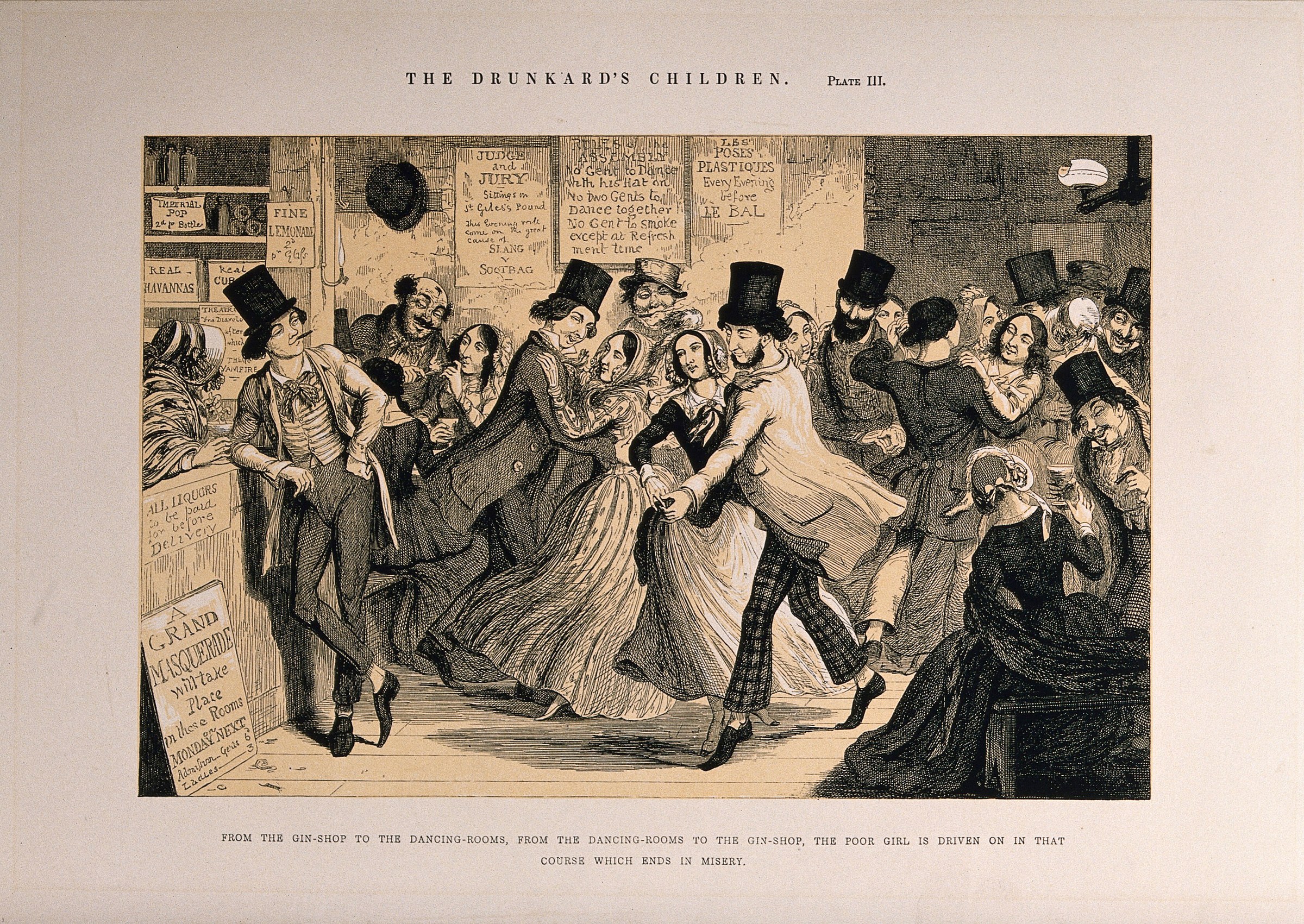
A drunken scene in a dancing hall with a sly customer eyeing a girl. Etching by G. Cruikshank, 1848, after himself.
Unknown artist
- Source:
- Wellcome Collection
- Rights:
- Public domain — free to use, share and adapt.
- Recorded as:
- Public Domain Mark
For historians of dance, this work provides rare visual evidence of how ordinary people actually danced in urban public houses—the postures, the intimacy of the hold, and the unschooled physicality of working-class social dancing in the 1840s. Cruikshank was a rigorous observer of contemporary life, and despite his satirical intent, he documented a form of popular dance that is otherwise nearly invisible in the historical record.
What you are looking at
A crowded urban dance hall or public house in the 1840s, rendered in Cruikshank's characteristic satirical style. The scene bursts with social chaos: working-class figures in top hats and bonnets press around a central dancing couple, their bodies locked in an intimate embrace. The woman, in a pale flowing dress with dark trim, is pulled close by a man in checkered trousers and dark coat; their posture is loose and uncontrolled, suggesting intoxication. Around them, spectators lurch, gesture, and ogle—some with sly grins, others with exaggerated concern. The setting is marked by visible signs: "Judge & Jury," "Nose Plastics," and alcohol brands are posted on the walls, establishing this as a gin-shop or low public house where dancing was permitted. The composition is dense and kinetic, with figures overlapping at multiple depths, their faces rendered with grotesque caricature that emphasizes the moral anxiety around working-class leisure and inebriation.
The dancing
The central dancers are in a close, frontal embrace typical of popular social dancing of the era, with the woman's body tilted back and her skirt swinging outward in a characteristically ungainly manner. The man's posture is slouched and controlling, his weight forward. Unlike the structured positions of ballroom dancing, this is loose and physically compromised—the bodies sag together rather than hold firm frames. The surrounding figures display exaggerated facial expressions and awkward gestures: some lean in to watch with predatory interest, others gesture wildly or recoil. No formal technique is evident; the movement is vernacular street-dance, unschooled and physically reckless.
The dance depicted
This depicts a popular social dance, likely a quadrille or waltz variant, performed in a working-class gin-house or dancing saloon of 1840s London. The intimacy of the hold and the woman's swinging skirt suggest the scandalous new embrace dances that provoked moral outrage among the middle class—the waltz or polka were considered dangerously close and sexually suggestive. Cruikshank's satire targets not the dance itself but its context: performed under the influence of alcohol by the urban poor, with spectators who are either lustful or contemptuous. The dance is rendered as a symptom of moral decline rather than as a social pleasure, which reflects real middle-class anxieties about working-class sexuality and public intoxication in the industrial city.
How it was made
An etching with hand-coloring, rendered in Cruikshank's dense cross-hatched line style. The etching technique allowed for fine detail and sharp tonal contrasts—notice the way the darkened figures recede while the central dancers remain lit and prominent. Hand-coloring distinguishes the figures' clothes and adds visual interest without softening the satirical bite of the line. As a satirical print, this would have been reproduced and circulated widely in London, sold as a separate sheet or bound into a serial publication. The medium and its reproducibility made Cruikshank's moral commentary accessible to the literate middle class who were his intended audience.
About this work
This is a print from a satirical series on the moral consequences of alcohol, titled *The Drunkard's Children*, made by the celebrated caricaturist George Cruikshank in 1848. It captures a specific moment of moral anxiety in the industrial city: the working-class dance hall, where intoxication, sexuality, and poor supervision converge. The dance itself—an embrace waltz or quadrille—is secondary to Cruikshank's larger argument about the social decay caused by gin and alcohol. Yet the work is visually anchored in an actual form of vernacular social dancing, and the artist's acute observation of how intoxicated bodies move and relate gives the scene a sharp documentary edge beneath its moralizing surface.
How to look at it
Pay attention to the postures of intoxication: the slouch, the loss of vertical balance, the way the bodies cling together for support rather than maintain an independent frame. Notice how Cruikshank differentiates the spectators—some leer with sexual interest, others avert their eyes in disgust—to show that even in this scene, there is no innocence or mutual pleasure, only exploitation and shame. The woman's face is not shown clearly; she is defined by her swinging skirt and her helplessness. The artist freezes the moment at the height of the swing, when the movement is most visible and most morally damning. The setting—the printed signs on the walls, the crowded depth—grounds the scene in a specific social geography of London's poor quarters.
The artist
George Cruikshank (1792–1878) was the most celebrated caricaturist and printmaker in early 19th-century Britain, famous for his savage social satire and his precise, densely worked line style. He produced thousands of prints, many in series, targeting politics, morality, drink, and public life. *The Drunkard's Children* was one of his major works, a multi-plate narrative that warned of the dangers of alcohol—a moral crusade Cruikshank championed in his later career. His prints were mass-produced, affordable, and widely circulated among the middle class, giving them immense cultural influence.
The period
The 1840s saw intense moral panic about working-class leisure, urbanization, and drink in industrial Britain. Public dance halls and gin-houses were viewed by middle-class reformers as sites of moral danger, particularly for young women. The waltz itself had arrived in Britain in the early 1800s and provoked shock at its close physical contact—still considered scandalous by conservative opinion in the 1840s. Cruikshank's series capitalized on these anxieties, presenting the dance hall not as a place of innocent pleasure but as a symptom of social dissolution. This reflects a moment when new forms of commercial entertainment and working-class sociability were becoming visible and contested in the industrial city.
Where it lives
This is one plate from the print series *The Drunkard's Children*, published in 1848. It is held in the Wellcome Collection, which focuses on the history of medicine, public health, and social welfare—a fitting home for a work explicitly about the health and moral consequences of alcohol.
Dance in this work
Questions about this work
Is this actually a dance scene or just a morality tale?
It is both. Cruikshank's intent was moral satire, but to make that argument, he had to observe how working-class people actually danced. The physical positions—the embrace, the woman's swinging skirt, the man's controlling posture—are accurate to the popular dances of the 1840s. What makes it a satire is the setting (a gin-house), the intoxication, and the predatory onlookers. The dance is real; the moral commentary around it is what makes it a print for middle-class consumption.
What dance are they doing?
Most likely a waltz or a quadrille variant, popular social dances of the 1840s. The close embrace and the woman's swinging skirt are characteristic of the waltz. The exact dance matters less than the intimacy of the hold, which was the shocking new thing about these dances and which provoked moral outrage from conservative critics.
Why is this in a dance collection and not a social history collection?
Because it documents vernacular social dance with considerable visual accuracy. While Cruikshank was primarily a satirist, he was also a gifted observer of contemporary life, and this print captures the body positions, the hold, and the physical dynamics of working-class dancing as it actually happened. It belongs in both contexts.
Who was the intended audience?
The educated middle class—people who could read the moral message and who wanted to be warned about the dangers of alcohol and working-class life. Prints like this were affordable and widely circulated, used in campaigns against drink and public houses. They reinforced middle-class anxieties about working-class leisure and sexuality.
More dance artwork





