49 works in this view — arrow keys or swipe to move between them.
Dance in Art
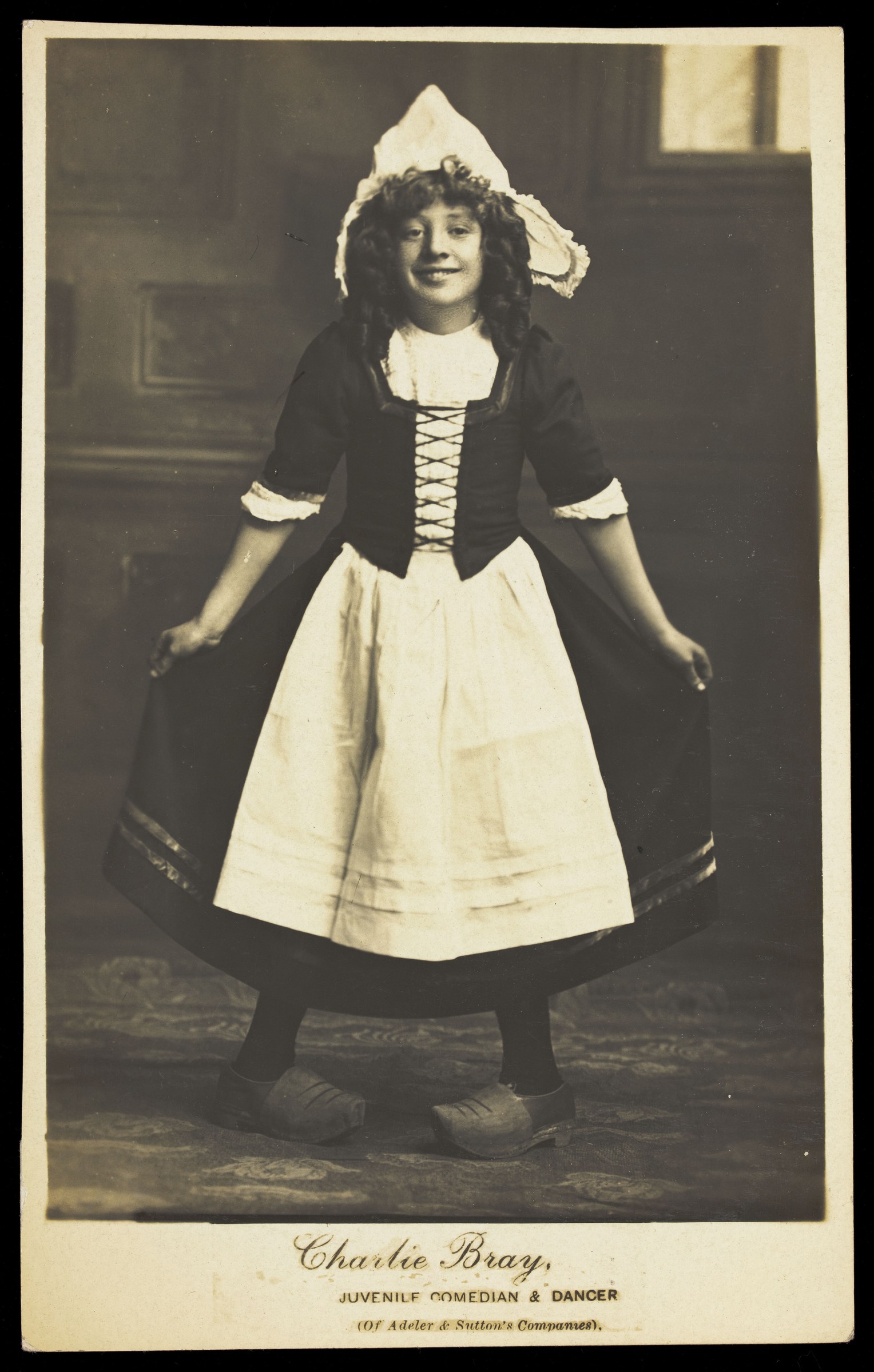
Charlie Bray in character as a Dutch girl. Photographic postcard, 191-.
Unknown artist
- Source:
- Wellcome Collection
- Rights:
- Rights reserved by the holding institution — do not reuse without permission. Source record ↗
- Recorded as:
- In copyright
This work captures the world of juvenile performers in commercial theater before film, showing how folk costume was adapted for the stage and how performers were marketed to audiences through mass-produced imagery. It documents a now-vanished mode of entertainment—the music-hall variety show—through one of its main promotional and collectible artifacts.
What you are looking at
A young performer stands centered in a studio photograph against a dark backdrop, wearing a Dutch folk costume. The figure faces the camera with a gentle smile, arms relaxed at the sides, legs planted firmly in a natural stance. The costume consists of a black bodice with white lace cuffs and neckline, laced tightly at the front, paired with a voluminous white linen skirt with horizontal tucks or pleats that falls to mid-calf. A distinctive white Dutch cap—a tall, peaked linen coif—sits on the performer's dark curled hair. Dark stockings and wooden clogs ground the figure. The photograph is formally composed with the figure filling the frame, lit from the front to model the costume's structure and detail. A studio door visible in the background establishes an indoor performance space.
The dancing
The body is upright and still, not captured mid-movement. The arms hang naturally without tension, the weight evenly distributed on both feet. There is no contraction or dynamic extension, no turnout or rise. The posture is plain and grounded, suited to displaying costume rather than demonstrating technique. The performer regards the camera directly with a composed expression—a moment of stillness between movement, not an action itself.
The dance depicted
The costume and context identify this as a performer in theatrical character dance, most likely a music-hall or variety entertainment piece based on Dutch or Northern European folk traditions. No specific dance is demonstrated in the image—this is a character portrait rather than an action shot. The wooden clogs, white linen cap, and black bodice are consistent with Dutch national costume, which was often adapted for stage performance in the late 19th and early 20th centuries. Such dances were typically short, energetic pieces performed in revue or pantomime settings, blending folk gesture with theatrical timing.
How it was made
This is a gelatin silver or albumen photographic postcard, a mass-market format that emerged in the 1890s. The photograph was likely made in a theater studio and printed as a promotional postcard for distribution to audiences. The formal studio setting and careful lighting indicate professional photography intended for circulation—these postcards served as souvenirs and publicity for performers, actors, and music-hall entertainers. The sepia tone and paper stock are consistent with the 1910s dating suggested by the record.
About this work
This is a studio portrait of a performer in character as a Dutch girl, preserved as a photographic postcard from the music-hall or variety theater era. Charlie Bray performed as a juvenile entertainer and dancer with Adler & Sutton's Companies, the major touring variety troupes of the Edwardian period. The image documents both the conventions of early-20th-century theatrical character costume and the celebrity culture surrounding music-hall performers. Postcards of this type were collected by audiences and circulated as mementos of performances, making them a primary record of popular entertainment and stage practice.
How to look at it
Attend to the costume's construction and detail—the lacing of the bodice, the way the white linen skirt is pleated, the shape and height of the cap—as the point of the photograph. The formal pose and centered framing are characteristic of character portrait photography of the era, designed to display the costume clearly and allow the image to be reproduced at small size on a postcard without loss of legibility. The performer's direct gaze and gentle expression invite identification and sympathy, a strategy central to the marketing of juvenile entertainers.
The artist
The photograph is a product of commercial theater publicity rather than fine art, taken by an unnamed studio photographer working in the music-hall system. Such postcards were produced in bulk by theaters and printing firms as part of the entertainment industry's marketing apparatus. The photograph's anonymity is typical of the period: studio photographers of postcards rarely received credit.
The period
In the 1910s, music halls and variety theaters were the dominant form of live popular entertainment in Britain and America. These venues featured short turns by many performers—dancers, comedians, singers, acrobats—arranged in a program lasting several hours. Juvenile performers (children and young adolescents) were a staple of variety, often in comedic or sentimental roles. Character dances based on national or regional costumes were a popular genre, blending theatrical spectacle with a veneer of cultural authenticity. The photographic postcard was the primary mode of celebrity circulation before postcards were displaced by cinema and later photography forms.
Where it lives
This photographic postcard is held by the Wellcome Collection, a major archive of historical imagery. The work entered the Wellcome as part of its broad collecting practice around medical and social history; it is catalogued as a document of costume and social life rather than as theatrical ephemera or dance history. The card's original owner is unknown.
Dance in this work
Questions about this work
What was Adler & Sutton's Companies?
Adler & Sutton was a major London-based theatrical management company operating in the Edwardian era (ca. 1900–1920s). It produced touring variety shows and pantomimes that played throughout Britain. Child performers were central to the company's marketing, and many went on to establish careers in music hall and revue. The company was typical of the commercial theater firms that dominated popular entertainment before cinema.
Why was this postcard made?
Theater companies and individual performers commissioned postcards as souvenirs and publicity. Audiences could purchase them at the theater or from postcard vendors, keeping them as mementos and trading them with friends. For the performer, postcards extended their visibility and income—they sold postcards or received royalties on sales. These cards were as central to theater marketing as modern social media.
Is this a dance photograph?
It is a character portrait of a performer, not a documentation of a dance. The performer is standing still, not dancing. However, it belongs in a dance collection because it documents how theatrical dances were performed, costumed, and marketed in the music-hall era, and because it preserves the image of a performer whose living was made through dance and movement.
More dance artwork





