49 works in this view — arrow keys or swipe to move between them.
Dance in Art
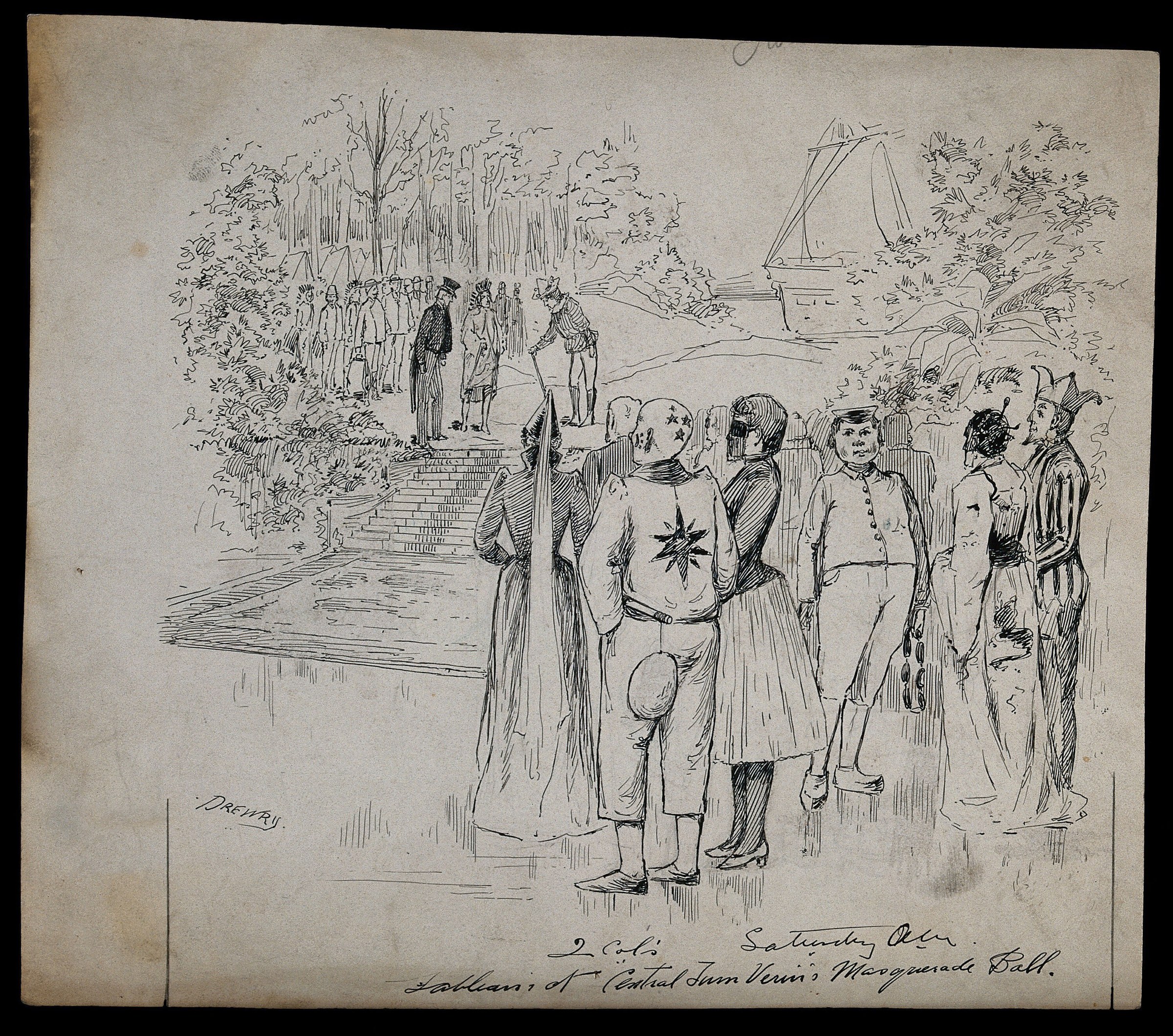
Commedia dell'arte figures at a masquerade ball. Pen and ink drawing by Drewry.
Unknown artist
- Source:
- Wellcome Collection
- Rights:
- Public domain — free to use, share and adapt.
- Recorded as:
- Public Domain Mark
Masquerade balls were a significant social institution in 18th-century Europe, and visual documentation of their character and conduct is relatively rare. This drawing captures not choreography but the theatrical and social infrastructure that enabled dance—costume, assembly, and the liminal space between entertainment and intrigue. For historians of social dance practice, it documents the context and expectation within which dancers operated.
What you are looking at
A pen-and-ink drawing depicting a masquerade ball in an idyllic garden or waterside setting. In the foreground, a group of costumed figures stand in conversation or preparation for dance, their elaborate masks and period dress suggesting 18th-century carnival costume. The figures wear long cloaks, breeches, and decorated waistcoats; one prominent figure in the center wears a starred ornament on his chest. Behind them, a broad flight of stone steps leads upward to a dense forest, where a crowd of similarly masked figures gathers. To the right, a sailboat on water suggests a Venetian or Mediterranean setting. The composition uses fine parallel hatching to create shadow and form, with particular attention to the texture of foliage and the folds of fabric. The whole scene is rendered in a delicate, theatrical register that emphasizes spectacle and social performance.
The dancing
The foreground figures stand in loose conversational groupings rather than formed dance partnerships, suggesting a moment of social assembly before or between dances. Their postures are upright and formal, weight evenly distributed, with minimal indication of active movement or dance frame. One figure gestures with an outstretched arm. The costumes—long cloaks, masks, and ornamental dress—privilege disguise and theatrical identity over freedom of movement, suggesting that costume rather than choreography is the primary mode of expression. Behind them, the crowd on the steps appears relatively static, assembled for observation or promenade rather than active dancing.
The dance depicted
This depicts a masquerade ball, a theatrical social event where dance was certainly expected but was secondary to costume, intrigue, and spectacle. The drawing emphasizes the event's carnival character—masks, elaborate dress, the waterside garden setting—rather than any particular dance style or technique. No evidence suggests a specific choreographed dance in progress. The occasion was typical of 18th-century aristocratic entertainment, where masked balls combined dancing with games, conversation, and theatrical performance. The artist has chosen to capture the social assembly moment rather than active choreography.
How it was made
This is a pen-and-ink drawing executed with fine cross-hatching and parallel line work to create tonal depth and texture. The technique is classical illustration, consistent with 18th-century or 19th-century practice—the kind of drawing used for book illustration, periodical engravings, or finished studies for engraving. The delicate line work and attention to costume detail suggest this was made either as a finished artwork for publication or as a preparatory study. The artist's signature 'Drewry' appears in the lower left. The drawing survives on aged paper, yellowed and foxed, indicating significant age.
About this work
This is a pen-and-ink drawing of a masquerade ball, capturing the social and theatrical aspects of 18th-century carnival entertainment rather than active dance choreography. The work documents costume, social assembly, and the festive setting—garden, water, crowd—that characterized such events. While dancing was integral to masquerade balls, this image emphasizes the spectacle, disguise, and promenade that framed the dancing rather than depicting it directly. The drawing is of particular interest to historians of social dance, carnival practice, and the visual culture of aristocratic leisure.
How to look at it
Attend to the layering of the composition: the foreground figures in refined costume, the broad processional steps, the crowd in the background, and the landscape beyond. This arrangement emphasizes social hierarchy and theatrical framing rather than dance action. Notice the artist's use of costume detail—masks, cloaks, ornamental dress—as the primary visual interest, and the relative lack of attention to bodily movement or dance posture. The waterside garden and sailboat establish a Mediterranean or Venetian setting, crucial to the masquerade tradition. The moment chosen is one of assembly and social navigation rather than choreographic performance.
The artist
The artist Drewry is not identified in the catalogue record. The signature 'Drewry' appears on the drawing. Without additional documentation, the artist's identity, training, period of activity, and specialization cannot be established. The quality of the draughtsmanship suggests professional training in either illustration or fine art.
The period
Masquerade balls reached their height of popularity in 18th-century Venice and spread through European aristocratic circles, particularly in Italy, France, and England. They were expressions of Enlightenment culture—occasions for wit, social transgression (masked identity), and theatrical display. Dance at such events typically included minuets, cotillions, and country dances, though the masquerade costume often impeded movement. The visual culture of masquerades was extensively documented in prints, paintings, and literary accounts, reflecting both the events' popularity and their association with carnival excess and aristocratic leisure.
Where it lives
The work is held in the Wellcome Collection, which houses primarily medical and scientific materials but also includes artworks and documents related to social history and cultural practices. This drawing's presence in the Wellcome suggests it was acquired as a historical document of social or cultural interest rather than as a fine art object.
Dance in this work
Questions about this work
What is a masquerade ball?
A masquerade ball was an 18th-century social event where guests wore masks and elaborate costumes, typically organized as carnival entertainment. Dancing was central to the event, but the masked identity and theatrical costume were the primary draw. Masquerades were occasions for social transgression—masked anonymity permitted behavior otherwise constrained by rank—and for elaborate display of wealth and fashion.
What dances would have been performed at a masquerade ball?
18th-century masquerade balls featured the social dances of the period: minuets (the most formal and prestigious), cotillions, quadrilles, and country dances. The minuet was particularly important as a display of rank and refinement. The elaborate costumes and masks sometimes impeded movement, so dances were often adapted to accommodate heavy cloaks and restricted sight lines.
Is this drawing an illustration for a book or periodical?
The style and technique—fine pen-and-ink work with cross-hatching—are consistent with book or periodical illustration of the 18th or 19th century. The catalogue record does not confirm publication history, so this cannot be stated with certainty. It may alternatively be a finished independent drawing or a preparatory study.
Why doesn't the drawing show people actively dancing?
The artist has chosen to depict the social assembly and theatrical spectacle of the masquerade rather than active choreography. This choice reflects what masquerades were primarily about: costume, intrigue, and social performance. Dance was one element among many; the drawing captures the broader event rather than a specific choreographic moment.
More dance artwork





