49 works in this view — arrow keys or swipe to move between them.
Dance in Art
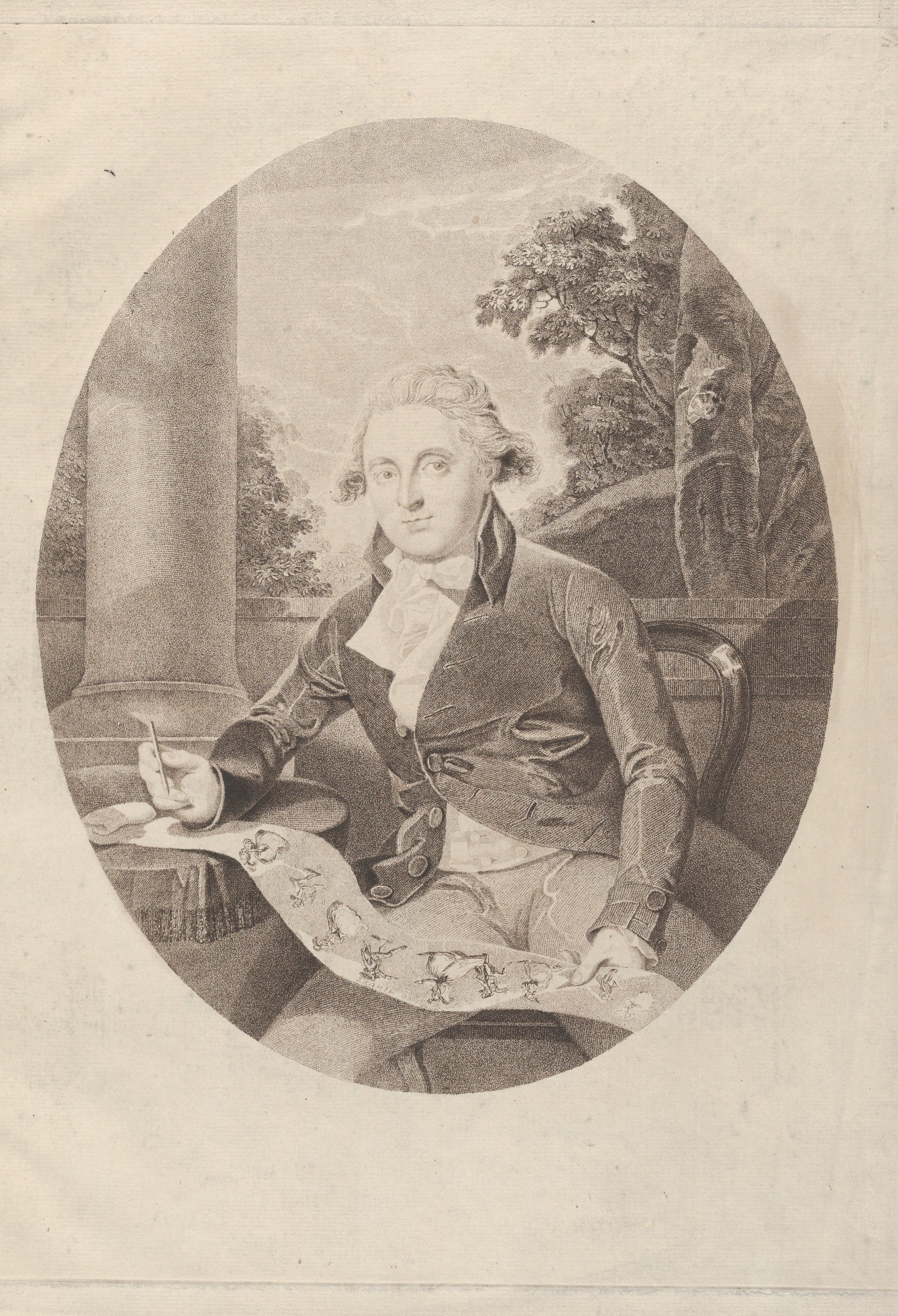
Henry William Bunbury Drawing his "Long Minuet"
Thomas Ryder I
- Medium:
- Stipple engraving and etching; working proof
- Collection:
- Drawings and Prints
- Source:
- The Metropolitan Museum of Art
- Rights:
- Public domain — free to use, share and adapt.
- Recorded as:
- CC0 (Public Domain)
This print documents a crucial moment when dance was being elevated from mere social practice to an object of artistic and choreographic design, worthy of being recorded and studied like any fine art. It shows us that the minuet—often dismissed as rigid and formal—was in fact a subject of artistic creativity and invention, designed and composed by named artists for discerning audiences.
What you are looking at
A gentleman in late 18th-century dress sits at a small table in an interior space, holding a sheet of paper or sketch on his lap, gazing downward at his work. Behind him, through an opening or window, an arcaded garden or colonnade recedes into soft light, with trees and architectural elements creating depth. The figure wears a dark coat with light-colored facings and decorative buttons, and his hair is styled in the fashion of the 1780s. The setting suggests both the intimacy of the artist's private study and the leisured cultured world of the period. The whole composition is contained within an oval frame, a format typical of portrait engravings of the era. The light is carefully controlled, emphasizing the figure's concentrated posture and the delicate rendering of his features.
The dancing
A single seated male figure dominates the composition, shown in three-quarter view, leaning slightly forward over his work. His right hand holds or gestures toward the paper; his left rests on his lap. The posture is contemplative and focused, the body angled to display both his face and the document he is studying or creating. The proportions and articulation of the limbs suggest careful life study; the artist has captured the specific tension of a man engaged in skilled manual work.
The dance depicted
The title identifies this as Henry William Bunbury drawing his "Long Minuet," which appears to be a reference to a drawing or composition by Bunbury depicting or choreographing a minuet. The image itself shows the artist at work rather than a dance scene. What we see is the creative process of documenting or designing a minuet—one of the most formal and codified dances of the 18th century, demanding precise positioning, restrained gesture, and exact rhythm. The minuet was a centerpiece of courtly social life and artistic representation; showing its creator at work elevates both the dance and the artistic practice of recording movement.
How it was made
This is a stipple engraving with etched elements (working proof), a technique that uses small dots or stipples to create tone and volume rather than line. Stipple engraving was expensive and labor-intensive, favored for portraits of significance and works intended for relatively affluent audiences. The technique allowed for soft modeling of form and subtle rendering of textures—the fabric of the coat, the fall of light on the face—that line engraving could not achieve. As a working proof, this is an intermediate stage of production, not the final print, suggesting it is a trial impression used to evaluate the work's progress before the edition was completed.
About this work
This is a portrait engraving of Henry William Bunbury, an 18th-century artist known for drawing and graphic work, shown in the act of creating his composition titled the "Long Minuet." Rather than depicting the dance itself, the print documents the artist as choreographer and draftsman, seated in his study with the minuet design on his lap. The work celebrates both the minuet—the most refined and geometrically precise social dance of the Georgian period—and the emerging status of dance as a subject worthy of serious artistic attention and documentation. The oval format and refined technique mark this as a prestige portrait engraving, circulating among educated and cultured viewers who would recognize both Bunbury and the significance of his work on the minuet.
How to look at it
Pay attention to Bunbury's posture and the direction of his gaze: he is not performing the minuet but studying it, concentrating on the paper in his hands. This is the moment of creation and judgment—the artist assessing his own work. The setting, with the classical arcade visible behind him, connects dance design to the broader world of refined taste and classical learning. The print invites us to see choreography as an intellectual and artistic pursuit, not merely social practice; Bunbury is presented as a man of letters, a creator whose work deserves the same respect and attention as a writer or painter.
The artist
Thomas Ryder (1746–1810) was a prolific English stipple engraver and printmaker. He specialized in portrait engravings and reproductive prints, working in the refined stipple technique that was fashionable among the upper and middle classes in the late 18th century. Ryder was part of the community of artists and engravers centered in London who produced high-quality prints for collectors and for circulation among educated patrons. His work often depicted writers, artists, and men of letters, celebrating the cultural figures of his time.
The period
In the 1780s, the minuet was undergoing transition: it had been the dominant courtly dance of the 18th century, but by this decade it was beginning to yield to newer social dances such as the cotillion and the allemande, though it remained central to dance instruction and formal social occasions. The publication of this portrait engraving in 1789 coincides with a broader late-Enlightenment interest in documenting, analyzing, and theorizing human movement and artistic practice. Dance notation and the publication of choreographic scores were becoming increasingly sophisticated, and named choreographers and dancers were achieving celebrity status. Portraying an artist creating a minuet reflects this moment when dance was entering the discourse of the fine arts and when individual choreographic achievement was becoming recognized and celebrated.
Where it lives
Held by the Metropolitan Museum of Art in its Drawings and Prints collection. This is a working proof—an intermediate stage of the engraving process—rather than a final published print, indicating it may have been retained by the artist or publisher for evaluation or archive.
Dance in this work
Questions about this work
What is the 'Long Minuet' referred to in the title?
The 'Long Minuet' appears to be a specific choreographic composition by Henry William Bunbury, though detailed documentation of this particular work is limited in standard sources. The title suggests it was either notably extended or structurally distinctive compared to conventional minuets. The print honors Bunbury by showing him as its creator, elevating the minuet from a social dance to a named artistic work.
Why is this a working proof rather than a finished print?
A working proof is an intermediate stage during the engraving process, printed to assess the progress of the plate before final publication. It allows the artist and engraver to evaluate tone, detail, and overall effect. This proof was retained rather than discarded, suggesting it was of special value—possibly kept for archive, gifted to a patron, or used for reference.
What does this tell us about how the minuet was understood in 1789?
By this date, the minuet was established enough as an artistic subject to merit a portrait of its creator. Rather than show the dance in action, the print depicts the choreographer at work, suggesting that minuet composition was recognized as a skilled intellectual activity, comparable to other artistic practices. This reflects the high status of dance in educated society and the emergence of choreography as a named and valued craft.
More dance artwork





