49 works in this view — arrow keys or swipe to move between them.
Dance in Art
Dancers Practicing at the Barre
Edgar Degas
- Medium:
- Mixed media on canvas
- Collection:
- European Paintings
- Source:
- The Metropolitan Museum of Art
- Rights:
- Public domain — free to use, share and adapt.
- Recorded as:
- CC0 (Public Domain)
For dancers, this painting is a mirror: it shows the postures and the discipline of their own daily work, rendered with complete respect for its difficulty and its necessity. For historians, it is evidence of the pedagogy and the physical culture of the Paris Opéra at a specific moment, before the techniques of the twentieth century. And for anyone interested in how artists represent work itself, it is a masterpiece of attention: Degas chose to show practice, not performance, and in doing so he elevated the rehearsal to the status of art.
What you are looking at
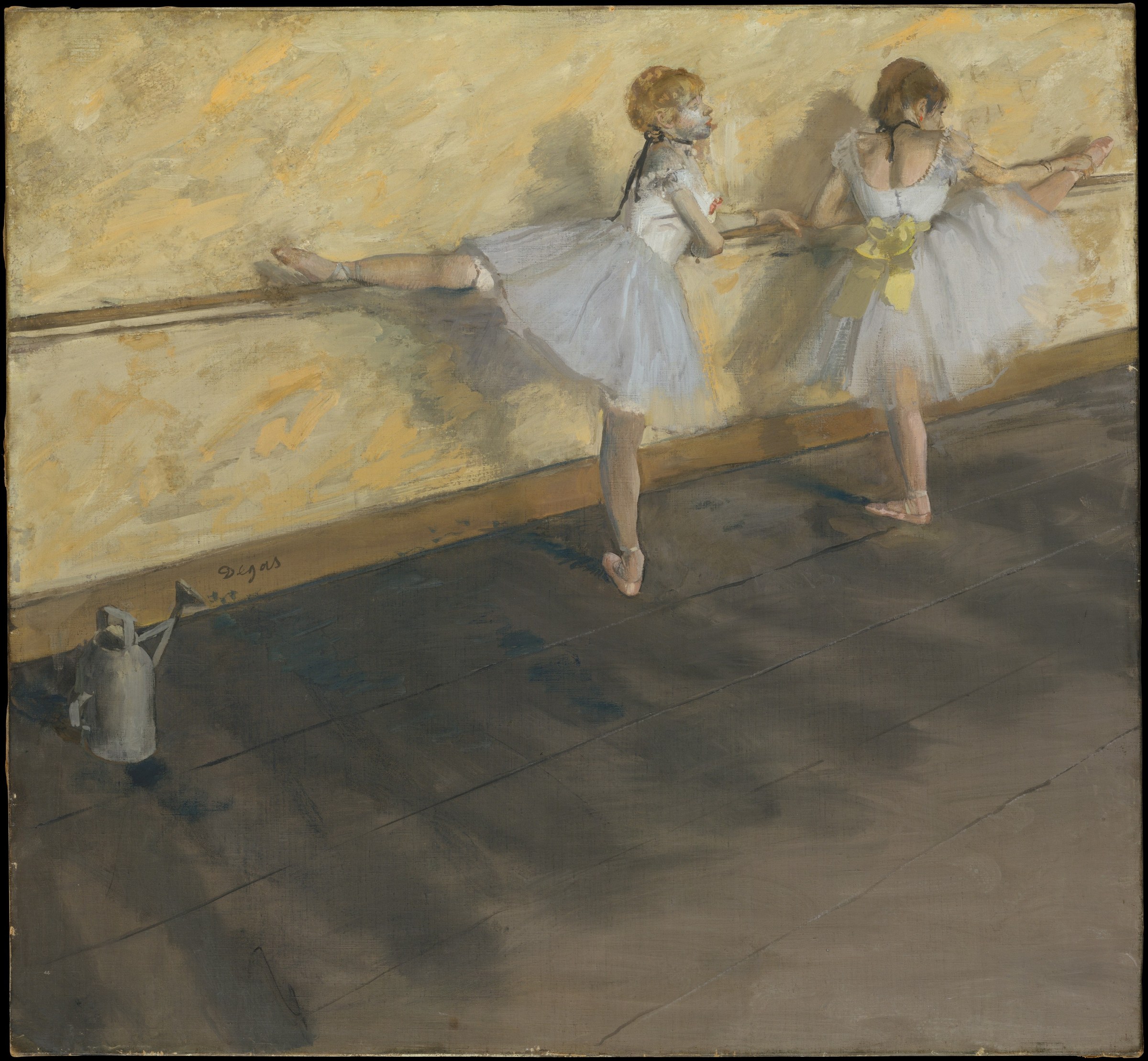
Two young dancers in practice clothes stand at a wooden barre in what appears to be a studio or rehearsal space, their bodies angled toward the viewer in three-quarter profile. The nearer dancer, with reddish-blonde hair pulled back, extends her right leg in a high développé or battement, her left arm reaching forward along the barre for balance; her pale blue tutu and pointe shoes are rendered with meticulous attention. The second dancer, partially obscured behind and to the right, mirrors the pose with similar extension and arm carriage. The studio walls are a warm buff or ochre, with soft directional light creating subtle shadows on the floor—a dark, polished wooden surface that grounds the composition. A white pitcher or water jug sits alone in the lower left corner, the only still-life element in an otherwise spare interior. The painting captures the peculiar intensity of solitary practice: the dancers are absorbed in their work, indifferent to the viewer, performing for the barre and for the discipline of the movement itself.
The dancing
Both dancers hold the classical five-position or en dehors stance at the barre, with spines extended and heads carried high. The lead dancer's right leg is extended at hip height or above, her foot arched and turned out, her left hand resting lightly on the barre for proprioceptive reference rather than support—the arm position suggests she is past the earliest stages of training. Her right arm extends forward and slightly outward in a loose port de bras, not the rigid épaulement of formal pedagogy but the functional arm carriage of a dancer attending to her leg work. The second dancer repeats this geometry: same leg extension, same arm positions, suggesting they are working through a combination or études under the watchful eye of an instructor (implied but absent). Both are en pointe, their bodies evidently under control despite the height of extension.
The dance depicted
This is a rehearsal of academic ballet, almost certainly the French or Italian school of the 1870s–1880s, captured in the moment of a basic adagio or développé combination at the barre. The pose—sustained leg extension with a turned-out hip, one hand on the barre—is the foundational vocabulary taught to every ballet student from the age of seven onward, and nothing in the image contradicts the historical record of how that was taught in Paris. Degas witnessed many such sessions, having gained studio access to the Opéra de Paris, and the specificity of the costume, the height of the barre, the width and polish of the studio floor, and the exact posture all confirm that this is observed rather than imagined. The dancers are likely students at the Opéra school or apprentice members of the company, in a morning or rehearsal-day class, not a performance.
How it was made
The catalogue record identifies the work as mixed media on canvas, though the precise materials are not specified. The surface has the soft, worked quality of pastel or gouache overlaid on prepared canvas, with subtle gradations and a matte finish that diffuses light rather than reflecting it—we can see this in the way the floorboards absorb shadow while the walls retain luminosity. The technique allowed Degas to build tone and atmosphere through layering and blending, creating the sense of dust and studio air that hovers between the figures. The canvas scale and formal presentation suggest this was not a preliminary study but a finished work made for exhibition or a collector, and indeed Degas frequently showed ballet scenes in the Impressionist exhibitions of the 1870s and 1880s.
About this work
This is one of Degas's most direct and unflinching studies of ballet training, showing the moment before performance becomes dance—the repetitive, solitary work of muscle memory and postural control. The two dancers are not characters in a narrative; they are students, and the composition honors the plainness of that fact. Degas observed the Opéra ballet from the inside, in the wings, at rehearsal, and in the practice rooms, and he rendered ballet not as the romantic fantasy it appeared from the audience but as labor: physical, technical, and sometimes tedious. This painting belongs in a gallery about dance because it makes visible the infrastructure of virtuosity—the barre, the plain clothes, the studio light, the repetition—that no other artist of the period recorded with such clarity. It is a document of how dance was actually made in the 1870s, and also a profound meditation on the solitude required to master a difficult craft.
How to look at it
Notice first the stillness and the concentration: these dancers are not performing for an audience but for themselves and for the discipline of the movement. Look at the lead dancer's face—it is turned away, almost indifferent to the viewer, and her gaze is inward. Observe the precise angle of her leg extension and the small adjustments of her arm position: these are the micro-negotiations between balance and line that occupy a dancer's attention every moment she is at the barre. Notice also the empty space in the painting: the broad, dark floor, the plain walls, the absence of other figures or narrative incident. This emptiness is intentional—Degas is asking you to attend to the body and its work, not to spectacle. Finally, look at the light: it comes from the upper left, creating soft shadows on the floor and on the dancers' legs, suggesting the patient, even light of a studio rather than the theatrical dramatic lighting of a stage.
The artist
Edgar Degas (1834–1917) was a founding member of the Impressionist movement, though he rejected the label and the landscape focus of many of his peers. He was fascinated by movement and the body in motion—ballet, horse racing, laundresses in the act of ironing—and he gained unprecedented access to the backstage world of the Paris Opéra, where he sketched and painted compulsively. He developed a distinctive compositional style that borrowed from Japanese prints (off-center framing, unusual viewpoints, cropped figures) and from photography (the flattened perspective, the frozen moment). His ballet paintings number in the hundreds and span his entire career; they are neither sentimental nor voyeuristic but forensic, interested in how the body actually works and how artists might represent that work on canvas. He was a draftsman above all else, and his paintings are built on thousands of drawings.
The period
The 1870s and 1880s were a transformative moment in ballet pedagogy and practice. The Romantic era (1830s–1860s) had celebrated ethereal, passive heroines; the works of the 1870s began to demand greater technical virtuosity and a wider range of dramatic roles. The development of pointe-work became more codified and widespread; the barre, once a supplementary tool, became central to daily training. At the same time, the Paris Opéra was modernizing its facilities and its teaching methods, influenced by the Italian school of Cecchetti and by innovations from Russia. Degas's paintings document this moment: his dancers are not Romantic apparitions but trained athletes, working in a concrete studio with concrete tools. In the visual arts, Impressionism was itself reaching maturity; Degas and his peers were developing new ways to capture movement and the effects of light, and ballet—with its formal gestures and its dependence on the body in space—offered a perfect subject.
Where it lives
The work is held in the European Paintings collection of the Metropolitan Museum of Art in New York. It entered the museum's collection through one of the major American bequests of Impressionist works from the early twentieth century, a period in which major museums were actively acquiring French avant-garde art.
Dance in this work
Questions about this work
How do I know these dancers are students and not professionals?
The setting is a rehearsal studio, not a stage, and the plain practice clothes and the presence of a barre for training work all indicate this is a teaching or apprenticeship situation. The Paris Opéra employed students as apprentices and later as junior company members, and Degas had access to both. The casual intensity of their focus also suggests they are still learning—a professional ballerina would likely be rehearsing a specific choreography rather than working through basic combinations.
What is the dance step they are performing?
The fundamental position is a développé or a slow leg extension at the barre, one of the most basic adagio (slow) exercises in classical ballet training. The dancer extends her leg gradually from a bent position to full extension at hip height or above, while maintaining turnout of the hip and control of the supporting leg. This is not choreography but pedagogy—the building block of all ballet technique.
Why does Degas paint ballet so much?
Ballet combined several of Degas's deepest interests: the human body in motion, the relationship between discipline and grace, the effects of artificial light, and the structure of labor. He was also granted unusual access to the backstage world of the Opéra, which most artists did not have, and he made use of that privilege to see how ballet was actually made. His paintings are a record of that access.
Is this painting realistic?
Yes, in the sense that Degas drew directly from observation and that every element—the studio, the barre, the pose, the costume—corresponds to historical fact about ballet training in 1870s Paris. It is realistic in its attention to light, space, and anatomy. But it is also a composed and deliberate work of art: Degas has chosen this angle, this moment, this light, and this empty space to convey something about the nature of the work itself.
More dance artwork





